
The Narrative unit challenges Freestyle students to practice communicating stories through structure. Students use storyboarding, cinematography, narrative digital art, and storytelling to produce stories with fleshed-out character arcs. Students improve their technical communication skills by using modern professional equipment such as Wacom Digital Drawing Pads, lighting equipment, downshooters, Adobe Photoshop, Adobe Illustrator, Adobe Animate, Adobe Premiere Pro, Adobe After Effects, Avid Pro Tools, Propellerhead Reason, HTML/CSS, DragonFrame, and Google Apps.
I valued this unit because it taught me more about channeling my creativity into a structured form. I enjoyed exploring my writing and deepening my understanding of narrative expression. I learned a lot about how to present characters and plots in a cohesive way through a variety of mediums such as drawing, camerawork, writing, art, and more. I improved by gaining a better skill set to tackle narrative storytelling and a better sense of the three-act structure.

In English, students were asked to come up with a short story about a character who experiences a conflict. I took a lot of inspiration from cooking shows I had watched growing up and my own experience with restaurants. I felt inspired to write a story about a chef with a very mixed view on her job and life. I also wanted to create a character that was somewhat unlikeable – rude, abrasive, and controlling. I have always been drawn to complex characters, especially women. I wanted my main character to have bad qualities while also being sympathetic to the audience.
To produce the audio version of my story, I recorded myself reading it in the Digital Media recording booth. Then, I went through the audio and adjusted and cut it where needed. I also added music and sound effects to make it more realistic.
Direction of Perfection
Dissection of Perfection by Chloe Outten
Some people make food. Others purchase it. At the moment, Edith would have preferred to stomp every plate she’d ever made to absolute bits. Her rage stemmed not only from her career choices in general, but more so from the fact that it had only taken five minutes for a forty year career to implode.
Edith had worked at the Gilded Fork for over three decades, and many employees who had worked for her claim that residency at the GF was not about the food at all. Rather, it was entirely an exercise in combating Edith. And working with Edith could certainly be described as combat.
In fact, if one were to line up all of the most prominent chefs of the last few centuries, all of the innovators and trailblazers and men who could slice a tomato into paper-thin layers, and challenged them to get Edith to compromise on a single thing, the only certain outcome was that she would have to tear them apart with her bare hands. Escoffier would cower, Carême would run away screaming. Scappi would simply pass away from the sheer exhaustion of getting that woman to budge on anything. Whether it be the best angle to chop vegetables, or even the particular press of a chef’s apron, nothing got past Edith.
Indeed, Edith had made her career not through promotion or connections but through warfare. Nobody had better taste, or a stronger opinion on others’ taste. She had risen from a lowly cook to head chef then continued to be the head manager, surpassing everything and everyone in her way. However, her contentions had all been for nothing thanks to a man named Schmidt. The shortest, stoutest, stupidest food critic in all of Manhattan, who three days ago had come to the Gilded Fork to topple Edith’s empire. She could picture it now, how he had ordered the most expensive wine on the menu then boisterously denounced all of the heinous crimes of fine dining. By the main course he would’ve been onto the politics of food trucks, and by dessert he would be falling out of his chair drunk over the economic downfall of the deli industry. Then, of course, the postprandial course. The one star review. A review that, despite the fact that she hadn’t actually cooked any of the food, mentioned Edith by name.
She stalked out of her office and into the kitchen, letting the door slam. The chefs were already in motion, white hats bobbing up and down as they worked to cook, plate, and deliver. Their faces looked pale and tense beneath the harsh fluorescent lighting, marking the long shifts they had undergone. Sometimes, Edith liked to observe this conveyor belt of high dining, but tonight she had no wish to foster the juvenile 20-something year olds whom she worked with. After all, their poor skills in the kitchen had caused this mess. Tonight, she needed a moment to herself.
She marched past and ascended down a long, marble staircase, whose golden railings led into the dining room. The chamber was assembled almost as deliciously as the food. From the warm glow of the chandeliers, the floor to ceiling glass windows, the carefully selected art framed neatly on the walls, everything held a careful and forceful touch of Edith. It had been a long time since she had entered it.
She slowly worked her way to the middle of the room, acutely aware of the echo of her heels clicking against the floor. Her cracked fingers traced the handle of one of the seats, studying its handcarved-intracities. She lowered herself slowly into the seat, almost in spite of herself. How must it feel to sit in this chair, greedily swallow round after round of bite-sized delicacy? She couldn’t picture it. And yet, she couldn’t help but wish that her guests would care about it just a little bit more.
The guests would have, of course, read the review. And just as her boss had, they would have come to the conclusion that a woman of such inadequacy was not equipped to operate such a high-class venue. She sensed, almost intuitively, that once she was gone the new management would change this place. Buy new chairs, new art, maybe refurbish the floorboards. She desired in that moment, more than anything in the world, that somebody had once sat in this seat and saw this room the way she had. Had, despite never knowing her, saw in such a painful and intimate way her soul, flung across the walls of this establishment.
Coming back to herself, she had the sudden thought that there was something that she needed to do before she left. With the chandelier reflecting across her face like a spotlight and her mind clear, she shot up and left, closing the door behind her with a definitive thud.
Shortly after, the evening’s guests arrived. They galavanted to the front door, already eager to tell their friends all about how they had eaten at New York’s best dining. And they ate. Appetizer, entree, dessert. They consumed on average every other bite of each dish then fled into the night to pick their kids up from the nanny. However, just a few noticed something else about the food that hadn’t been there other nights, something they couldn’t quite place yet felt distinct.
By midnight, Edith was sitting in her office, neatly packing up its contents into small brown boxes. The sky was a deep, impenetrable black, and Edith hated to admit that she was sad to be leaving. She was wallowing in the memories when she was interrupted by a knock. Edith whipped open the door. To her surprise, she found a familiar man waiting outside, face illuminated by the faint halllights.. Mid-thirties, scowl, clenching to a notepad and pen. Schmidt. His audacity astounded her.
“Did you need something?” she sneered, arching a thin eyebrow at him.
“I just wanted to-” the man paused, fiddling with a rusted silver ring on his smallest finger.
“-Want to what?” she snapped, tapping her foot impatiently. Edith was in no mood to tassel with whatever half-baked assumption about her he had formed this time.
“I wanted to…offer my thanks to the head chef,” Schmidt finally landed on. It did not sound particularly sincere.
“Well, I’m not the head chef am I?”
Schmidt didn’t back down.
“The main course tonight was very well constructed, much better than yesterday’s.”
“Put that in the follow-up article.” Edith snipped. She cocked her head, suddenly curious. “How did you know that I orchestrated the main dish tonight? That’s usually not done by someone in my position.”
Schmidt shrugged. “Well, I doubt that those idiots in the kitchen could have made anything like it.”
This, Edith concluded, was true. And despite the disaster of the day, she almost found herself smiling.


I think I managed to tell my story fairly well using the music and SFX. I picked out many different sound effects to include that were mentioned in the story, such as bangs, thuds, etc. The music proved a little more difficult, as I had to consider the emotional and tonal aspects of the plot in order to choose the right pieces. I am really happy with how it came out, and I think all of the sounds came together really well.
I am most proud of the kitchen sequence when the main character walks out of her office – I had to layer many different parts in order to make it seem believable without being too overbearing. I also added a few that weren’t necessarily kitchen appliances in order to really sell that she was in a professional kitchen where food was being prepared. I put a lot of effort into it and ended up lying about what came out.
Producing an audio-only story, including music and SFX, has allowed me to grow in my ProTools skills and really focus on the importance of what you hear in storytelling. It’s important to create an audio layout strong enough to allow the story to be visualized, which this exercise helped me learn!

For illustrations, students worked on gaining skills in digital art. Adobe Illustrator was a main focus, and we learned many different ways to create images on the platform.

For this assignment, students were randomly paired to create a series of connected images. Groups decided on where each image would start and end on each artboard, and then made art without seeing what everybody else had done. At the end, it was revealed what had been created.

For our short stories, we were tasked with creating an original album cover on Adobe Illustrator. Since my story revolved around the head chef of a luxury restaurant, I chose to have a plate frame my text. I made it be gold-dipped and have a trim around the edges to show that it was high quality, and to add a little originality.
For my Illustrator Project, I created a digital illustrator and then printed it by hand using ink and embroidery thread.

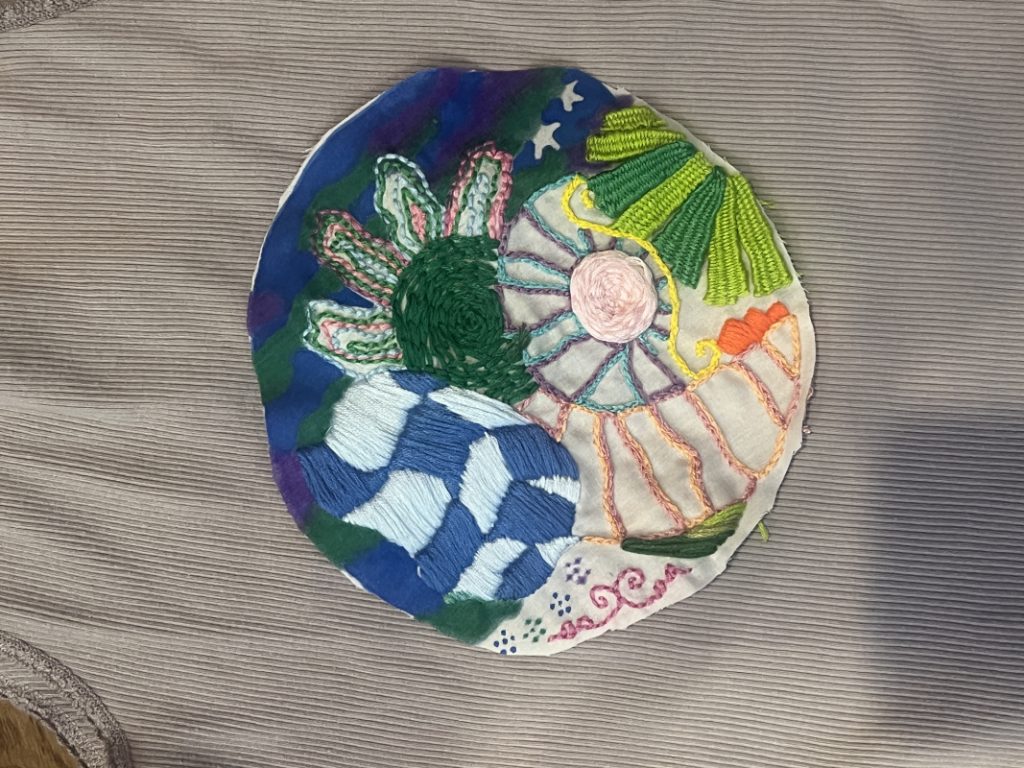
Using Illustrator for image creation as opposed to Photoshop was a somewhat new experience for me. Where Photoshop was largely focused on the manipulation of preexisting images, Illustrator required me to learn more about digital art and the process of making it. I valued learning how to use the different brushes and tools on the platform, and admired how differently they worked from physical materials. Where it is much harder to redo and erase things using materials like watercolor or colored pencils, Illustrator made it far easier to delete things. Alternatively, it took me a long time to figure out how to use the mouse pad and Wacom tablets correctly enough to make the drawings I wanted to.
I chose to create an embroidered pattern because I really enjoy embroidery and I have a background in it. I wanted the design to be fun and colorful, with a vague theme of underwater life through the blues and shapes. From there, I traced the sketch and used embroidery to outline and fill in all of the main details that I wanted to look more 3-D. For the background, used blue, purple, and green in alternating and blending blobs to create color that wouldn’t distract from the rest of the design. From there, I ironed it onto a tank top for my completed look.
In my Illustrator project, I included underwater design because I liked how those colors all went together in a fun way. I enjoyed messing around with different spirals, waves, and repeating patterns. I am not the best at drawing realistic depictions in online art, so making my project more of a sample of different patterns worked well for me. I had a lot of fun exploring different mediums and ended up really happy with my results!Thank you!

▶ Bags
⏸ Bags

Our main takeaways from the music recording project are that music recording takes a lot of work, but is also a lot of fun. It’s important to take risks and put yourself out there, without being afraid of being embarrassed. We had so much fun going into the studio and singing, and we really enjoyed stepping out of our comfort zone to try something new and unique. It was interesting to try to keep the timing with each take, and we had to learn how to collaborate over multiple attempts. We ended up being really excited after listening to our final product, because we had so much fun making it. Fair warning – none of us are the best singers, but we can’t wait to come back and continue to have fun and improve!


Our main takeaways from the music recording project are that music recording takes a lot of work, but is also a lot of fun. It’s important to take risks and put yourself out there, without being afraid of being embarrassed. We had so much fun going into the studio and singing, and we really enjoyed stepping out of our comfort zone to try something new and unique. It was interesting to try to keep the timing with each take, and we had to learn how to collaborate over multiple attempts. We ended up being really excited after listening to our final product, because we had so much fun making it. Fair warning – none of us are the best singers, but we can’t wait to come back and continue to have fun and improve!
▶ Freeform Sounds
⏸ Freeform Sounds

For the Experimental Music Project, students learned how to create sound using Pro Tools MIDI and had to create an original song from online instruments. For my music, I focused on using simple chord progressions and mixing instruments to create an ethereal and unconventional sound.
My inspiration for this music was to create something relaxing and lo-fi. I started off by adding the piano track and messing around with different progressions. Afterwards, I added drums, but they felt too upbeat in comparison to the more melancholy piano, so I kept going. I added harp, choir, and other tracks until it sounded the way I wanted it to.
I am most proud of learning how to make different chord progressions, as I went into this with no prior experience playing instruments like the ones in ProTools. I had to do some research on how to play each individual note, then order them in a way that made sense. I am proud of putting in that extra effort, and I think that it ended up sounding much better!
I valued learning a new way of creating music and more about how to operate Protools in general. It was very fun to be able to put together my own piece and I had a great time figuring out how to use all of the different instruments and tools.


Music production was definitely a difficult unit for me because I haven’t had a lot of prior music production experience. I think that doing it digitally made it easier for me because I could intuitively sense how to use it better than a physical instrument. I had a lot of fun studying chord progressions and making my music! Playing around with different sounds and instruments taught me a lot about what goes into music production.

In my film class, we were challenged to produce several films and exercises to teach us about narrative structure and how it can be portrayed through cinematography. I really valued learning new skills with my camera and improving the quality of my shots.
For this project, we learned about the history of Griffith’s Pattern and its purpose in film. Then, we recreated his methods through a short video.
For the suspense scene, we worked with a partner to create a scene with tensions and elevated suspense.
For the Chase Scene, we were tasked with creating a scenario in which somebody or something was being chased. I used two of my friends as actors and created a fictional scenario for their chase.
FINAL PITCH:
We open with a tired-looking young man, asleep in bed early in the morning. Everything
in his apartment is neatly organized and clean, and seemingly lacking in color/creativity. The
only sense of personality in the room is a lone music box sitting on the bedside table, open to
reveal a figurine of a ballerina. On the other side of the room, an unusual-looking notification
pops up on his phone – loudly informing him it’s time to wake up. He immediately shoots out of
bed and grabs the phone, just as it pings again and informs him to go feed his dog. He does so,
and as he completes this task another notification pops up. He progresses through his morning
routine following the same pattern of notifications, however just before leaving home he briefly
pauses on the music box. He reaches out to it, as if to turn the handle and make the ballerina
spin, however his phone beeps again and he quickly shuts the box and exits the room.
He transitions into his commute to work, then to the rest of his day. It is clear that he
runs his day-to-day life meticulously on this app, which continuously sends him reminders of
what he needs to be doing the second he finishes a task. However, despite his commitment to his
routine, he repeatedly has brief halts in productivity due to minor but noticeable distractions. A
small tidbit of music turns his head, he pauses to stare at an old theater, etc. However, each time
he seems to be about to pull away from his routine, the phone buzzes and pulls him back.
As he moves through the day, every action he takes (Grabbing a coffee, organizing his
papers, etc) is prompted by the app, and it is clear that he is lacking spontaneity. He seems to be
cracking under the pressure of this system, as seen through his apparent exhaustion and
jumpiness at each notification. Finally, disgruntled after a long day of work, he heads home with
a defeated posture, as if the day has drained him. However, he soon becomes entranced by a
nearby street performer, performing a ballet piece. He seems entranced by this dancer, and this
time when his phone pings he briefly ignores it to continue to watch the performance.
Eventually, he turns and leaves, but appears to be in a much different mindset.
He continues to operate on his usual routine, but the distractions that had once been
minor now occupy more and more of his attention. He hears the music again and purchases a
pair of headphones. He walks by the old theater and takes his phone out to snap a picture,
swiping up on a notification for the first time ever. He sees the ballerina again and thinks about
approaching her, but decides not to.
As this sequence progresses we begin to see him take bigger and bigger leaps towards
freedom, seeming overall much happier and constantly listening to music on his headphones.
Most importantly, he begins to stop to watch the performance whenever he passes by, catching
the attention of the ballerina, who begins to recognize him and waves.
We see him back in his apartment again, sitting on his bed with his phone on the bedside
table next to the music box. He seems to be debating something. The phone buzzes forcefully,
interrupting his train of thought. He reaches out as if to pick it up., but his hand pauses just
above it. He hesitates, then reaches out to the music box and opens it up, making the music
begin and the ballerina spin. He smiles then walks out the door, leaving his phone behind.
He runs into the ballerina again, who has just taken her final bow of the day and is
packing her things into her bag. She smiles as he approaches, as she has seen him at some of her
past performances. He opens his mouth to say something when a familiar ping interrupts, but
this time not from him. The ballerina holds up her hand and digs into her things, pulling out a
similar looking device. The man looks crestfallen, but the girl smiles and flips her phone around,revealing a notification that says something.
The two laugh over this then go off together.
The End.
STORYBOARD
My Narrative Film was my longest project, where I structured a three-act plot about a teenage girl trying to overcome her shyness.
My Narrative Unit was a lot of fun for me! I had previously enjoyed writing and consuming narrative stories, but went in with a lot of expectation for learning how to produce them myself. I was able to explore this through a variety of different devices and lenses, and made several products that I am very proud of. I had a lot of fun exploring storytelling and different narrative structures in my classes.