Introduction

For the narrative project, we were tasked with answering “How well can you visually tell a structured story?” In English, we read The Metamorphosis, which helped analyze fictional stories and figure out how we wanted to write our own. Furthermore, we made our own music in Digital Media through a MIDI keyboard, and also made short story audio productions from our fictional stories we wrote in English. In Film, I created my own narrative story and then shot it.

Story
For this assignment in English, we created our own flash fiction stories. My inspiration for this series was from a play we read earlier in the year titled “Red” which is about Mark Rothko. I got inspiration from the characters in this, and their relationship with art and the people around them. Specifically how both characters almost drown themselves in the work that they do, and that it is all that they care about. I got comments from other people saying they could see the connection between the two characters. I produced the audio version of this through Pro Tools, and using mics in the sound proof rooms. It was super cool to edit my own voice and make a recording of me reading it. I also really liked the sound effects and how it worked well with the story.
In the Shadows
“Do it to yourself.” The client says.
“What?” Elias whispers.
“Change your own shadow, I want to see that this actually works.”
Elias hesitates and runs his fingers through his grey hair. His hand trembles in the lamplight.
“You’ve seen it on other people, why do you need to see it on me?”
“I want to see it in person, I’m not paying for stories.”
Elias knows he can’t perform his art on his own shadow. It despises him, loathes him even. He hesitates, “It won’t work. Shadows don’t open their owners.”
“Convenient excuse.”
“No, it’s a law. Like gravity. You can’t lift yourself by your own hair.”
“Then maybe you’re not the artist everyone says you are.”
Ouch. Elias flinches. And his shadow behind him darkens, listening. The client leaves through the steel doors of the small studio, while Elias’ reputation goes down the drain. All at once, he begins losing clients. Rumors crawl through the city.Meanwhile, Elias isolates himself in his studio, obsessively working with new paints and magic to try to perform work on his silhouette. I just want to make people their best selves. And maybe if I prove to people that I can change myself, they’ll come back. The truth is, Elias had been chasing that ever since the night he failed to save his brother. Years ago, his younger brother begged him for help. He wanted to “fix” the way he saw himself, to take away the insecurities that Elias never took seriously. He hesitated, believing that real change should come from within, not with his paints. By the time he finally agreed, it was too late. His brother was gone, and Elias was left with a permanent sense of guilt. Now, every client he works with is an attempt to help someone before they break. And every failure feels like losing his brother again. Elias seems to think that ridding the darkness of his own shadow is the only way to be freed of the guilt of losing his brother. Weeks pass. Elias begins decorating his home in mirrors, trying to trap his contour. He mixes color with his own blood, painting his silhouette until it refuses to dry. His food rots untouched, his appearance looks deranged, and the lightbulbs in his house buzz and burn out. With all the effort Elias puts into this, he begins to fade, becoming almost translucent. His reflection in the mirrors becomes fragmented. His eyes are hollow, his skin tone gray, and he’s almost unrecognizable. He whispers to a dark patch on the wall, “Why won’t you let me fix you?”
The shadow doesn’t move, only breathes when he’s not looking. Slowly, he pushes his shadow further and further away, agitating it, yet making it darker. His shadow feels more independent, it acts freer. Sometimes, neighbors see it walking home before he does, or appearing in places he’s never been.
One morning, he collapses. His brushes fall to the floor like pins and needles. He feels the faint sunlight passing through the windows on his cheeks. His shadow waits beside him, perfectly still. For the first time, it doesn’t mock him, but mirrors him. Elias exhales, “You were never broken.”
He gains the strength to stand and opens the blinds all the way. The light floods in, almost too bright and unbearable. The shadow contorts and stretches, but doesn’t disappear, and neither does he. Elias steps forward, into the glow, both of them crossing together. And for once, he doesn’t try to paint it.
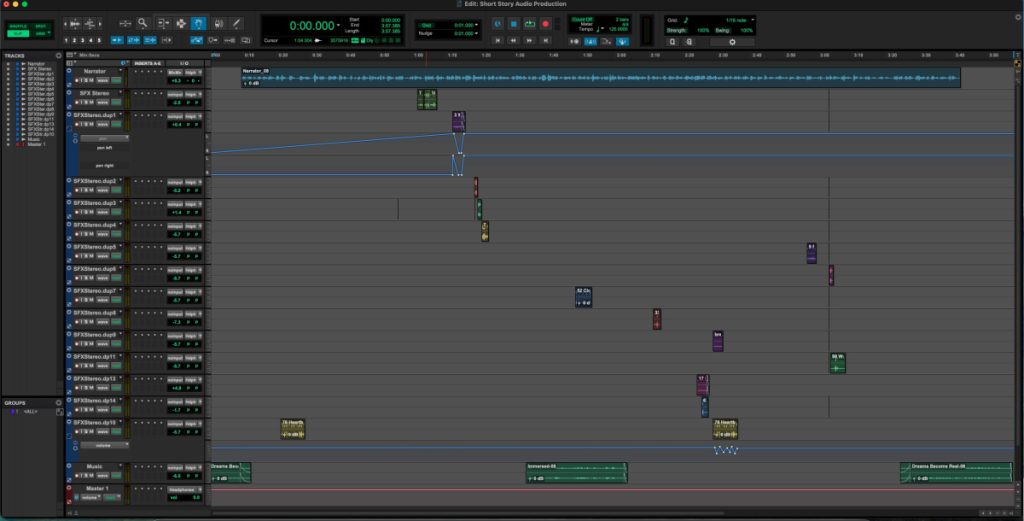
Short Story Audio Production Reflection
I think that the sound effects really helped tell the story and give the listener a cool experience. I think that the music, specifically in the middle during the sad part, helped add emotion to the story and help the listener feel the sadness I was portraying in the story.
I think I am most proud of the sound effects because it was cool to find sound effects that already existed and matched what I was looking for. I also think I was very selective and so it sounds good.
Something that I value from producing an audio only story is that you can’t directly read it off of a page so you have to pay attention to all of the sound effects and words being said. I also think that when I get into listening to a story like this, the panning and volume effects definitely get my attention and help engage me in the story.

Illustrations
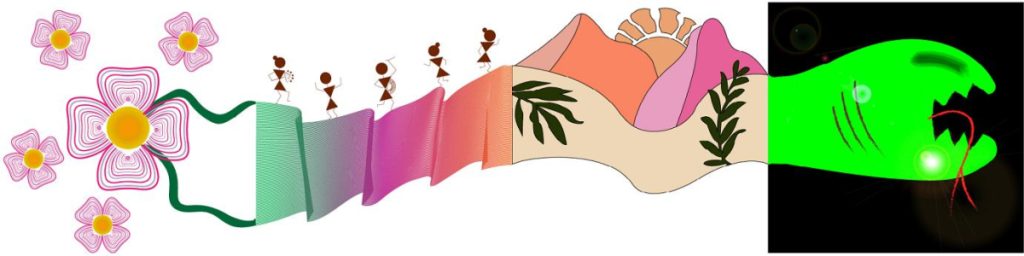
In Digital Media, we did a project called the Exquisite Corpse group image. This was an illustration cut into 4 pieces, each student took one piece and made art on their artboard. We didn’t know what each other made until it was shown at the end of the week. Additionally, there were little markers on the edges indicating where the art should line up, but that was the only information we were given. Mine is the flowers on the far left. I created the flower pattern by repeating the same line and slowly making it bigger.
For my illustrator project choice, I decided to do a mug because I really like to sip drinks in the mornings and thought it would be cool if I had my own mug. I really like the book the Very Hungry Caterpillar by Eric Carle, so I replicated the caterpillar onto my mug. It was interesting to create my own image in Illustrator because I had to create the image from scratch, which is unlike the usual editing of images I’ve done in Photoshop.


Here’s the Artist Statement for this production: Junior Illustration Project in DM – Stickers, Clothing Art, Patch, Personal Illustration, etc.
Title: Illustrator Final Project Mug Art
Using Illustrator for image creation as opposed to Photoshop was initially hard for me, as it was more than just editing photos but creating shapes/vectors and dealing with a lot of layers. It was different from photoshop because you created the image yourself, whereas in photoshop I would regularly be editing photos I have taken.
I chose to create a mug because I love to make fun drinks for myself, especially in the mornings. So I thought it would be cool to have a mug of my own that I created. My inspiration for designing this mug came from Eric Carle’s book ‘The Very Hungry Caterpillar.’ I love the look of the caterpillar and the food itself, and I read the book a lot when I was a kid so I have a personal connection to it.
In my mug art production I included a yellow background behind the caterpillar to create dimension and make it more complex. Additionally, the viewer wouldn’t know that the antennas on top of his head were originally triangles that I free form edited and transformed to create smooth looking antennas. Furthermore, I wanted them to look different from each other so I distorted them, I also did the same with the eyes so they weren’t perfect circles.

Music Production
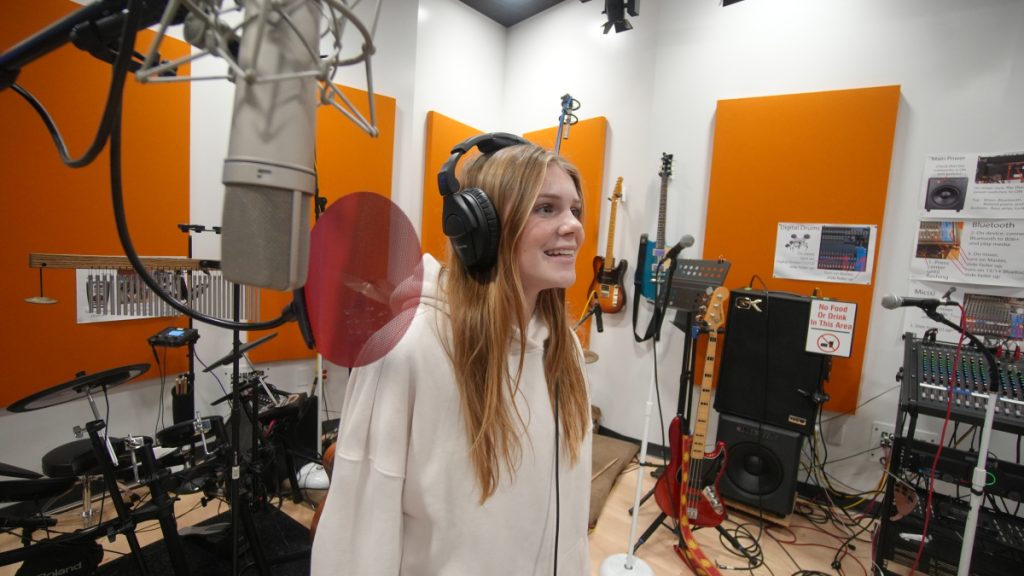
For the Music Recording Project, we created a cover for a song that we really liked. My friend Ashley and I did the song “Something Stupid” by Frank Sinatra. We really loved the harmonies in this song, and knew we could sing it together because we used to do choir together. We went into the studio and created a couple of tracks of us singing, and then just put the karaoke under it.
▶ Something Stupid (Cover)
⏸ Something Stupid (Cover)

Some key takeaways we experienced while recording in the studio room is that there is a lot that goes into recording in order to get the best out of it. Although there were a lot of steps that you must follow in order to begin, once you get it going it’s simple from there. We had an amazing time harmonizing and working together to make this beautiful cover. Overall, it was important that we worked together and followed the steps to make sure our music was going to be the way we want it to be.

▶ Nightlight Serenade
⏸ Nightlight Serenade

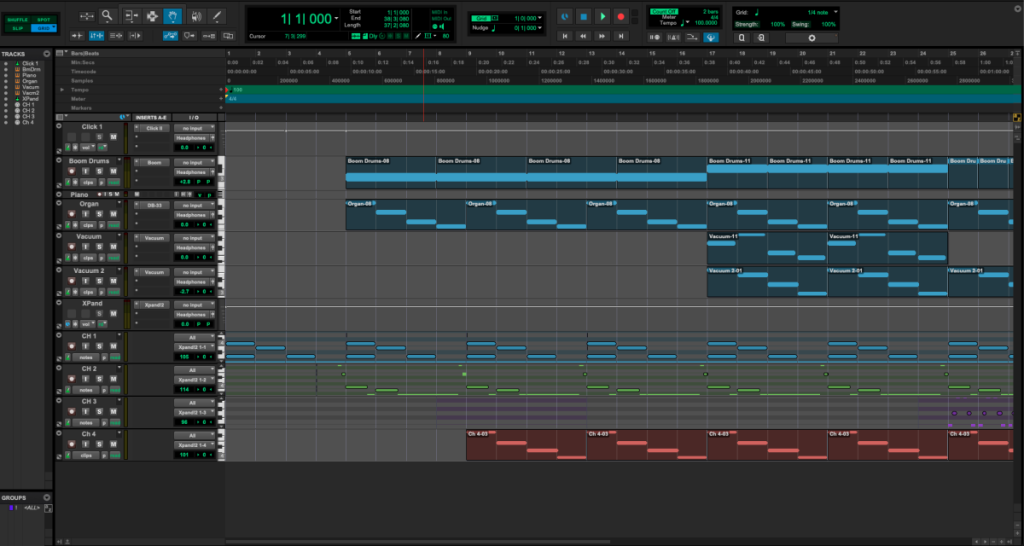
For the Experimental Music Project, we made our own songs using a MIDI keyboard that allowed us to use a bunch of different instruments. This was super cool because it taught me how to use Pro Tools and how to make my own song. Additionally, it taught me how different instruments work together and how they sound.
Here’s the Artist Statement for this production: Junior Experimental MIDI Music in DM
Title: Nightlight SerenadeMy inspiration for this music was that I wanted some angelic sounding chords with a fun drumline. Originally, after creating the chords and lead, I thought I should make it a kind of reggae, but eventually decided I wanted it to sound more synthwave.
I am most proud that I was able to create my own song and learn how to play other instruments on the MDI keyboard. I really liked the process of figuring out what chords and beats worked together and what I thought sounded nice.
I valued learning how a bunch of new instruments sounded through the MIDI Virtual Instruments. I thought it was cool that through playing the keyboard, you could play other instruments like guitar or english horns.

Film
Griffith Scene
For the Griffith scene video, we explored using Griffith’s pattern to help establish a scene, character and the overall storyline. It consists of an establishing shot, which is a wide shot and introduces where the film takes place. Then, we see a log/medium shot where it sets the rules of the space. Like the 180-degree rule. After, there is a medium shot that introduces the characters. And finally, there is a close up to reveal emotions and reactions.
I really valued this scene because I use it in almost all of my films because it is a great way to set up the story and depict the rules of the world and who the most important characters are.
Suspense Scene
For the suspense scene, we worked on creating a scene that evoked a sense of fear or worry for our characters. We relied on anticipation, and showing the viewers something before the character knew about it. Additionally, we used a lot of different camera angles that made it feel like the character was being watched and that they didn’t know they were being followed.
Chase Scene
For the chase scene, we worked on using fast cuts to emphasize speed and almost being in a hurry. It was really cool to work with the 180-degree rule in this scene because you had to be really mindful of where the characters are turning and where they are facing and things like that. The most challenging part of this was the spacing, because I was in my friend’s house and didn’t have a lot of room or change of space.
Narrative
Synopsis – Ashley Cook and Daphne Heatherly
Once upon a time,
There was a lonely mime who nobody noticed because he couldn’t speak. He lived in a
big city. He was stuck in an invisible box that he felt prevented him from being seen by other
people/people to treat him like a human being. Every day he would do normal mime things to try
to entertain, but as time moved on the box shrinked. He has less space to be known/be noticed.
There’s another mime across the street from him, who is already smaller than himself. Each day
he gets smaller and smaller until he disappears into nothing. This makes the mime realize that the
same thing will happen to him unless he gets out. He becomes more desperate to get out of said
box. One day, he is crouched over himself when a little girl knocks on the box. (Her mother was
shopping in the nearby store) She can see him??? He jolted up and hit his head on the ceiling of
the box and the little girl laughed. This is where they built a relationship. Each day she came by
with new tools and toys to try and break the box from the outside. But each attempt fails. By
sunset her mom came to pick her up (we only see her legs or her hand grabbing the daughter)
and take her home and the mom didn’t notice the mime and thought that her daughter was
playing by herself.
One day she was trying to break the box as usual, she used a sharp/heavy object like a
hammer, and she did actually crack the box and a little piece of glass shard scratches her hand
and she starts bleeding but she didn’t mind. Her mom gets very worried and upset when she
comes to pick her up and from that point on the mime never saw her again. This was when the
mime realized that he had to break out of the box on his own. (abyss moment). He tried breaking
the glass from the inside out but he got very upset and mad. He realized that he can’t get out on
his own. The box got even smaller and he felt like it’s the end. Until one day a strong wind and
rain comes from the outside and he feels pressure on the box. Maybe this is a chance! He
struggles to push the box (does classic mime moves but like they have a purpose just trust) it
doesn’t work and he sees one of the tools that the girl left behind. He squeezes through the crack
and struggles to grab it. Once he does he can smash it from the inside. He steps out of the box
and the rain hits his body. It’s a new sensation and feeling. He takes a breath of fresh air and
becomes so happily overwhelmed with this new world. His makeup rubs off due to the rain and
people start to notice him.
The next day he is sitting on a bench and sees the little girl walking by. She glances at
him but doesn’t recognize him, she also sees the shattered box and is happy he got out but also
sad because she doesn’t see him anymore. He smiles as she walks past because of the memories
he and her made. Now in the end, he is a normal person just like everyone else and although he is
still not personally noticed by everyone else, he is no longer trapped and can live the life he
always dreamed of.
Shot ideas:
- Intro scenes: wide shot of the city that’s San fransisco, colorful
- In that scene you can see the black and white box (edited) and he is inside
- Close up on peoples shoes walking around him
- Close up on his face
- Follow shot of little girl coming up to him
- VIBES: 1950s ish or just very old fashioned city like
- Time skip shots of days passing
- Close up of little girls eyes being very happy
Overall, these productions in film taught me a lot about storytelling, and how to set up a character’s plot. One thing I specifically worked on a lot was making sure I “planted seeds that had trees at the end” Meaning, I made sure that if I established something important about the character or just in the film, that it was addressed again at the end so it had more impact. Additionally, I learned about the importance of well-timed cuts and where I am placing my clips in relation to each other.