
In our junior narrative unit, we explored character and fiction development through numerous multimedia projects that spanned multiple classes. Most of the unit was based on the Flash Fiction that we wrote in English. Then, once our piece was fully edited, we created audio productions and story art in Digital Media. Aspects of my story even influenced my work in Design, where I used character traits of my primary character to create an illustration of a hybrid creature. In this unit we used Wacom Drawing Pads, Adobe Photoshop, Adobe Illustrator, and more!
I value all of the skills that I developed in this unit, however I am the most grateful for the advances I made to my knowledge of sound production. It was really immersive to hear my story out loud, meshed with sound effects that helped build the setting, and I think it added a lot of value to the text. Sound/audio also happens to be the area that I made the most improvement in. I have never been musically inclined, but after watching many (and I mean many) pro-tools tutorials, I managed to create something that I was proud of.

Process
For my flash fiction project, I chose to write a short story that built on themes of suspense, guilt, and lies. The Witch of Swindon-by-the-Sea takes place over a single conversation between Bethie-Lou and Reuben, two residents of Swindon-by-the-Sea. Over the course of the conversation, through Bethie-Lou’s refusal to speak (instead choosing to write in her journal), and Reuben’s semi-paternal treatment of her, a complex character relationship begins to form. We begin to learn more about why Bethie-Lou doesn’t speak and why the town seemingly hates her. The story culminates with the realization that one of them is lying.
The way I went about starting this project was by first developing a moodboard. Having a visual guide for what I want the setting of Swindon-by-the-Sea to look like helped a lot in the drafting process. After I completed my moodboard, I began to outline characters and general ideas for plot. Typically, when I write I tend to prefer writing longer projects (such as full-length novels), so it was a challenge for me to figure out how I was going to condense all of my ideas into such a short format. Eventually I managed to complete a draft and edit it down to satisfying the word count maximum.
Then, in Digital Media, I began the short story audio production. I went into one of the iso-booths and recorded myself reading the story out loud, and then cleaned up the audio in pro-tools. Once I was satisfied with how it sounded, I went in and added sound effects. I knew I wanted lots of ambient wave and bird noises, as Reuben and Bethie-Lou are sitting on the edge of a dock, and that I wanted to emphasize some of the onomatopoeias I wrote into the original text.
The Witch of Swindon-by-the-Sea
The air hung damp, tasting of salt and distant rain, as Bethie-Lou sat hunched on the barnacle-studded planks of the old Swindon-by-the-Sea dock. She was a scrap of a girl, with choppy hair that kissed her collarbone and eyes the color of a pebble.
She heard Reuben’s boots before she saw him – a dragging, uneven rhythm of heavy, waterlogged leather against the rotted wood, each thunk-scrape, thunk-scrape drawing closer. He was pushing seventy, his face a roadmap of wind-scoured lines, but he always carried the same sour, brackish smell as the ocean, a mix of stale whiskey and forgotten fish guts clinging to his threadbare woolens.
He didn’t offer a greeting. Just shuffled to the edge and spat a thick wad of tobacco-stained phlegm into the churning gray.
“You’re out early again, ain’tcha, Bethie-Lou?” Reuben’s voice was a gravelly rasp, roughened by a thousand cigarettes and years of shouting into gales. “Ain’t much worth catchin’ out here no more.”
Bethie-Lou didn’t answer, she never did. Her pen just scratched a slow, deliberate line across the page. Reuben watched the careful curve of her letters. “You got secrets in there, don’t ya?” he muttered, tilting his head towards the journal. “Town says you’re keepin’ curses. Figure it’s just stories.”
Nothing. Just the faint scritch-scratch of graphite on paper.
With a series of cracks and groans from his old joints, he knelt beside her, settling heavily onto the damp planks. He didn’t look at her, but instead at the water, his breath visible in the icy air.
“Used to fish this dock with your daddy,” he finally spoke. “‘Fore he went under.” Her hand stilled. The fog had begun to roll in from the sea, blurring the horizon into an indistinguishable smear of gray that reminded her of the sludge at the bottom of Rourke’s boat.
“That’s the night it all went to hell,” he continued, not paying her stillness any mind. “Mackerel gone. Nets clean as bones. Your Mama–” He hesitated, the name catching in his throat, as if uttering it might stir something dangerous from the depths. “She walked right into that water after him.”
Bethie-Lou’s grip tightened on the pencil, knuckles a bloodless white.
Reuben’s eyes, rheumy and distant, flicked to her face. “You were just a babe then, screamin’ your head off on the dock. Pulled you off her coat ‘fore the tide took it.”
The air thickened, heavy with the scent of rain. Bethie-Lou snapped her journal shut. Reuben produced a tarnished silver flask. He took a long swig then offered it to her. She didn’t move, her gaze fixed on the water.
“Town blames you, ya’know.” He murmured, the whiskey warming his words. She knew, of course. Bethie-Lou knew a lot more than people thought she did. She knew they thought she was the reason the Mackerels left. That they called her the Witch, and watched her tend to her Devil’s book.
He sighed, a long, weary exhalation that stirred the wiry stubble on his chin. “S’pose they need someone t’hate. Always did.”
Bethie-Lou rose slowly, her gauzy little dress rustling in the wind. She brushed a fleck of dried mud from the hem, then walked to the very edge of the dock where the old planks sagged.
The wind picked up a mournful whine, whipping strands of her mousy hair across her face and scattering frigid spray across them both. He squinted at her, his gaze finally sharpening. And then he saw it – the faint, purple bruises shadowing her knees.
He swallowed hard.
“They’ve been botherin’ you again, ain’t they? Those boys from the co-op?” He stopped himself abruptly, the whiskey having made him wiser.
Bethie-Lou’s gaze flickered to him, filled with a bone-deep tiredness, like it had been worn into her very soul. Reuben gripped the railing, his jaw tight, muscles working beneath the weathered skin.
“You should’ve told me,” he said, almost pleading. “I’d’ve done somethin’. I’d’ve–”
“You didn’t last time.”
He froze. The words hit him like a rogue wave, ripping the breath from his lungs.
“What?” He choked out, though he already knew.
“You saw,” she whispered, “you saw them push her in.”
“We were scared.” Reuben’s breathing turned ragged. “Whole town was. Your mama–she wouldn’t stop talkin’ bout what they’d done. Said she was gonna tell the papers, the state. And–”
He shook his head, a violent shudder passing through his gaunt frame. “It just happened. It wasn’t our fault–” Reuben couldn’t finish.
The truth, he thought, would forever remain lodged in his throat. And she knew it.
Bethie-Lou knelt back down, picking up her journal, tucking it carefully under her arm. She stepped closer to him, close enough that he could smell the sharp scent of salt on her skin.
“I write it down,” she said quietly, her voice laced with an unnerving steel. “Every name.”
Reuben’s eyes widened. “Bethie–”
But she was already walking past him, the dock groaning under her Daddy’s old boots.
At the very edge, where the planks met the restless sea, she slowly lowered the journal and dropped it into the water. She watched it for a long moment, the dark leather bobbing, the pages spreading slowly like dark, ink-stained wings.
“Some things ain’t meant to stay buried,” she said.
Reuben’s face crumpled. His voice, when it came, was thin and broken.
“Whaddya gonna do?”
Bethie-Lou didn’t look back, her silhouette sharp against the graying sky.
“Nothing,” she said, her voice utterly calm. “It’s already done.”
The cold, dark surface momentarily split, drawing the gray light down with it, receiving her without resistance, without question.
Reuben lurched forward, calling her name once, twice, a ragged cry torn from his throat. But even he, he who was the last of the ones who knew her before she was the Witch, fell silent.
When the fog finally cleared an hour later, revealing the stark expanse of the sea, the only thing left floating was her little leather journal, waterlogged, wind-whipped pages open to the last entry.
A list of names.
All of them men from Swindon-by-the-Sea.
And Reuben’s. His was the last one.
Artist’s Statement: I think I ended up telling my story really well. I managed to really emulate the vibe and tone that I had in mind when I was drafting my story, while still making sure that you can understand what I’m saying. Listening back to the final bounced final, I think it is a really unique rendition of my Flash Fiction, and the auditory aspect of the project adds a lot to my work.
I am most proud of my use of SFX in this story to create a very believable and realistic sounding environment. The scene depicted in my flash fiction takes place on the end of a dock in a tired, worn-down fishing village and was supposed to feel eerie and desolate. To achieve this, I layered the sounds of waves breaking against the pillars of the dock with the chirping and humming of wildlife that would be native to the setting. In addition, I layered individual SFX to accentuate specific phrases in my text, keeping the listener engaged. For example, me saying the phrase, “the faint scritch-scratch of graphite on paper” is layered with the corresponding SFX.
I value and appreciate the opportunity this project has given me to further develop my Pro Tools skills and learn how to cohesively incorporate SFXs into my audio productions. These new skills allow me to explore new, creative applications of my creative writing. I also immensely value the chance this has given me to learn about how to balance vocal narration with music and SFXs. I think there is a really delicate balance, and this project pushed me to figure it out.
Behind the Scenes

In Digital Media and Design, we learn how to use Adobe Illustrator to create complex vector graphics that we can then uses as illustrations for a variety of projects. In Digital Media, we applied the skills we have learned to three main projects this unit: exquisite corpse, short story album cover, and our free-choice adobe illustrator project.
Exquisite Corpse
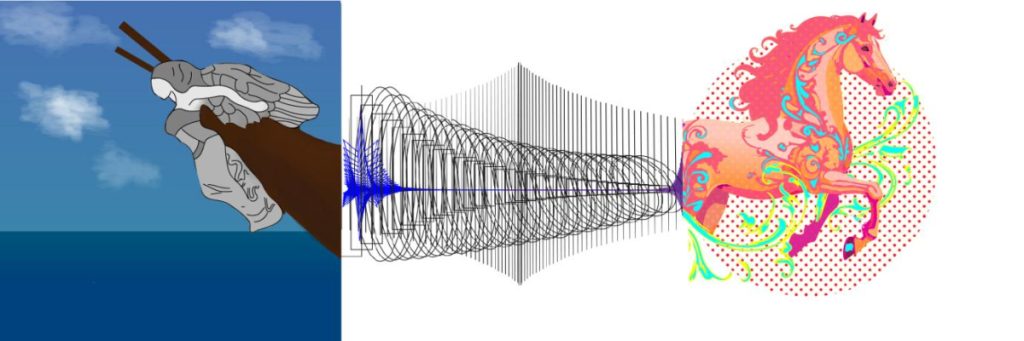
The way an exquisite corpse works is that three (or more) people each draw a segment of the body without showing each other, and then connect the various pieces to create a Frankenstien-like monster. Typically, this is done by folding a paper. However, we used Adobe Illustrator to create ours. Chloe drew the ship, Nico drew the shapes, and I drew the horse.
Short Story Album Cover

This is the album art that I created to represent my flash fiction, The Witch of Swindon-by-the-Sea. I knew I wanted to include a fish, as mackerels play such an important role in the plot and the exposition, but I also recognized that I wanted it to maintain the slightly-creepy vibe of the story. That is how I settled on using a collage of fonts, most of which look like they have been cut out of magazines and glued together. The final touch was the overlays, which I added because I love the texture and depth that they add to the design.
Illustration Project Choice
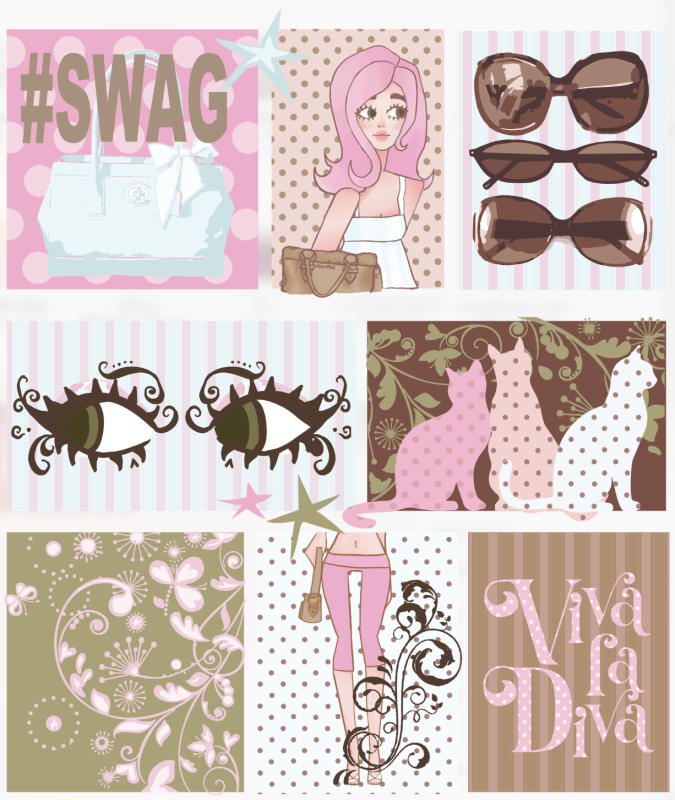
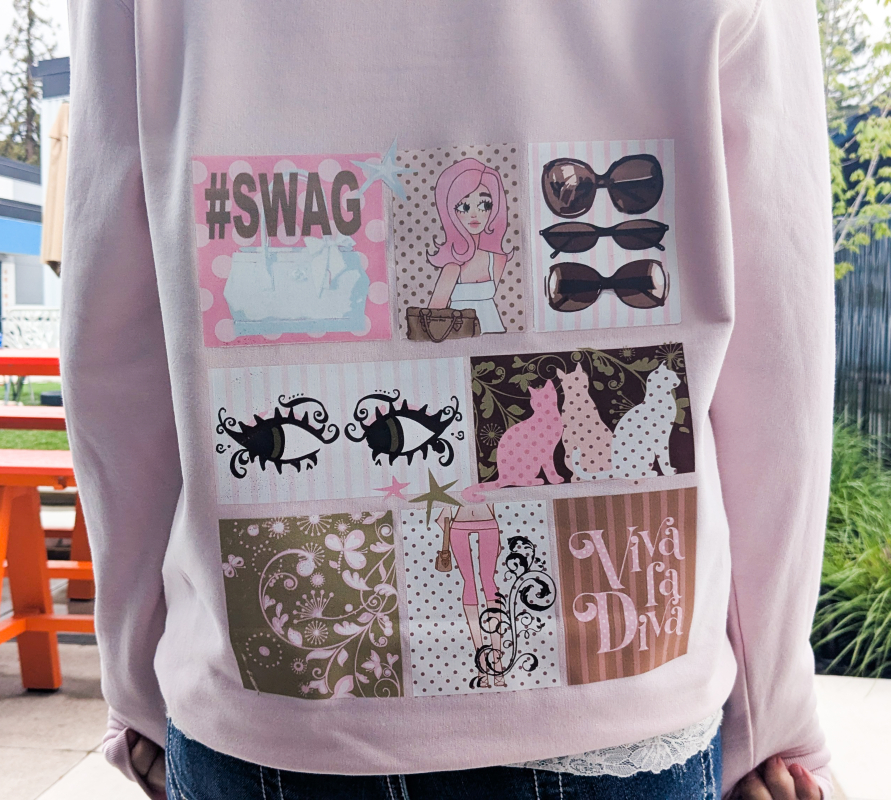
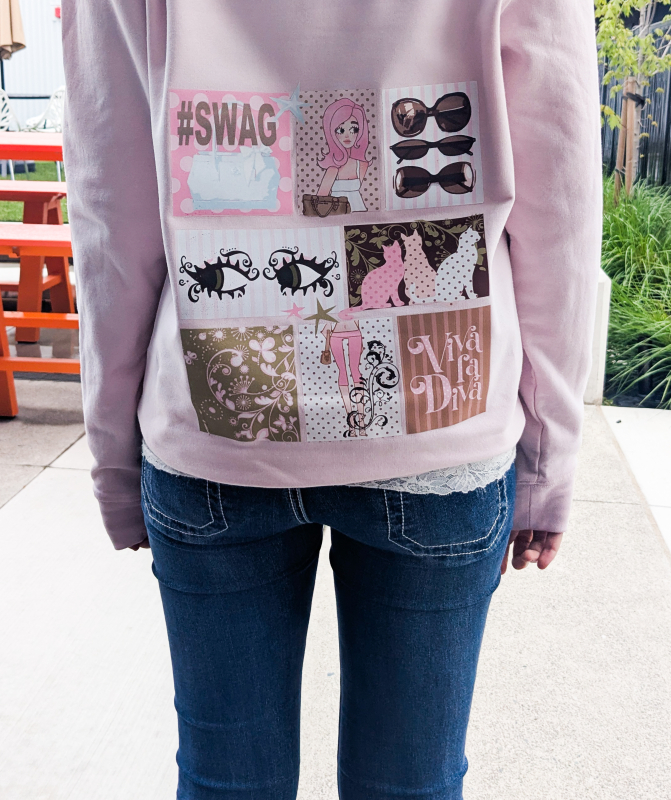
For the final illustration-based project of the narrative unit, we were given complete freedom to turn our designs into physical objects. Fashion and garment creation has always been very integrated into the mediums of art that I like to explore. For this reason, I decided to take my design (pictured above) and print it onto the back of a hoodie.

To me, using Illustrator for image creation as opposed to Photoshop has always felt more creative. Instead of altering photographs or images that I had created through other mediums, I am able to use the tools the program provides to create shapes, gradients, and everything I need to turn my ideas into visual designs. However, I do believe that this preference also stems from the great deal of time I spent learning the intricacies of illustrator in Design. Because of this, I find Illustrator to be significantly easier than Photoshop, and is my Adobe program of choice.
I chose to create a segmented design that incorporated many items that I interacted with on a daily basis—my comically oversized sunglasses, the bag I use to carry my books to school—while using fun colors and patterns to lend them the whimsy I attempt to imbue my designs with. Essentially, I wanted to translate how I see the world into a digital design that I could then share with others. The decision to print my design on a hoodie was one of the first I made in regards to this project, long before I came up with a concept for my design. I have always been passionate about fashion and personal expression through clothes, and this project seemed like the perfect way to apply the skills I have developed at Freestyle to hobbies that I pursue outside of school.
I am extremely happy with the work that I put into this project and it is one of the pieces that I have created at Freestyle that I am most proud of. It combined the colorful, pattern-heavy art style that I have been developing since I first expressed an interest in art with mundane objects from my everyday life to create a final product that I feel is very representative of me.
If you were to ask me, I think I would say that Illustrator is my absolute favorite Adobe Program. It gives me total freedom to create, destroy, and mold my designs into something that reflects the truest version of my ideas. Through both Digital Media and Design, I have developed the skills that I need to create the kind of art that I want to digitally. Specifically using the pen tool and the gradient tool, I gained much more control over the silhouettes of my art than when I just used the shape builder tool. Coloring is one of my favorite aspects of illustrator—especially the recolor tool, which made ensuring a cohesive color palette much easier. Overall, I really value the skills that I developed in this unit and I am excited to continue to use them in the future.

Music Recording Project
▶ Bags by Clairo Cover
⏸ Bags by Clairo Cover

For this project, Chloe, Harlow, and I decided to sing a song that all of us were familiar with and was relatively easy to sing. After that, we divvied up the lyrics and starting planning what sections would be sung individually and which would be done as a group. In the end, we settled on individual verses but a layered, group chorus. This was my first time in the recording studio, so not only was it exciting, it was also quite nerve wracking. It really helped that I was doing this project with my friends. We did some live mixing of the vocals and Mr. Flo helped us mark the places on the timeline that we were going to cut our various individual clips. From there, it was up to us to use what we’d learned about Pro Tools to produce our final song. I decided to cascade the layering of the vocals in the chorus to make the transition from a single voice to three smoother.
Collaborative Artist’s Statement:
Our main takeaways from the music recording project are that music recording takes a lot of work, but is also a lot of fun. It’s important to take risks and put yourself out there, without being afraid of being embarrassed. We had so much fun going into the studio and singing, and we really enjoyed stepping out of our comfort zone to try something new and unique. It was interesting to try to keep the timing with each take, and we had to learn how to collaborate over multiple attempts. We ended up being really excited after listening to our final product, because we had so much fun making it. Fair warning – none of us are the best singers, but we can’t wait to come back and continue to have fun and improve!
▶ Dolce far Niente
⏸ Dolce far Niente

For the Experimental Music Project, we were tasked with using the ProTools skills we developed in previous projects and making our own midi music. Midi is a universal digital language that allows computers, synthesizers, and musical instruments to communicate with one another. We used a midi keyboard to program the blocks, and then used various plug-ins to translate the sound into recognizable instruments. By teaching myself mediocre piano skills (mostly playing by ear) I was able to create a song that included all sorts of instruments I don’t know how to play. I started the production process of this piece by just messing around with the keyboard and recording a few ideas. Once I created something I liked, I began to experiment with layering various sounds and instruments. This was a very experimental process, and I relied on trial and error to help me produce my final composition.
Artist’s Statement:
My inspiration for the music was the classical pieces that I listen to when I study. I wanted to mirror the dramatic crescendos and emotional composition that are present in some of my favorites, as I find they make the song audibly engaging in the absence of lyrics. I was also inspired by the eerie, vibrating sound the DB-33 Organ made when I held a chord for an extended period of time. I ended up building off of that vibe and using that as the tone for my composition.
I am most proud of my use of multiple instruments and my creativity. Going into this project, I had no clue how to play a piano or compose music, but in the end I ended up having a lot of fun with ProTools. Once I learned how to (partially) play a keyboard, I was able to make it sound like I had composed music for an orchestra. Overall, I am very proud of all of the hard work I put into making this piece something I enjoy listening to.
I value learning how to use MIDI Instruments for music production because it allowed me to explore music production, which I have never done before. It is an accessible middle ground for people like me who don’t know how to play a ton of instruments, but have an idea for the kind of song we want to listen to. Most of all, I value the new skills that I have learned.

Narrative Illustration


For the Narrative Illustration project, I first compiled a moodboard drawing elements from the moodboard I used to draft my flash fiction, and then moved into the illustrating process. We continued our development of linear perspective through this assignment. I used 1 point linear perspective to draw the background.
Narrative Illustration Artist Statement
My flash fiction follows Bethie-Lou, a quiet girl from a dried-up fishing town who is alienated from the close-knit community due to the events that resulted in her parents death. The entirety of the story takes place over an interaction she has with Reuben, the last resident of Swindon-by-the-Sea that will speak to her, and slowly reveals that what happened to her parents was not an accident but instead a conscious choice of the townspeople. The story draws to an end with Bethie-Lou’s acceptance of the events that occurred that night, complete with an ambiguous ending in regards to her fate.
The first step of this project was to come up with our hybrid creature. The way I did this was by selecting five of Bethie-Lou’s most prominent characteristics and picking five animals that I thought reflected them best. The doe represents her being withdrawn, the chameleon is observant, the mackerel is methodical, the magpie is calculated, and the Polyphemus moth is silent. After I picked body parts from the various animals, I collected images and began the process of tracing them in Adobe Illustrator using the pen tool. After I filled each of the shapes with colors from my color palette, I started on gradients and made my creature look three-dimensional. The final step of creating the creature was all of the texture overlays, which I achieved through the ‘Texture’ section of Illustrator effects. For the background, I wanted to take a background directly out of my story, so I drew the end of the dock that Bethie-Lou and Reuben are sitting on while they interact. It is done in 1 point linear perspective, illustrating an exterior scene because I thought it would best reflect what I wrote in my Flash Fiction.
I am very proud of how my final illustration turned out. Initially, I was worried about the creature and the background feeling flat, however I believe my use of gradients, textures, and shadows quickly resolved this issue. Another problem that I had was my original assignment of body parts. In my original design of the creature, it had the entire body of the deer, with gills and fins to represent the fish. But after receiving feedback that it looked too much like a deer, I altered the pose of the creature and gave it a Mackerel tail, which I think ultimately made the composition far more interesting.