INTRODUCTION:
For the Conceptual Project, juniors develop abstract thinking and communication skills while exploring the question, “How can unconventional forms be used to express ideas?” The project focuses on learning how different mediums — such as poetry, music, art, animation, and web production — can communicate meaning. Students also begin building technical communication skills by learning to use professional equipment and software, including DSLR cameras, audio recorders, Adobe applications, Word Press, and Google Apps.
We explored these numerous tools, learning how to use them while experimenting with different forms of self-expression.
ART REFLECTION VIDEO:
Our first real project of the school year was this Art Reflection Video. In english, we were exploring the concept of the “eight wonders of life,” as sources of everyday awe by reading excerpts of Dacher Keltner’s book about Awe. We then took these ideas with us to a field trip to the San Francisco Museum of Modern Art (SFMOMA), where we were asked to find a work of art that filled us with awe and write a reflection on it.
After polishing this reflection in English, we then took it to Digital Media where we were to produce a short video describing the awe that we experienced and connect it to personal experiences.
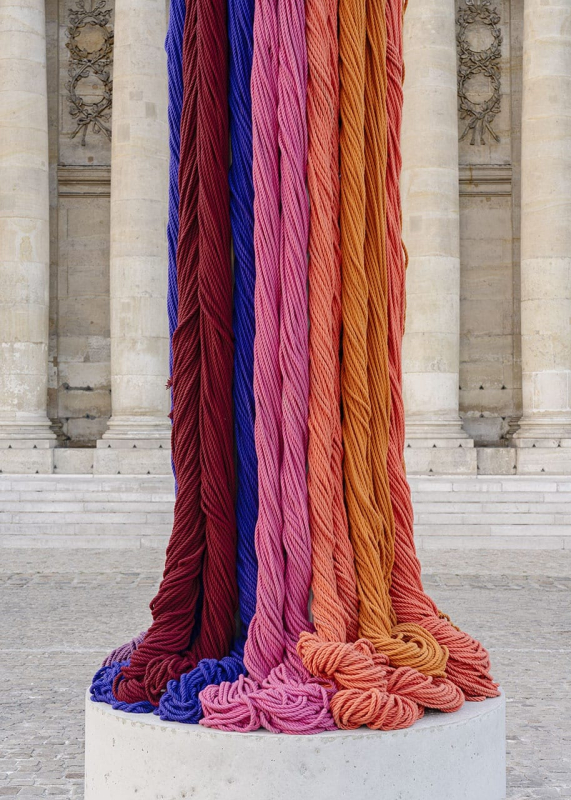
At SFMOMA, an art piece by Sheila Hicks spoke to me: Vers des Horizons Inconnus or “Towards Uknown Horizons”.
I really enjoyed further exploring Premier Pro, especially practicing putting together the background music. I liked this background music, however it was only half as long as I needed it to be to last the entirety of the video. I overlayed the two to create a fairly unnoticeable transition in the middle.
I loved learning how to use Premier Pro, and I can see it being incredibly useful in many projects later on. This is a snapshot of what this project looked like during editing. The upper left window is the key-framing, the upper right is the playback, lower left is all my media, and the lower right is the timeline.
I still have a lot to learn in the world of video editing, however this project was a good introduction and I look forward to future video production and editing.

PHOTOSHOP BLEND MODES
As part of our practice in learning Photoshop, we were taught how to use various blending modes and how they worked.
DSLR PRACTICE PHOTOS
We spent many days in class learning how to navigate and use a DSLR Camera. We learned about ISO, aperture, shutter speed, white balance, and more.
ANIMATION
INTRODUCTION:
We began this semester in Animation by learning about the history and principles of animation. By the middle of August, we had been introduced to a brief history and the principles, and were to do deeper research to write an essay on them.
This semester I was able to explore different animation techniques and mediums, and really develop an animation process. It was difficult completing animations in a limited time period, however it allowed me to create many more animations and therefore learn and experiment more.
ZOETROPE
Our first real animation project was this zoetrope animation, where the animation is drawn on one long 16-frame strip of paper. This would go on the outer edge of the zoetrope, where it could then be reflected by 16 separate mirrors. The sharp corners between the mirrors break the persistence of vision, separating each frame so that the animation is visible.
This project was tricky because to be able to make the frames consistent, we essentially had to make two strips, so that we could trace one from the other. Below is a photo of the final strip and below that is the tracing strip. I didn’t add the details to the tracing strip to save time, which still got the job done, however wasn’t ideal for animating the ostrich tail and feathers.

PAPER CUTOUT STOPMOTION
This paper animation was our first stop-motion projects of the year, and I had a lot of fun with this one. I spent 2 class periods planning, cutting out, and glueing together the character. For some facial expressions I had to create a whole new character, like when the mouth opens really wide or is fully closed. For most of the animation, however, I just overlapped separate pieces of paper to change the expression. I made 3 different tongue shapes, 2 eyelids, a lower jaw, and 7 blank brown pieces to show the creature growing in size. This was one of the most difficult parts of this animation, since I really wanted to minimize the amount copies of the character I made, but still convey a good amount of movement form these pieces of paper.
To make this top-down animation, we connected our DSLRs to a stand designed for this purpose, and plugged it into our monitors. We used the program Dragonframe to take photos and turn it into a stop-motion.
OBJECT STOP MOTION
For this project, we were to make an animation of any object– I chose play-doh for the freedom of movement. This was one of the less time-consuming animation, even though it’s around 500 (around 400 or so more than my other animations), since there wasn’t any preparation before hand. This one doesn’t have much of a plot, since I just animated whatever I wanted as it went along.
I had a lot of fun with this one, and I have found that Play-Doh is a pretty forgiving animation subject (except for when it unintentionally sticks to your notebook and doesn’t come off), since it’s very easy and quick to shape it into whatever form you’d like. This notebook definitely took a beating during this animation (and the previous one as well).
To set this animation up, I put my DSLR on a tripod just in front of my desk and plugged it into Dragonframe, just like the previous stop-motion animation.
EXQUISITE CORPSE FLIPBOOK
This flipbook is one piece of a class-wide animation. Each person was to create an animation that connected two different shapes. In this case, I was connecting a small circle in the lower right corner to a large blue oval in the center. Eventually these animations will be edited together to create one long continuous animation (hence the name exquisite corpse).
I had difficulty while making this animation to convey the jumping action of a non-human shape while still trying to maintain the shape of a duck’s foot. This animation was my attempt to make a simple but still appealing animation with the goal to save time as I was getting very busy during this time. This didn’t actually end up working too well, since I got carried away with the fire-breathing duck and wanted to add many extra frames at the end.
All Posts