Introduction
For the Documentary Project, I had to find a person, place, thing, or organization that I found interesting, get interviews from people knowledgeable about the subject, and write a narrative documentary based on those interviews and supplemental secondary sources. Additionally, I had to relate the subject to current day discourse that impacts the people around me. The key to this project was truthful storytelling to interest readers while allowing the topic to stay true to itself. I had to create this documentary in three forms, the documentary text, a magazine article, and a documentary book.
For my topic, I initially wanted to document a group that managed a nature preserve near my house, the MidPeninsula Open Space Trust. I tried reaching out, but all of the impersonal ways of reaching out were managed by bots, and I figured that there would be no way my request would be seen in time. Instead, I did a bit more research, and was able to find the Peninsula Open Space Trust, or POST, an organization that buys and sells protected land to preservation groups.

I was mainly able to get contact because my mom knows someone in the group and she was also the one who gave me the idea to change topics. Because of her, I was able to get into contact with my interviewees Brad O’Brian and Peter Cowan through Eric Normington, her contact. Because of this contact, I was able to finalize my idea of documenting POST and how it benefits people’s lives every day.
Process

In English, I was tasked with writing my documentary paper. After securing my interviewees, I found secondary sources online that supported the ideas of preservation I wanted to convey while building on top of the foundation that my interviews laid. I also did a lot of process work, like laying out which sources would go in what parts of the text, finding good quotes to use from my interviews, and even removing some of the more useless sources I found.

The most challenging part of the writing process was 100% keeping motivation over four months of work. Even though I only started writing my draft about two months in, it was hard to stay focused, especially when at times it felt like I was making little to no progress each week. I can only really thank my teachers for setting a hard deadline that snapped me out of my laziness and helped push me to finish in time for publication of my design book.
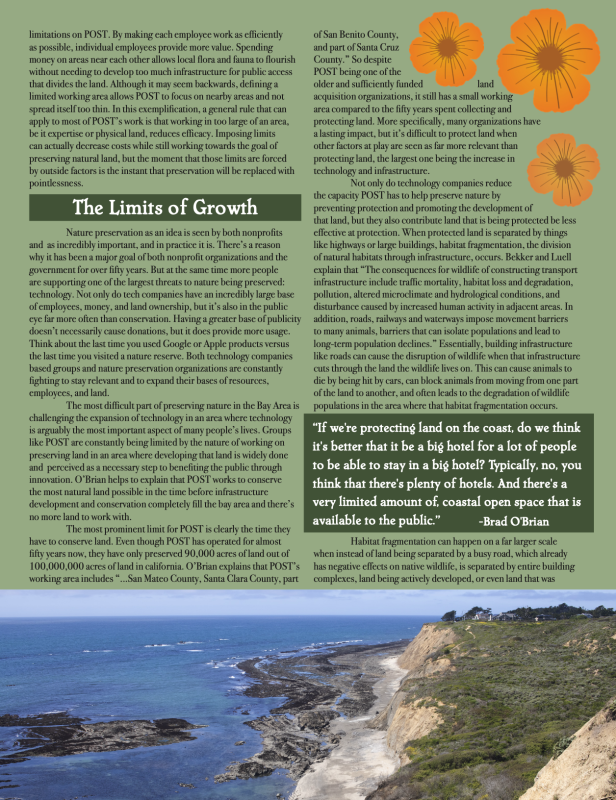
In Digital Media, I one major project, creating a magazine article that used my design book’s layout and content as a base. I used mostly the same GDEs and colours, but this time accounted for the full amount of text, increased page size, and decreased page number. I think it ended up pretty great, and I especially liked the background colour I added that wasn’t in the design book.
Book
In order to begin making my design book, I first had to create repeating design elements in Adobe Illustrator called GDEs. These would allow for the design rule or repetition to be followed while also letting a cute design element exist on every page. I made about five, a cattail, California poppy, birds, vines, and a bush lily. I also worked in Illustrator to make other things like my table of contents.

After making my GDEs, I input them into my InDesign document in order to help arrange the text and designs in an appealing way. Even though InDesign is really, really good for arrangement, it can barely make anything, so if I wanted to add new things to my book, I had to make it in Illustrator first the export it to my files, then input it into InDesign. I also used InDesign to both arrange my text and double check that the spelling was good enough for publication.

I made my table of contents mostly in Illustrator. I used linear perspective from the narrative creature project to make the sign point in a bunch of different directions while staying consistent with the text. It was really finicky and annoying, because I had to go back into Illustrator every time I wanted to change the text since it was turned into an object in order to make it fit into the linear perspective grid.

I also used InDesign to input photos edited in Photoshop into my book. I then used the easy cropping tools to fit the photos to my bleed lines, lines where photos and text must end at to ensure good printing quality. Photoshop sucks at cropping, so being able to do it in InDesign was amazing.
One of the most fun parts of this process was happening in the background during all of this daily work on the book: taking photos. In order to get photos that showcased protected land, I decided to actually visit said protected land and show its beauty in my book. I also chose to use some smaller scale pictures like the cover, that show only a small part of nature. The picture-taking was so incredibly fun, and if this wasn’t a part of my project I’d have rioted.
Interviewees
Brad O’Brian is the Secretary of the Board at POST, and has been practicing legal work for over forty years. He first joined POST by helping the as a freelance legal worker because he wanted to do more civil-minded legal work, and POST seemed like a really good opportunity to do it. He was the first interviewee I reached out to with the help of Eric Normington, and he helped me get a ton of background and legal information about how POST works.


Peter Cowan is the Director of Conservation Science at POST, and he was the second interviewee I reached out to. He was incredibly helpful in learning more about the actual benefits that nature preserves provide to people and biodiversity.
Reflection
Overall, I’m really proud of my work on this project overall! I took about four months to complete, but I think all of the effort and work I put in definitely paid off. I learned a lot about how to write in a more narrative style while tackling a more serious topic in English, learned how to use Adobe InDesign, was able to practice my skills in Adobe Illustrator by drawing GDEs, and learned how to put all my skills from the year together to create a physical book. I think that this was a valuable project because I learned a lot of new things, but I was also because I was able to see the product of all of my effort. Having a real result rather than just files prove the usability of all the skills I’ve learned over the year.