Narrative 1
Throughout our time in freestyle, we learned many professional tools like Pro Tools and Adobe applications. We also created a long and complex documentary in English. In animation we used Adobe after effects and Photoshop.

At the beginning of our English unit, we focused on flash fiction. Flash fiction stories are short, concise stories, usually under 1,000 words. I wrote my story about a creepy cabin in the woods with a big plot twist. I had a lot of fun with this. This story was then narrated and turned into an immersive podcast with music and sound effects in Digital Media. We learned how to use Pro Tools for this.
The Room with no Windows
The tired man stepped into the musty cabin in the woods. It had the smell of wet earth after a long rain. The cabin had three rooms. A kitchen, bedroom, and small bathroom. In the kitchen sat a gas stove that looked as if it hadn’t been updated since the 1950s. The ceiling paint had a dark stain right above the stove, likely from a buildup of grease and smoke without proper and up to date ventilation. A small, antique dining table was positioned a few feet away from the stove along with four creaky wooden chairs. Connected to the kitchen area was a brown, patchy couch and a splotchy grey rug. Hopefully the rug was grey to begin with, and not white. Across the couch sat a TV. The man ran a finger across the top of the TV and a thick, dusty residue came off on his finger.
Spectacular. The man thought sarcastically, wiping the dust off on his pants. The cabin belonged to the man’s older brother, who had suggested he spend the weekend there to decompress and get his mind off work. The man sighed and sat on the couch, immediately standing up and coughing from the dust that shot up when his butt hit the cushion. The man let out a short string of curses as he sneezed a couple of times.
It was getting pretty late, as he had arrived at the cabin around 10:00 pm, so he decided to head off to bed. He walked into the bedroom, where minimal furniture sat- a dresser, bed, and bedside table. The bedroom had no windows, which the man thought was pretty strange. The bed was pushed up against a wall that hung midsized painting. This room appeared to be slightly less fusty than the rest of the cabin. To make sure, he felt around the wall of the dark room until his hand grazed across the light switch. He flicked it on, but the room stayed dark. Whatever. It doesn’t matter.
The man was absolutely exhausted and was planning on going to sleep anyway, so he kicked off his shoes and climbed into bed. The pillow smelled stale like a basement, but at this point, he was too tired to care. He turned his head to the wall parallel to the bed and noticed the very strange painting. My brother must have a weird taste, the man thought as he scrunched up his face in confusion. The painting depicted a thin and grotesque looking man that looked like he hadn’t gotten sleep in decades. His skin was grey and ashen, and it appeared to be barely clinging to his bones like a poor paper mache job. He had uncanny looking eyes that seemed to stare directly at him. They were too big – not alien eyes big, but too big for comfort. They were sunken in with dark circles around them. His hair was dirty and matted, and it appeared to have fallen out in clumps.
The man shuddered and turned away from the painting. He shut his eyes to get some rest. In the morning, he woke up to light streaming through the cabin window directly in his face. He opened his eyes and turned to look out the window near his bed. The forest outside was absolutely gorgeous, with rays of sunlight streaming through the spaces in between the trees. The ambience of birdsong sounded around the cabin. The man smiled, feeling a sense of calm for a few seconds before a horrifying realization came to him. What window?
Reflection questions:
What were your main goals or intentions for this first full revision? Which pieces of feedback from your peer readers most influenced the changes you made? How did your own vision or instincts for the story guide your decisions beyond peer feedback?
I want to make the plot twist more clear, as it is pretty unclear to those who read it and even me. I also want to describe the man more. I think that adding a more detailed description to the person in the painting/window would make the story much more interesting.
Which specific changes made your story stronger (for example: cutting lines/words, focusing an image, deepening emotion, adjusting the ending, etc.)? Why were those changes important?
I think that adding more of a description to the cabin and really selling the “musty and moldy” aspect adds a lot to the atmosphere. I also want to convey the man’s emotions better than I wrote in the rough draft.
How has your understanding of “show, don’t tell” or “raising the stakes” evolved during this revision? Give one example from your story that shows this growth.
I think that the “What window?” part is a pretty interesting plot twist, and rather than saying something like “The cabin always had windows and the painting with the scary man was not a painting at all!! It was actually some creep staring into the window the entire time! Boo!” It was left for interpretation. I think that I need to highlight this and make it easier for the reader to understand.
Who is your protagonist, and what do they want versus what they need? How does the conflict grow out of this want-need tension? Which moment or action best reveals it?
My protagonist is a tired, stressed, and tense man who is taking a vacation in his brother’s cabin for a weekend. My protagonist wants to decompress, but is unhappy with the cabin he is staying in. There is a brief moment in the end of the story where he feels content until he realizes the situation with the window in the bedroom.
How does your setting support or contrast with the story’s emotion or conflict?
I think that the setting does both, because a cabin in the woods seems like a very lovely and relaxing place to stay at, however, the dangers of being completely alone, being in a musty and dusty cabin, and feeling isolated gives many people mixed emotions. Some people might love the idea of isolation in the woods while others might be terrified by the idea.
What specific actions, gestures, or physical details now help the reader feel the emotion/tone story instead of being directly told?
The action of the man running his finger across the surface of the TV and picking up a thick layer of dust, then sighing and thinking “spectacular.” sarcastically shows the emotion of the man feeling grumpy, tired, and just done with everything.
Which writing technique or stylistic choice from the flash fictions we read (“Reunion,” “Sticks,” or others) influenced your own revision? How did you try to apply that technique?
Reunion heavily influenced the writing style of the story, because rather than flat out stating what is happening and stating the exact characteristics of the people in the story, it unravels as you read.
What’s the point/message or purpose of your story, and why do you think readers (your audience) need to receive this meaning? (Basically, how would you answer the question “So what?” about your story’s resolution?)
To be honest, I was extremely stuck with the meaning behind the story, because in my opinion, there isn’t exactly a deep meaning behind this story. It’s mostly just a short, scary story. It could represent stress? I’m not sure.
What kind of feedback would you most like to receive on your next draft?
I hope to receive tips on how to highlight the climax with the window painting situation. The main thing that I think I need to work on is really pointing out what happened with the window.
Finally, add a word count at the end of the draft. If your draft is significantly under or over the suggested word count (500–1,000 words), explain what you will do to bring the draft within this range (or closer to it).
544 words. I’m probably going to add on to this, so it might be closer to 650 – 700 later on.
How clearly does your current draft establish the protagonist’s want and need, and what changes will you make so the emotional shift (the “need”) becomes clearer in the narrative arc?
I think that I can definitely improve a lot with stating what my character wants and needs. I only put one sentence describing how the man went to the cabin to decompress and get his mind off of work. I should definitely highlight that more.
What did your group’s feedback reveal about your use of setting, action, and description? Identify one moment where you will revise to strengthen tension, clarify motivation, or use sensory detail more purposefully.
As I expected, a lot of people who read the story were confused about the window and man situation, since I didn’t make it clear enough. As I revise, I’m definitely going to focus on making the situation much more clear.
What did your peers notice about your symbol (or lack of one), and how will you revise to make this symbolic element more recognizable, consistent, or meaningful within the story?
I unfortunately did not find a symbol yet. I think that some symbols I could use are mirrors, eyes, dust, and paintings.
Which piece of feedback most helped you understand where the story’s arc (rising action → climax → resolution) did or did not land for readers, and what specific narrative change will you make in response, if any? If it is working well in the eyes of your readers, explain why they found it effective.
One person said “wait, did the painting turn into a window?” which clearly means that what happened towards the end is not clear at all and needs to be refined because almost nobody understands what happened.
Looking across all feedback, what is the single highest-impact revision move you plan to make next, and why will this change improve the reader’s experience of the story?
I think that when someone told me that adding more descriptive imagery to the painting itself would help draw attention to the painting and window rather than adding so much descriptive detail to the cabin.
Behind the scenes: The podcast episode was created using Pro Tools. Using a mix of SFX, audio effects/ layering, and music, I was able to bring the story to life.

This unit was filled with Adobe Illustrator! I’m going to be completely honest: Illustrator was incredibly confusing and frustrating for me. It was fun nonetheless though!
Short Story Album Art

For the story album cover, I used the Wacom tablet and Illustrator. It was fun making this cover. I made this entire drawing with messy scribbles, so I was able to just go ham. I tried to make the cover somewhat scary, but it just looks funny to me.
Exquisite Corpse Group Project
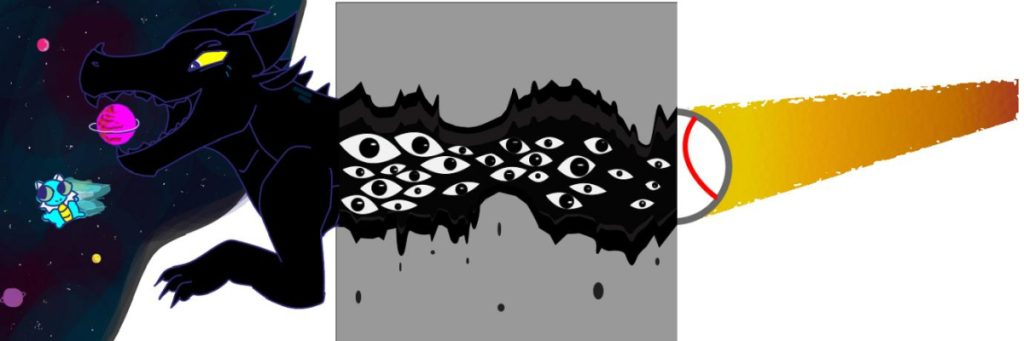
Mine is the one in the middle! I really liked how mine turned out. I think it’s a really cool design that would look pretty cool on a TShirt. I ended up turning this in at the last minute, but I would have made more time to reshape the shapes and add more variety in the eyes if I could. Overall, I really like it though!
Illustrator Project
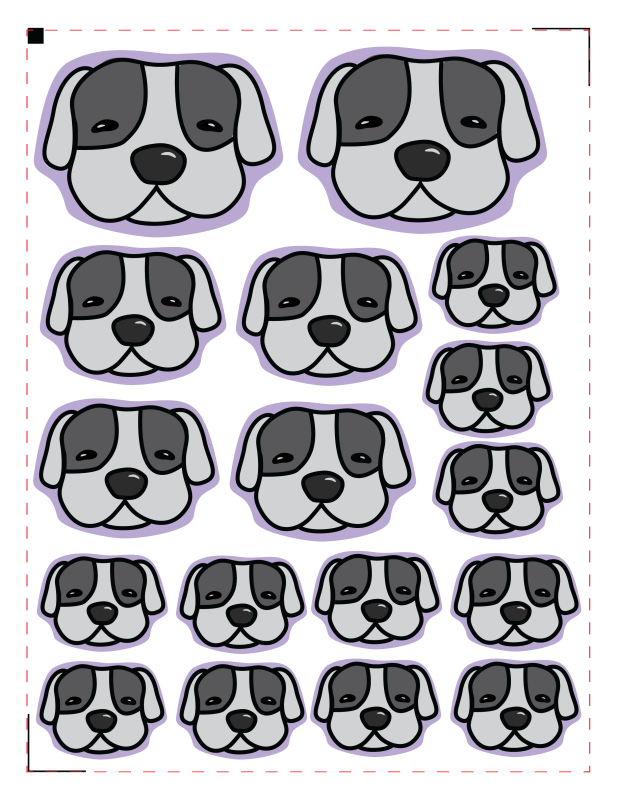
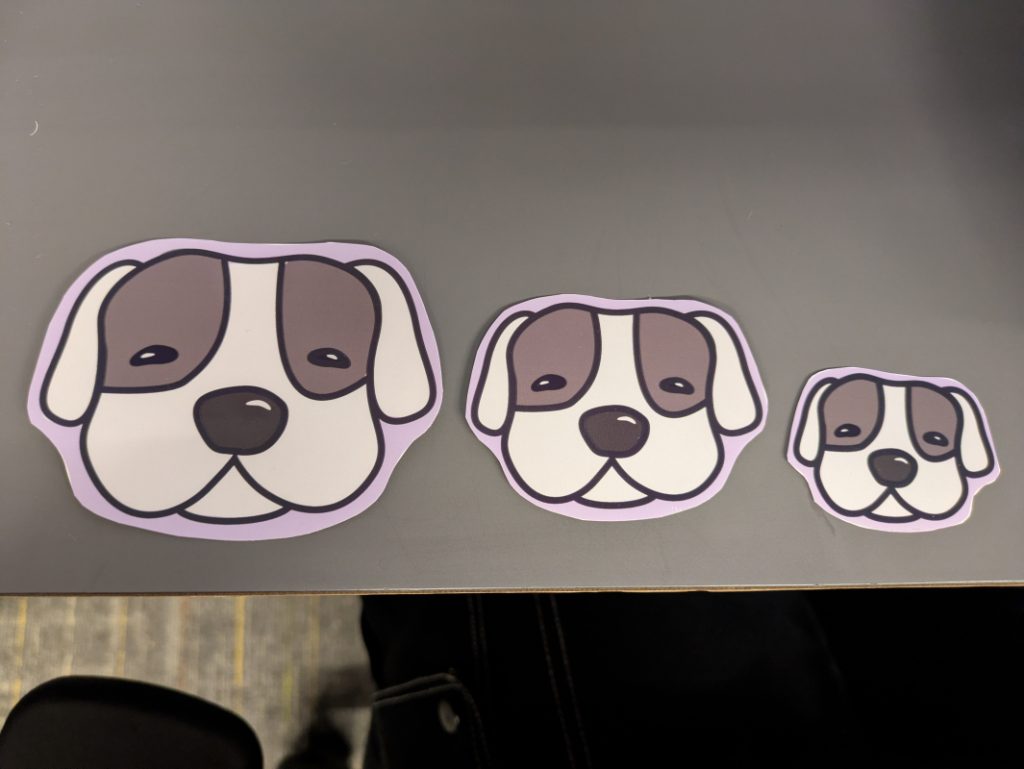
I’ll admit something: Using Illustrator for the first time as someone who uses Procreate and Photoshop was the equivalent of going from riding a bike to flying a spaceship. All the controls, settings, and shortcuts confused me. Photoshop uses bitmap, while Illustrator uses vector. This means that zooming in to an Illustrator file will not necessarily blur out the image. Photoshop is more for editing and creating thumbnails, while Illustrator is made for creating pictures and designs for print, stickers, etc. Even though it was confusing at times, I had a lot of fun doing this project. For my project, I chose to make a sticker set of my dog, Darla. I’ve always wanted to make custom made stickers, and I was really excited for this opportunity. I also wanted to create a bunch of stickers for my mom and neighbors, because Darla is very popular.


In this unit, we used Pro Tools, A professional and commonly used music application. Personally, this was my favorite unit in Digital media, and I had so much fun experimenting with the different instruments and tools! We did three projects using Pro Tools:
The music recording project: which was where we could partner up and sing a cover of a song.
Experimental music: We could make our very own music. No prior musical experience was needed for this project, and we could really be creative.
Short story podcast with SFX: This project is covered in the “Story” section!
.
.
Music Recording Project
Unfortunatly, due to my incompitence during first semester, I never recorded or turned this project in. I take complete responsibility for this.
Experimental Music Project
This song was inspired by a mix of trip hop and electronic music. I had a lot of fun using the Xpand tool because of the huge number of instruments I could use. I’m most proud of the mood of the entire song because it feels like there’s some huge buildup going on. (I kind of just let it fade out though) I’m really happy that I got to learn about MIDI music production because I think setting the mood of a scene with music is something I’ve always wanted to do. I’m not too happy with how this came out since I have no musical knowledge and I have no idea how to combine different instruments and melodies into one thing without it sounding all mashed up and jumbled.
▶ Electronic
⏸ Electronic


By far, Animation has been my favorite class of all time. I feel so in control and professional every time I use the applications to animate in this class. We mainly used Photoshop and After Effects to animate. Second semester was definitly focused more on digital 2d animation, while first semester was by hand. I enjoyed this unit so much, and I learned a lot too!
.
Puppet Walk Animation
This was probably the most complex out of all the animation projects. To start off, we built our very own puppets to animate using stop motion. Then, we went to Photoshop and animated our puppet’s walk cycle. With the two animations, we combined them to a final composite in After Effects. This project was definitely very difficult for me since I nor Mr. Cho could figure out the technical problem with my camera shooting at an extremely low exposure. This made my puppet animation nearly impossible to see because it was so dark. Unfortunately, I was unable to get my puppet animation turned in on time. I still have the puppet bio and drawing. I’m really proud of the drawing!

Lip Sync Animation
Now this… THIS!! This is my favorite project I did this year by far! I am genuinely so incredibly proud of how this turned out, and I cannot stress this enough. I had so much fun in fact, that I stayed behind in Animation and finished this project 2 whole weeks early. I’m so happy that I got to animate my OC!!
Group Project – 2D Narrative Animation
If I’m being honest, I did not enjoy this project. Don’t get me wrong, animating was fun, but it was incredibly stressful. I was the team leader for this project, and I was in charge of most of the project. To be honest, I’m not too happy with how it came out, I feel like I had to rush the animation and SFX and cut corners. Despite this, I feel very accomplished for pushing through it and finishing it (sorta on time.)