One of our first projects for the unit was to investigate a topic of our choice and write a lyrical essay on it. A lyrical essay doesn’t necessarily have to be lyrics, although it can be. It can also take the form of poetry or even a less formal essay. What makes a lyrical essay stand apart from a traditional essay is that the format is looser, allowing the writer more creative freedom to express their thoughts. For honors students, we were challenged to incorporate research into our essay and include a works cited page at the end.
Lyrical Essay
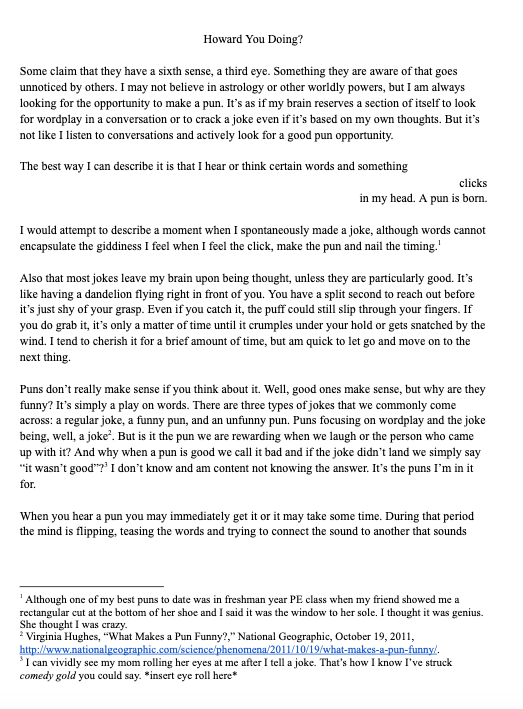
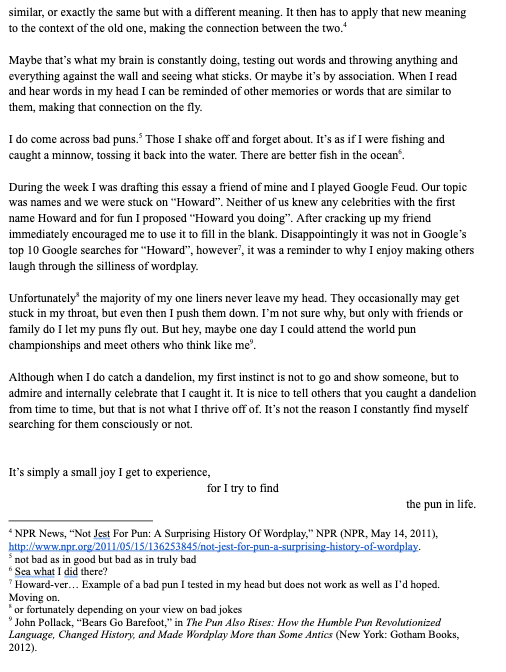
For my lyrical essay, I chose to write about puns and how I’m always looking for the opportunity to make one. It was difficult at times to find articles I could reference to fulfill the research requirement, although it only pushed me to look further into the topic of humor and how it impacts our society.
Before drafting the essay itself, I wrote a poem to help me generate ideas.
English is such a fickle language The waves on a beach differ from the wave of a stranger The lie you tell digs at you as you lie in bed Keys on a computer go click as the keys for your car jingle
They’re there, it’s alright
How can one find humor in a language that tricks? Easy, you make fun of it.
You make a joke. People laugh. People smile. People rolls their eyes Puns are like bits of dandelion Floating in the wind You have but small window to catch it Then it’s gone Or in this case No longer funny
I decided I wanted to make my lyrical essay more more conversational and utilized footnotes to make it feel as if the reader was getting an inside look to my thought process.
Lyrical Essay Production
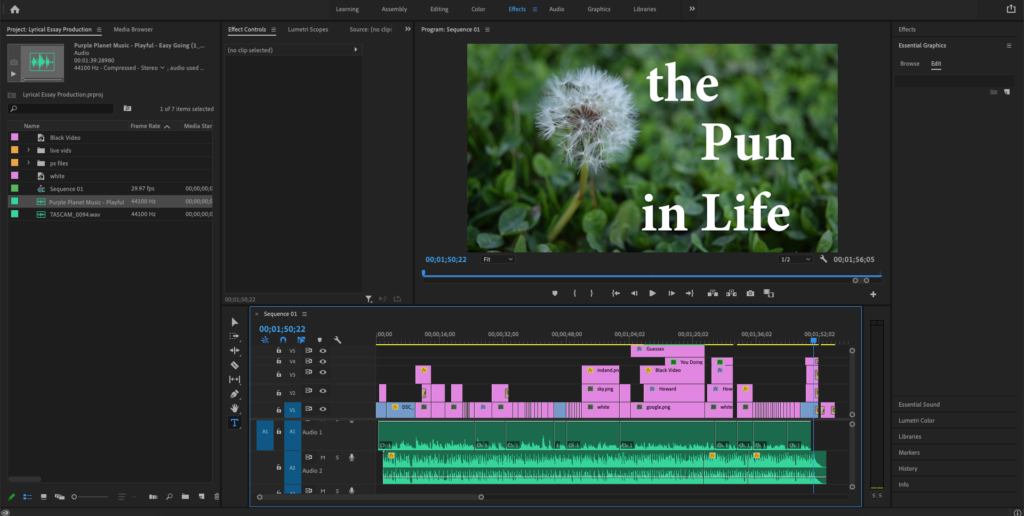
After writing our essay, we were then tasked with making it into a production. The guidelines for this were quite loose as well, we even made our own grading rubrics before we started. I decided to make a video in Premiere Pro with a voiceover of me reading parts of my essay. To challenge myself, I included stop motion and drew the illustrations using Photoshop, something I had not tried before.
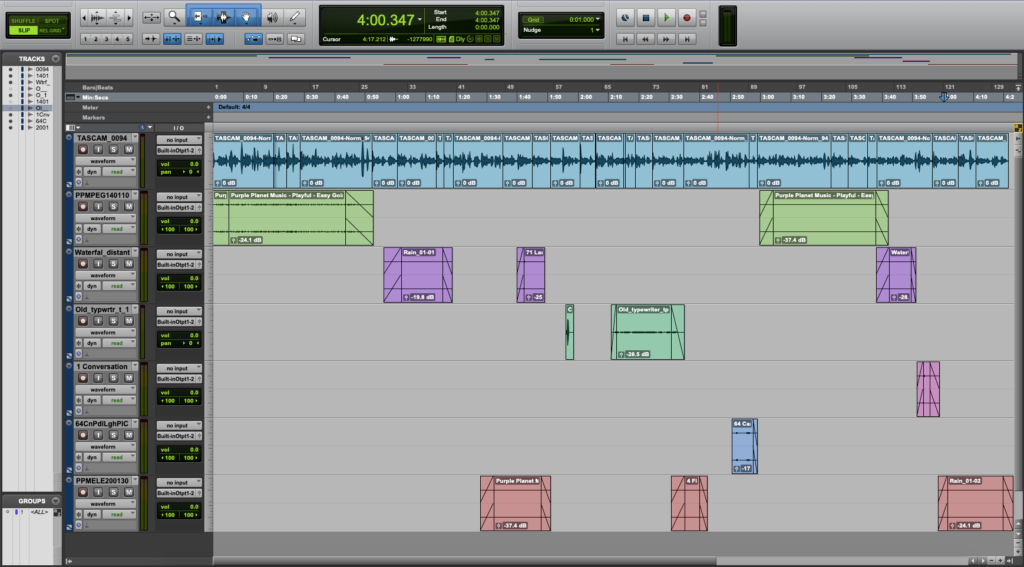
We also had a smaller project where we enhanced our lyrical essay project using Pro Tools. I used my voice recording as the foundation and added different sound effects and music to make the audio it’s own piece.
At the end I was satisfied with my production since it was a combination of original drawings and live footage. It gave me the opportunity to improve on my drawing and Photoshop skills while giving me more practice to use the Wacom tablet. I remember spending a lot of nights gradually piecing the project together, although it was never a burden or another task to check off my to-do list since I genuinely enjoyed working on it.
Lyrical Essayist Study
For honors we read Citizen: An American Lyric written by Claudia Rankine which contains a series of poems and lyrical essays revolving around racial discrimination and prejudice we still see in today’s society. We wrote an essay that analyzed a review of Citizen and discussed whether or not we agree with their critique.
Apples to Oranges
In the review “The Limitations of Claudia Rankine and Ta-Nehisi Coates’ Common Project”, guest contributor Clara B. Jones acknowledges the power behind Rankine’s work, Citizen: An American Lyric, yet also points out weaknesses in her writing. Jones is a retired scientist and practices poetry who emphasizes identity and power while overseeing research on experimental poetry as a woman of color. Jones comments that Rankine does not promote the “structural change” that needs to be seen if society is to make steps toward a more equitable future. She also analyzes that Rankine merely describes moments of black suppression rather than examining the context of why and how the situations came to be in the first place. If the reasons and background to the interactions were dissected, it could provide a clearer blueprint to how humanity could begin to make positive racial progress. In addition, Jones believes Rankine should have integrated more calls to action and challenged the foundation that racism is built off of. Overall, Jones’ review critiques Rankine’s static position and wishes she had taken a more offensive approach in her writing.
I understand Jones’ arguments, however, I only partially agree with her review. I agree that it could be beneficial for Rankine to include more analysis of racist interactions and micro agressions, but I feel that Rankine’s use of mixed media gives the reader more information, as well as context to accompany her words. One of numerous examples done by Rankine was “In Memory of Trayvon Martin”. She uses a second person point of view to illustrate a relationship with a brother who is later hanged. She speaks of the person and incident as if she is in the moment, providing no background or reasons. However, following the text is a black and white image of people, predominantly if not all white, looking up at a tree where one can assume a body is hanging from. The reader can glean a lot of information from the photograph despite there being no words. Rankine commonly pairs sections and poems in her book with images that relate to it in some way, similar to how she described lynching and how it has impacted our society. Despite Rankine not using words to directly provide context, her use of photographs and mixed media provide numerous layers to what she may be leaving out.
In addition, I agree to an extent that Rankine’s book lacks a tangible outline of how society could go about making change. Although I do think Rankine is hinting toward ways we can make those changes, she just does not say anything point blank. An example of this is on the last page of the book when Rankine describes another experience of micro aggression. A woman had pulled up her car next to the narrator and made eye contact with them, promptly pulling out and parking elsewhere. The narrator claims they could have followed the woman to test if their suspicions were true, but instead grabbed their “racket”. The narrator is asked if they won, to which they reply, “It wasn’t a match. It was a lesson” (159). Here Rankine is referencing her past section about American tennis player, Serena Williams. In this instance, the narrator could have followed the woman to verify she moved because they were black, but in doing so that would have made the situation worse. The reason the narrator calls it “a lesson” and not “a match” was because there was no back and forth, the narrator did not react. Instead, they were able to turn the situation into a lesson to show the woman how her assumptions were inaccurate despite society’s notion. This draws a parallel to how Williams initially acted out on the court to later in her career. When she got angry it only fed the flames of people’s prejudice against her, but when she ceased making a scene she got respect. As the essay comes to a close, I think Rankine is encouraging the reader to grab their own “racket” and enter the court. Granted, she is not directly saying “Go make change by doing x, y and z!”, but is demonstrating the steps she thinks readers could take toward building a better society.
In general I feel that Jones’ arguments are understandable and valid, although it feels as if the “rubric” she used when reviewing does not fit the category of Rankine’s work. Citizen’s use of mixed media and unique writing style separates it from your average essay, something I think should be considered when reviewing it. I think that any piece of writing, or anything in general, can always be improved upon, but it really depends on the criteria you are looking for when assessing it.
Works Cited
Jones, Clara B. “The Limitations of Claudia Rankine and Ta-Nehisi Coates’ Common Project.” ENTROPY, 15 Apr. 2016, entropymag.org/the-limitations-of-claudia-rankine-and-ta-nehisi-coates-common-project/.
Rankine, Claudia. Citizen an American Lyric. Penguin, 2015.