Reflections Project Introduction
The Reflections Project challenges us to explore a deceptively simple question: “Who am I?” Across English and Digital Media, this unit focuses on dissecting personal identity through essay writing, visual design, and interactive media. Through translating abstract ideas into physical objects, short animations, and web code, I gained a deeper appreciation for the iterative process—learning to articulate personal values not just through words, but through meticulous technical execution. My work throughout this project reflects core values of introspection, precision, and open-minded creative experimentation.
My Personal Mandalas
The Mandala Project focused on the power of reflection, symmetry, and repeating transformation tools in Adobe Illustrator. Beginning with foundational line work and rotational axes, individual motifs were duplicated and rotated to create intricate circular compositions. The process bridged digital vector precision with physical manufacturing—transitioning from screen designs to laser engraving and sublimation printing.
If the images do not display below,
On a Mac, press Command + (plus) then press Command – (minus)
On a PC, press the Ctrl + (plus) then press the Ctrl – (minus)
Black and White Mandala Artist Statement
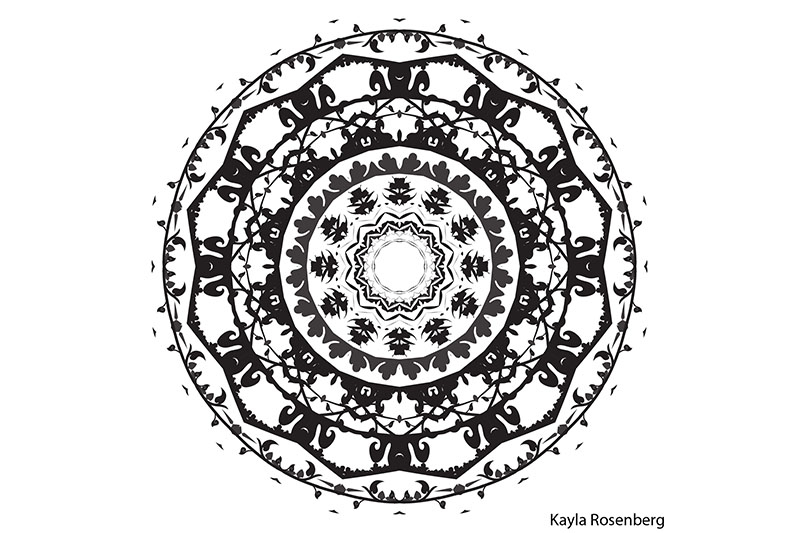
For this project, I designed a black-and-white personal mandala inspired by the intricate rhythm of traditional lace, combining woven geometry with organic plant silhouettes. I constructed the composition around reference circles and a 16-slice radial template, using repeating and reflecting transformations to duplicate each slice while keeping the inner ring as a standalone focal point. Because of how dense the linework got, I relied heavily on zooming in close and staying organized by locking, grouping, and hiding layers so different rings didn’t merge. Woven throughout the piece are personal easter eggs and symbols of patience and resilience—specifically the creeping vine tendrils, thorns, and leafy crests in the outer band. I played closely with CRAP principles, focusing on high contrast and proximity so the solid black forms and open white negative spaces feel balanced rather than cluttered.
Working with a drawing tablet and pressure-sensitive brushes pushed me out of my comfort zone. Before starting this, I had a hard time getting smooth, tapered linework digitally, and my marks often ended up either too rigid or unintentionally shaky. Practicing with pressure sensitivity allowed me to control stroke width dynamically, which was crucial for drawing the delicate vine curls, thorny edges, and scalloped rims. Using clipping masks helped me keep intricate overlapping shapes clean within my drawing boundaries without spilling over into neighboring slices. The process proved to me that digital illustration takes real muscle memory and deliberate pacing to get precise details down cleanly.
My favorite section of the mandala is the wide outer ring where the vine tendrils loop into sharp flourishes against the bold scalloped border. The contrast between the heavy black framing and the fine, airy leaf curls gives that outer edge a strong sense of motion. Looking back on the project, it changed how I perceive digital illustration; I used to just see the final image, but now I recognize the technical planning behind alignment, slice symmetry, and layer control. I’m excited to carry these linework and composition skills forward into my future digital art projects.
Colored Mandala Artist Statement
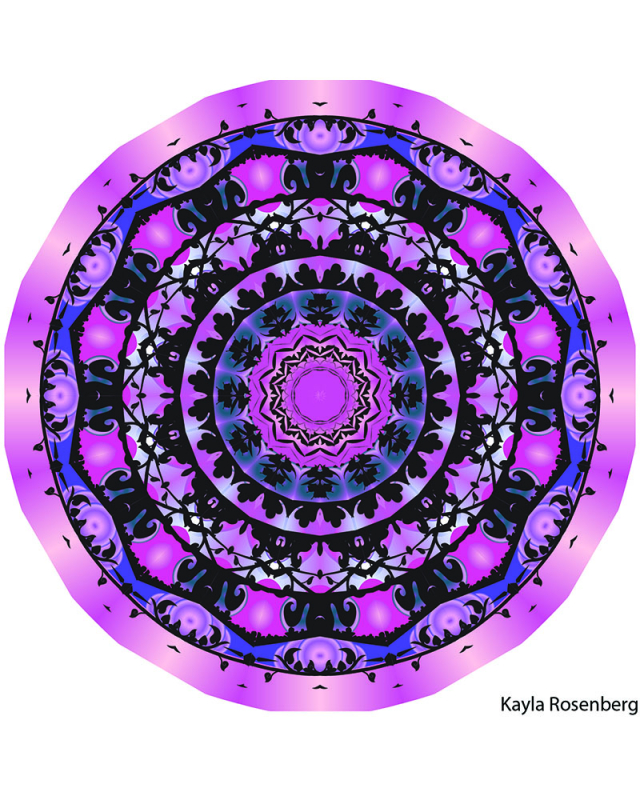
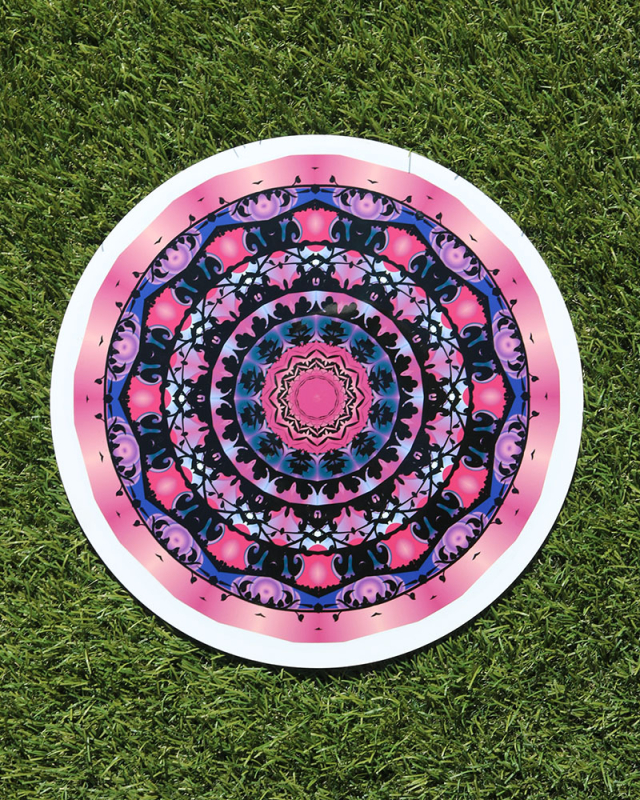
For this project, I took my original black-and-white linework and reworked it into a colored mandala. My first version was strictly about crisp, black-and-white shapes, but adding color completely shifted the mood and gave the whole piece a lot more depth. Upon seeing the printed colored mandala for the first time, my immediate reaction was how different and tactile it felt compared to staring at a backlit laptop screen. The physical ink made the magenta, purples, and deep blues appear much punchier and richer on paper. Seeing the physical object also made me realize how the colors guide your eye around the circle in a completely different way than the digital file, while still keeping the exact 16-slice layout, reference circles, and repeating transformations from before.
I picked a color palette of magenta, soft pink, deep violet, and bits of teal because I wanted the piece to feel bright, energetic, and a little dreamy. Instead of just dumping flat color behind the lines, I used colored fills and radial gradients that look almost like glowing orbs sitting underneath the black vine silhouettes. Switching from plain linework to color forced me to change my workflow completely. I had to get a lot more disciplined with grouping, locking, and hiding my layers so the background colors wouldn’t bleed over my pressure-sensitive line art. Using clipping masks kept the gradients clean and contained inside each drawing boundary without washing out the high contrast of the black borders.
What stands out to me most is the glowing pink and purple spheres nestled right under the dark, scalloped arches in the outer ring. I honestly didn’t think the gradients would create that strong of a 3D effect against the flat black shapes, so holding the finished physical print in my hands was a rewarding surprise. This project showed me how color and value contrast can redefine an entire design without having to redraw the actual linework. I’m definitely going to use these gradient techniques and layer-sorting habits in my future digital art projects.
Engraved Mandala Artist Statement
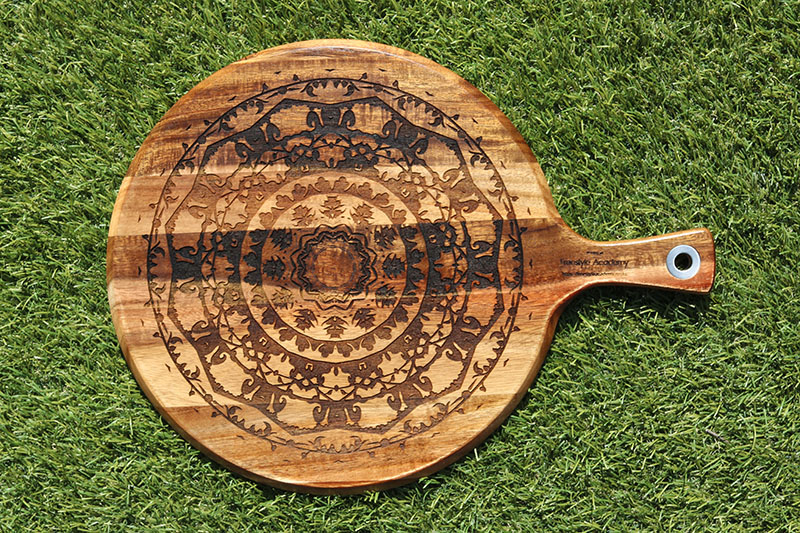
My initial reaction upon seeing the final laser-engraved mandala on my wooden pizza board was amazement at how precisely the laser cutter translated my delicate digital linework into a functional, textured object. When I compare my digital black-and-white mandala to the physical engraving, the piece gained a tactile, rustic quality that a computer screen simply cannot replicate. The crisp vector lines etched cleanly across the circular face of the paddle, giving the intricate lace-like patterns an organic permanence that feels both decorative and purposeful.
I chose a wooden pizza board for my laser-engraved piece because its natural circular form and handle provided the perfect functional canvas for a radial 16-slice mandala. Reflecting on the entire process—from setting up reference circles and repeating transformations to adjusting pressure-sensitive brush strokes—etching onto wood demanded strict attention to stroke weight and contrast. Because the laser burns the design without the aid of color, I relied entirely on line variety, negative space, and the rich contrasting grain of the wood to make sure the fine details and curved silhouettes remained bold and sharp.
What I am most proud of with this project is transforming a digital illustration into an authentic, everyday wooden artifact. Seeing the burned linework interact with the natural wood grain showed me how physical fabrication changes the way people experience digital art. Through this project, I gained a much deeper appreciation for the precision needed in both vector design and material preparation. I plan to carry these technical workflow habits and cross-medium design insights into all of my future digital and physical creative projects.
Mandala Build Video
Using Adobe After Effects, this video reveals the construction of the mandala stroke by stroke. Through sequential stroke reveals, kinetic timing, and motion graphics, the animation demystifies the finished design by walking through the concentric layers and rotational transformations step by step.
Entire Mandala Project Reflection
Working on the Mandala Project required bridging mathematical precision with organic self-expression. What started as simple vector paths in Illustrator evolved through animation in After Effects, laser engraving, and custom HTML/JavaScript web integration on WordPress. The greatest challenge and reward was seeing how a single cohesive concept adapts across wildly different mediums—from pixels and code to physical wood. It underscored how technical discipline in digital tools directly empowers personal storytelling.