
The concept of the Zenith project was to give students the opportunity to use the skills they had developed over their time at Freestyle to create something entirely new and original and something they truly wanted to make, outside of the usual projects and assignments.
My zenith project was to create a 3D Dance video. I was inspired by Dance Central which is an Xbox 360 game that I still occasionally play today. Similar to Just Dance, it challenges players to mimic the moves shown on screen and scores them based on their performance. However, unlike Just Dance, which features live-action dancers, Dance Central uses 3D models and motion capture technology to create its choreography.
This project is a new challenge for me because I have very little experience with lighting, and I’m also planning to redesign my entire character, which will put me under a serious time crunch. In my previous project, Narrative 2, I was mainly responsible for lighting, but I struggled a lot. We were pressed for time and had to prioritize rendering, so I never really figured out how to light scenes properly. Lighting feels really difficult to me, and this time, the challenge is even bigger because not only do I need to create good lighting, but I also have to animate it.
Maya Modeling
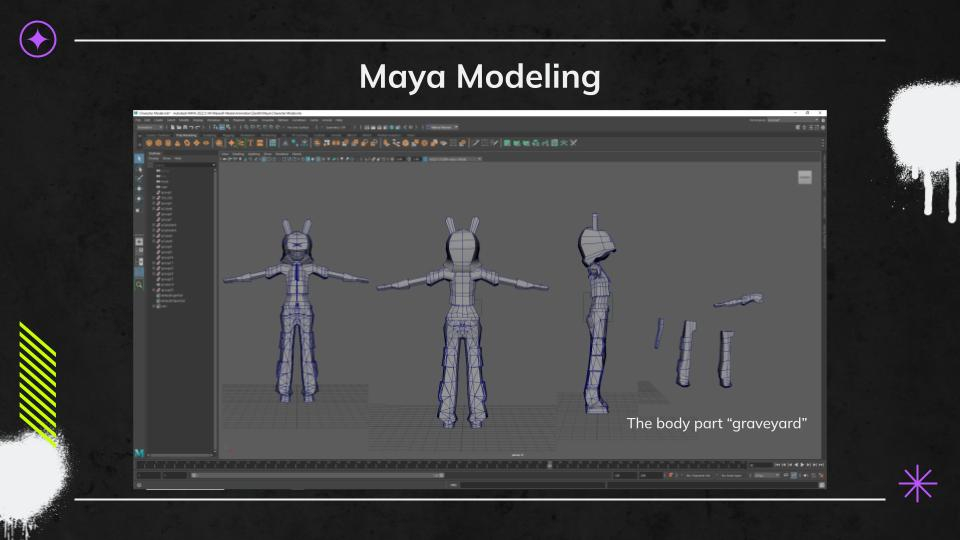
In Maya, everything begins as a simple cube. Extruding became my best friend throughout the process. I reused an old Maya model as a starting point to save time. I learned that models don’t need to be created as a single piece but instead, building them in separate chunks and combining them later is much more efficient. However, it’s important to avoid making shapes too thin, as this can cause major issues when importing into ZBrush.
Zbrush
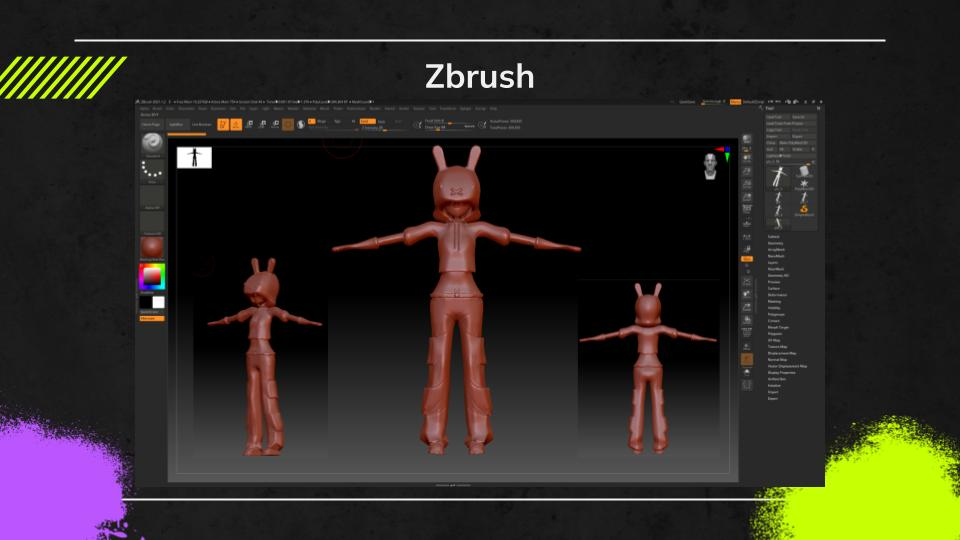
Working in ZBrush was one of the most challenging parts of the project. The interface was extremely difficult to navigate and is easily a 0/10 experience. I had to export both a low-poly and a high-poly version of the model. Managing face count was important: too high, and the computer would crash; too low, and the model would lose important details. I often had to go back and revise my Maya file multiple times to get a clean import. Although I don’t fully understand the functions of ZRemesher and Dynamesh, I had to use both tools to get the model to behave properly.
Substance Painter
Substance Painter was more straightforward compared to ZBrush. However, I noticed that the textures often looked almost non-existent from a distance, which is something I would want to change in future projects.

Audio Editing and Choreography
I edited the audio using Adobe Audition, which seemed like a good idea at the time but it ended up backfiring. I had forgotten that Maya often has compatibility issues with audio files exported from Audition, which caused unexpected problems later in the process.
The choreography was created during a single three-hour animation block. and luckily, I didn’t crash into any computers while recording the motion.

Motion Capture
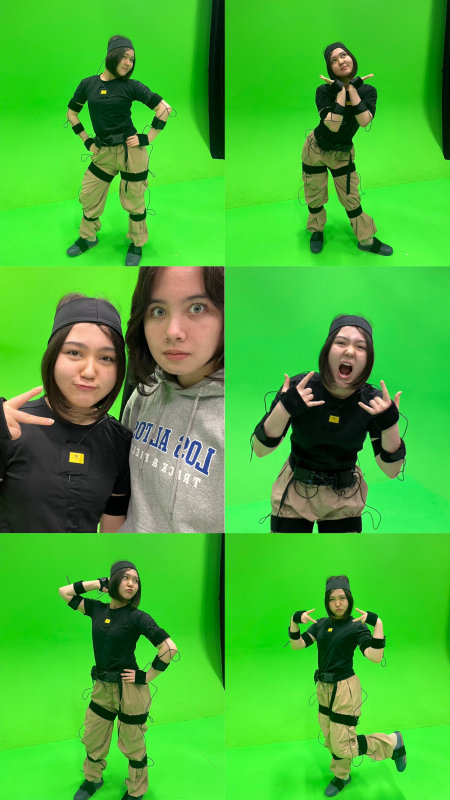
Putting on the motion capture suit always feels like becoming a science experiment. Ynez was there to help me capture it by being on standby. The experience is a bit weird, but it’s a key part of bringing the choreography to life in the final animation.
Editing Motion Capture in Maya
When editing motion capture data in Maya, the first step was deleting the X-axis movement. Simplifying the animation curves was necessary to make the data manageable, but I had to be careful since oversimplifying caused the animation to be unpredictable.

Rig & Hypershade
I added a basic skeleton to my model and used Hypershade to assign materials. Honestly, I still don’t fully understand what half the nodes in Hypershade do. I followed Mr. Cho’s tutorials step by step and hoped for the best. I’m aware there’s a lot of potential in this part, but due to time constraints, I wasn’t able to explore it.

Setting
The setting came together thanks to the internet. I found a downloadable gas station environment that fit well with the concept. The original Dance Central game often starts in random locations, so I leaned into that idea. I didn’t have the technical skill or time to build a transition from a realistic space to a club, so instead, I focused on shifting the lighting to create the effect of a scene change.

Lighting
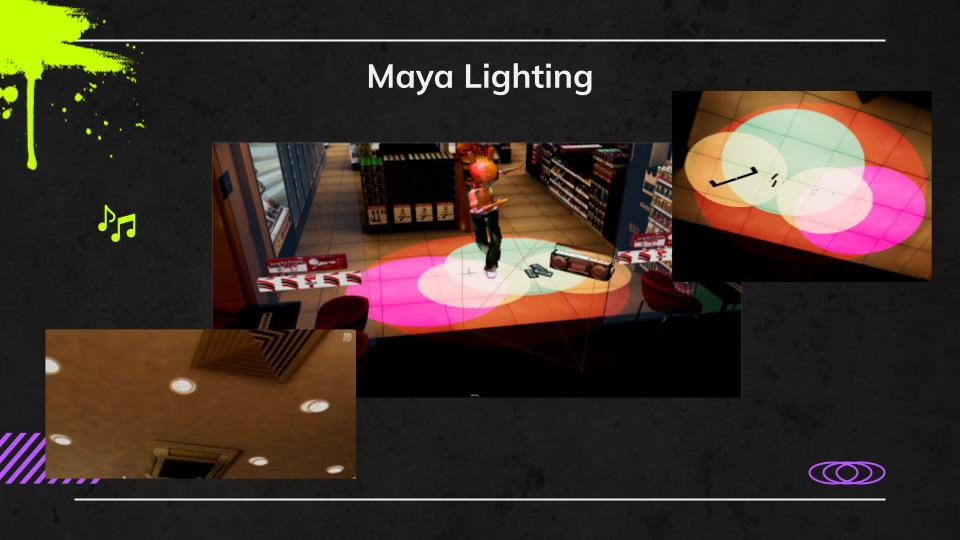
Lighting is still something I find difficult to understand, but this time, it didn’t look too bad so I kept it. I specifically wanted to improve my lighting skills for this project, and I do think I made progress. I learned how to animate lighting to fade in and out, and I also figured out how to use spotlights effectively.
rendering
This is probably something every 3D artist says, but render time is brutal.

editing
I did my final editing in After Effects. The process was relatively chill compared to everything else. At that point, I was mostly just praying the audio would line up correctly with the render.

Reflection
Reflecting on my final Freestyle project, the journey from the concept to completion has been very fulfilling, with my passion for dance and animation pushing me through. The idea for this project came from watching the previous years Zenith presentations. I was growing restless in my seat, and couldn’t stand sitting any longer. This inspired me to create something interactive that would break the endless cycle of sitting for hours on end. Inspired by games like Dance Central which merges dance with 3D models and motion capture, I aimed to combine animation with dance to not only bring my characters to life, but to bring everyone out of their seats.
This project was very new and challenging for me because I had very little experience with lighting, as well as the fact that I would have to redesign my entire character which put me under some heavier time restraints. In my previous project, Narrative 2, I was mainly responsible for lighting, but I struggled a lot. Since we were pressed for time and had to prioritize rendering, I never really figured out how to light the scenes properly.
The main programs I used throughout this project were Autodesk Maya which I spent the most time on. I created the base of my character, rendered, and did most of the animation on Maya. I also used Adobe Audition to edit audio, Adobe Substance Painter to add color to my character, and Zbrush to add details to my character.
Self choreographing was simpler for me as I was already used to making more elaborate dance pieces, so making a more digestible dance was easier, and yet also harder than I expected. While I was choreographing, I asked my classmates for their opinion on whether they would be able to do a movement or not. In the end, I decided to repeat many movements so that the viewer would be able to expect and grow used to what movement would be happening next.
Throughout this project, I’ve seen a lot of growth in my 21st Century skill of self direction. While managing many goals along the way with demanding finals, AP tests, and a major dance show, I’ve been able to learn how to set objectives, plan efficiently, and independently by managing my time well. I recognize that in the 21st Century skills, I could use more focus on social and civic responsibility due to the fact that my project did not promote public good and protect society, the environment, or democratic ideals.
Looking ahead, the skills I’ve gained from this project, especially in self-direction and technically proficient, will be the ones I use more in the future. As I enter and create new projects, I now feel more confident and ready to overcome challenges and turn my ideas into new creations thanks to my approach that I’ve taken for this project.
In terms of accomplishment, this project has solidified my passion for dance and has given me an opportunity to blend it with animation, something I’ve never done before this year. If I were to be given this opportunity to do this project again, I would most likely prioritize my time on refining my lighting techniques because I hope to add in missing details, and also add shadows and balance out the lighting.
Ultimately, I hope this project inspires others to discover the same joy in movement that I do. Dance is a creative outlet, and doesn’t just feel like mindless exercise to me as it brings me joy and excitement. I hope that others will be able to share this experience with me regardless of their skill level and find the fun behind dancing, as well as acknowledging the combination of 3D animation and dance, together to create something everyone can enjoy.
Advanced Learning Implementation
Our goal was to Increase your technical and artistic skills with Advanced Learning Choice Projects.
I feel like I improved my technical skills in 3D spaces within After Effects. I also enjoyed learning how to use Illustrator, especially discovering its 3D features. I found that I prefer using 3D elements in Illustrator over After Effects because of the faster render times and the final results. Overall, I’m glad I had the chance to try both.
Looking back on my Freestyle journey, I’ve valued my time using Illustrator the most. If I ever use Adobe programs in the future, I know I’ll return to Illustrator because it felt the most unique and useful to me. I feel that there are already many video editing programs that are easier to use than Adobe’s, and since I usually only make simple videos, my phone is good enough for what I need. Illustrator, on the other hand, is easy to use and I genuinely enjoy working with it. I’ve learned how to create 3D objects, use the Pen tool, the Paint Bucket, and many other techniques that I know will be helpful in the future.