Narrative 1
Freestyle Academy’s Visual Narrative unit centers around the following question:
“How well can you visually tell a structured story?”
Storytelling aspects are explored through our different classes with a variety of projects: flash fiction, illustrations, music, character walk cycles, narrative animations…
Throughout this unit I drastically improved in both my ability and my confidence to write stories and convey narrative ideas in various mediums. I valued the opportunities to grow in my writing skills with the flash fiction unit, to learn new software and visual art techniques in the illustration unit, to play music with my friends and then learn audio mixing and later learning software to compose music in the music unit… I had fun learning stop motion animation through animating a puppet I made myself, and I greatly enjoyed planning and bringing to life a narrative animation with my classmates, improving in my animation skills as a result.
The following page showcases the work I’ve done throughout these classes.
Flash Fiction
In our English class, we read through various short narratives such as the play “Red” by John Logan and “The Metamorphosis” by Franz Kafka. We analyzed usages of symbolism and other narratives devices, taking into note how each piece of a short story has important weight to the narrative’s function. We then started our own flash fiction writings.
With our flash fiction unit in English, we had various planning documents to think about character traits and motivations. Our story was to showcase some change within our character. We went through various questions to determine our character’s surface characterization, deeper motivations and wants, and how their struggle illustrates the theme of the story.
As for the inspiration for this story… I started brainstorming after listening to the lepidopterist by beetlebug a bunch of times. The only clear thing that really came from that song was that I wanted to have the main symbol / important object of the story be a butterfly. I settled on this idea of the main character being in the middle of moving out of their house, as that setting revolves around change and leaving the past behind to go somewhere new, yet this character is still hung up on parts of their past they never fully acknowledged and set free. Within our English class, we talked about symbolism and chose symbols to put within our stories. I already had the butterfly, which can symbolize change & moving through different stages of your life, which fits quite well in the story I wrote.
There is something—someone? in your living room.
You look up and startle after checking the time, dropping your phone you had just retrieved from the couch cushions. You didn’t notice it was missing until a good amount into working upstairs; you tried to turn on music, and then remembered the last time you did so was when packing the thicker jackets hanging in the corner down here.
Little hands phase through your sleeve; a childlike figure looks up at you with a slight frown. It wears your favorite sweater, oversized compared to its small body, and around its neck is a butterfly necklace you haven’t seen in a very long time.
After the seconds you spent standing still, staring, it walks forward, trying to pull you with it. You pass the piles of boxes in your kitchen, the ones by the stairwell, the line in the hallway that leads to the attic, all labeled in your messy handwriting. Your eyes linger on the open door of your room, closet and bookshelves in the disarray of the process of organizing. How was it 10pm already? You had thought you had lunch only a couple hours ago.
You pause when you’re guided to the untouched corner of the attic. The kid paws at a closed drawer. The spider hanging off the handle remains unphased until you reach down and gently detach it to peer inside the cabinet.
A butterfly, behind smudged glass, falls to the bottom of the wooden frame as you bring it close. Ghost hands pass through your own, trying and failing to grasp at the frame. You can’t see its face past the hair falling down, but you see its trembling hands and twitching movements as it buries its face in its knees. You slowly place the frame down between the two of you.
Your ghost sits with its arms curled around itself. It looks at the butterfly, pin crooked and bottom half of a wing fallen off the body. It looks at you, eyes starting to water.
You remember when she didn’t come to class anymore. Your mom told you she moved away. Why? Where? There wasn’t an answer to give you. You went back to sitting alone during lunch, the shade too cold and the sunlight too warm, the ants crawling under your toes and mosquitoes leaving itchy bumps on your arms. You had brought an extra cookie to share that day. A wasp crawled over it and stung you when you tried to shoo it away.
You sit across from your ghost, looking at the broken butterfly. It’s dark outside. Painfully quiet. You can see the dim streetlights from the attic window, moths circling around the lamps, constantly turning as the light distorients them. They’re lost, unable to see the moon and stars, flying aimlessly until they crash. You look at the child in front of you, head in its arms, softly crying.
“Do you want me to fix this for you?”
You pick up the frame and sit down next to yourself. A head nods, still not coming out of its protective shell. Its hand brings out the butterfly necklace, running its fingers over the metal.
“I’m going to glue it back together, ok?” You attempt to pat your ghost’s head. Your hand goes right through, but it doesn’t seem to notice, leaving you awkwardly hovering until you stand up and leave.
Glue… where would you pack something like glue? When’s the last time you did arts and crafts? Your mom would often encourage you to join art classes, trying to get you to meet new people, make friends…
Ah. You find an old bottle near the pantry. An open box of miscellaneous things you didn’t sort, glue sitting right by a handful of dusty hair ties. You head over to the table, grabbing a plate and some toothpicks as you pass the kitchen. You move a box and see your ghost’s head pop up, trying to look at what you’re doing. You bring over an extra chair so it can watch.
You pour out a drop of glue, dilute it with water, and mix it together with the toothpick. Carefully turning the butterfly frame over, you unhook and detach the backing. The pin is skewed and a section of the left wing detached, but otherwise, the insect is in decent shape. Your ghost scoots closer, head tilted to the side as you pick up the butterfly and place it onto a spare piece of cardboard.
“I don’t want to accidentally glue it to the backing,” you explain. The little ghost at your side nods, watching you intently, tearstains on its cheeks dried and leaving a slight crust of salt. It fidgets with the butterfly necklace as you work.
You add bits of glue and slowly adjust the pieces, trying not to damage the delicate wings with the ends of your toothpicks. When you’re done, you double check that it’ll dry in place properly, and clean up the supplies.
You wash your hands, shake them and try to clear your head. You pause on the stairs, watching a version of yourself wipe its face with the ends of its sweater, poking at the drying butterfly with transparent fingers.
You go back upstairs to finish organizing your room. You had wanted to finish the bookshelves today, and it’s already past midnight. You play music from your phone, get to work, and collapse into your bed when the last box is labeled and set aside.
When you wake the next morning, you find the dried butterfly on the table where you left it. A necklace sits on one of the chairs.
When you move into your new house, you place the repaired butterfly in clear view on the living room wall. You look at your reflection in the glass, the shine of a charm on an old necklace.
You’ll be okay.
Short Story Audio Production Artist Statement (click here to read!)
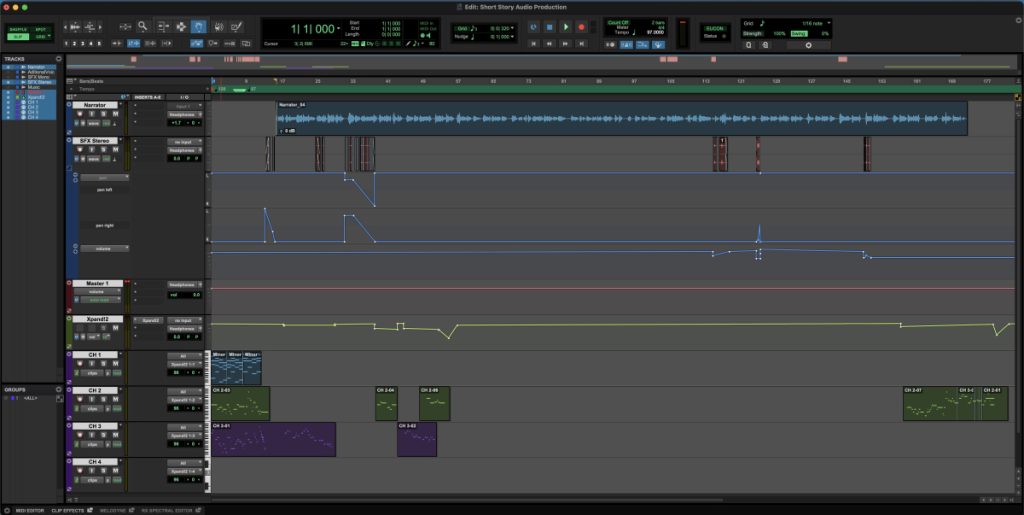
Within this project, I used music to set a mood and try to establish certain sounds/motifs with each of the characters, and used SFXs to immerse the listener in the world of the story. I think I did alright with this, although there’s always ways to improve and places I think I could’ve added more detail.
I’m proud of the music in this project, all of which I composed myself using Pro Tool’s Xpand!2 tool. I especially had fun with the intro music. Throughout this project, I started trying to associate the violin sound with the main character and the music box with the ghost, and created a motif for the ghost that I then repeated in a major key in the final violin solo to emphasize the happy tone to the ending & the change the main character has gone through with accepting this ghost and reconciling with their childhood self. If I were to spend more time on this project, I would want to compose more music to make more clear the association of the music box & violin with the two characters in my story, and add more music to emphasize emotional moments, especially wanting to add music & SFX to the middle/climax of the story.
I appreciate learning how to produce an audio-only story, as it challenges me to think about how to convey my creative vision solely through narration, music and sound effects, mediums I don’t often work with. It’s a challenge I find interesting, and I value the opportunity this project has given me to practice these relatively new skills. I’m glad to have more options and skills I can use for creative projects in the future.
Before starting this flash fiction unit, I practically would never write anything if it weren’t for a school assignment. There were various things I struggled with throughout the writing process, but I ultimately discovered that flash fiction and shorter snippets of stories is a format of writing I can find joy in creating. I greatly appreciate the opportunity I was given through this project; not because I’m particularly proud of my end product, but because of the self growth I went through as a result, and the fact that I now find myself writing little flash fiction snippets when I have free time.
Exquisite Corpse
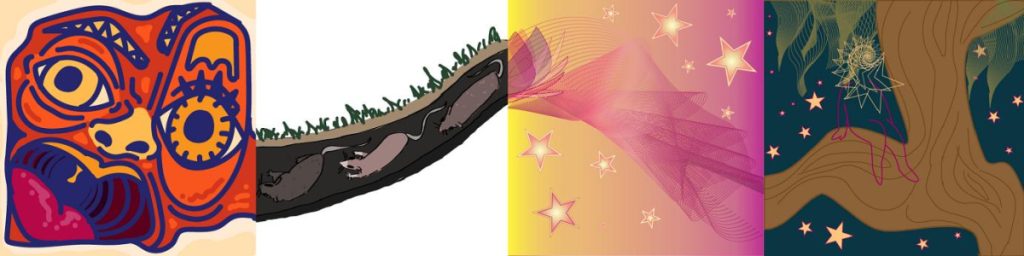
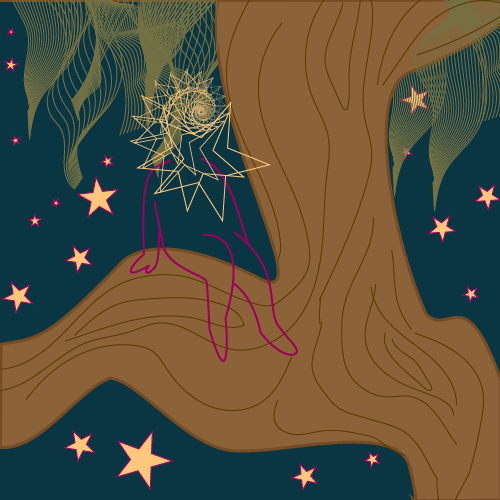
In groups of four people in our Digital Media classes, we used our skills within Adobe Illustrator to digitally make an Exquisite Corpse game: each person is given a blank canvas with a marked starting and ending point of where their illustration should be, and everyone individually makes something without knowing the other’s illustrations until the end, where it’s all compiled as one continuous image.
In my illustration for this project, I utilized various skills we learned in Adobe Illustrator. The pen tool and blend tool, which I talk about down below in the illustration project… I also used the shape tool for all the stars. Additionally, there’s also a feature in Adobe Illustrator that lets you compute copies of a shape, which I used to create the start that repeats, getting smaller and spiraling, for the ‘head’ of the character in my illustration.
Illustration Project
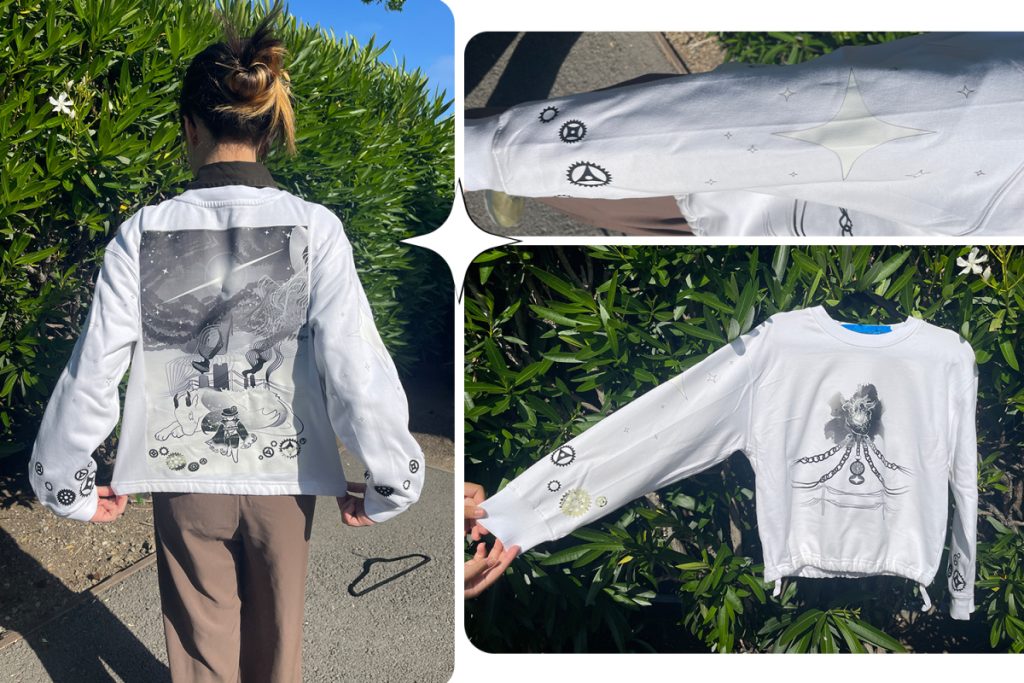
“running out of time” Artist Statement
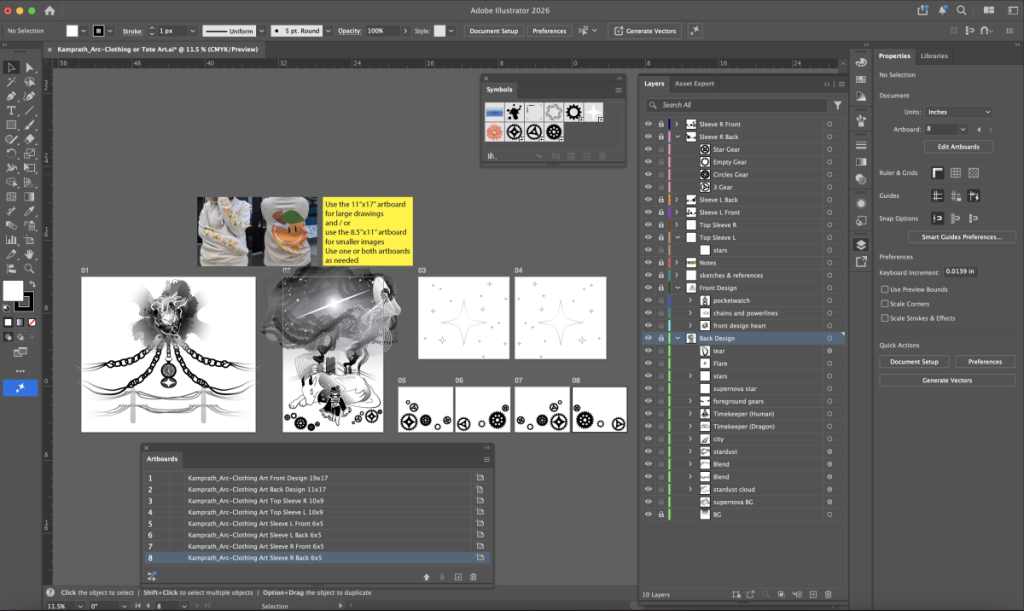
Digital drawing in Illustrator is very different from my experience with other drawing programs or pencil and paper drawing, as the majority of my workflow utilized illustrator’s pen tool in order to trace over a paper sketch of my design. That pen tool works by creating anchor points for the path of a curve, and editing the strength of the curve for each section of the line until you get the overall shape you want. It ends up being very useful, as you can make shapes within illustrator and edit them to be various colors or gradients. Majority of my artwork consists of dozens and dozens of these custom shapes, layered and colored to form the final design. I viewed the workflow similarly to how I created paper puppets for animation in the past; cutting out shapes and layering them on top of each other until it looks correct (at least from the front).
I chose to create a clothing design because I wanted to have my art on some item I would use often, therefore it would become more meaningful to me. The design of this shirt is based around a character I made for a story being worked on by me and some friends. I have a lot of fun making art for that story, so the idea of making some shirt design based on it was very appealing.
For the first attempts at heat pressing my design onto this shirt, the ink actually didn’t transfer that well, leaving a weathered look that made parts of the design hard to see. This was fixed by printing a second time on top of the previous ink. However, I chose to keep the weathered look for the bottom part of the back design + part of the sleeve where it had happened. Partially because it was difficult to align the pieces properly, but also because I liked the weathered look, and thought having the character visually fading away would be interesting with the context of the story (this being a character who is slowly dying). This production is valuable to me because it is highly personalized, and I now have a piece of wearable artwork that will last for a very long time.
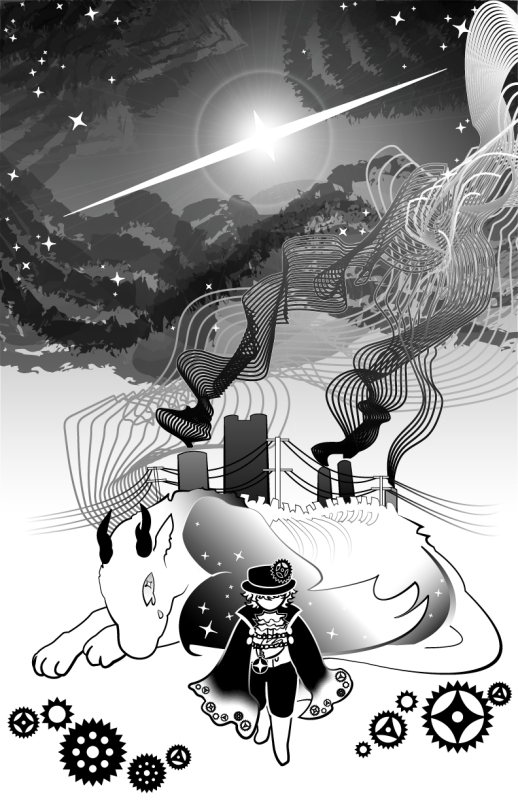
This project was a lot of fun to work on. Digital Media class taught us how to use Abode Illustrator, and our culminating project was to use the software to make some design we could print out onto a physical product. I chose to create a shirt design, designing pieces for the front, back, and sleeves of my clothing piece.
Mentioned in my artist statement above, majority of the shapes in these illustrations were made with Illustrator’s pen tool. Another main skill I learned and implemented through this project was Illustrator’s blend tool. This tool allows you to choose two shapes, or lines in my case, and have the computer create a chosen amount of shapes in between them, slowly morphing from one shape to the other. This was used to create the line patterns shown in the smoke and the surroundings of the supernova: I drew the surrounding starting and ending lines of each shape, and had the computer calculate all the steps in between.
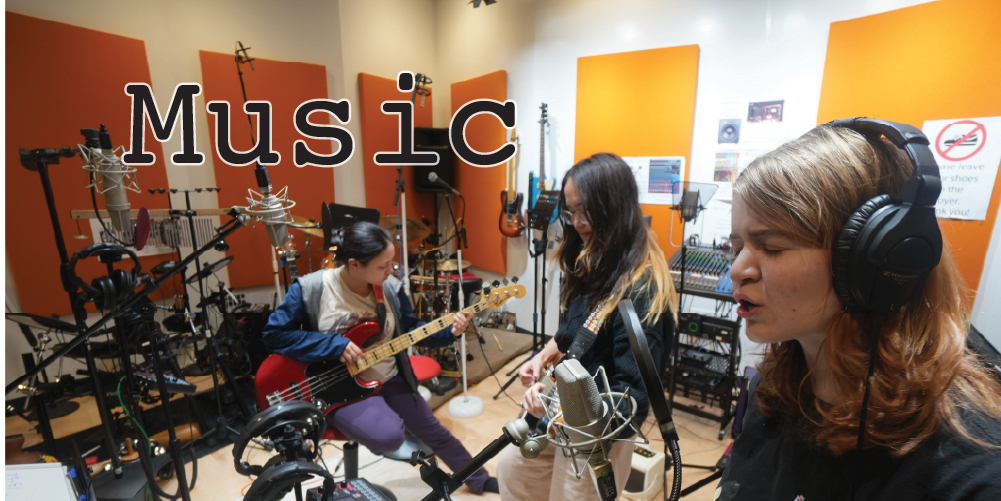
This Digital Media unit focused on producing music: knowing what it’s like to record in a studio, learning how to mix audio of multiple instruments and voices, and creating original music with the instrument plug ins within the Pro Tools software. As someone for which performing music has always been a big part of their life, I was pretty excited for these projects. I’d never created my own songs before, but was eager to try, and it was certainly well within my comfort zone to learn and perform songs. As a result, I chose to join two different groups for the Music Recording Project instead of just the expected singular one.
Music Recording Project
▶ From the Start
⏸ From the Start
▶ Hollow Moon
⏸ Hollow Moon
Within the music recording project, we were to form a group with some classmates (or friends outside of Freestyle, but at least one other Freestyle student) and perform a song within Freestyle’s recording studio to be recorded. I had two different friend groups that wanted to perform songs I enjoyed, so I decided to take on an extra group for this project. With Laufey’s “From the Start”, I already had learned the song on ukulele awhile back and enjoyed playing and singing that song. For “Hollow Moon” by The Crane Wives, me and those friends love that band, so we wanted to choose a song by them. I taught myself to play guitar for that recording, slightly shifting the techniques I learned through teaching myself to play ukulele in the years prior. I had a lot of fun playing music with my friends for this project, and learned lots of valuable knowledge on audio mixing.
“From the Start” Group Artist Statement
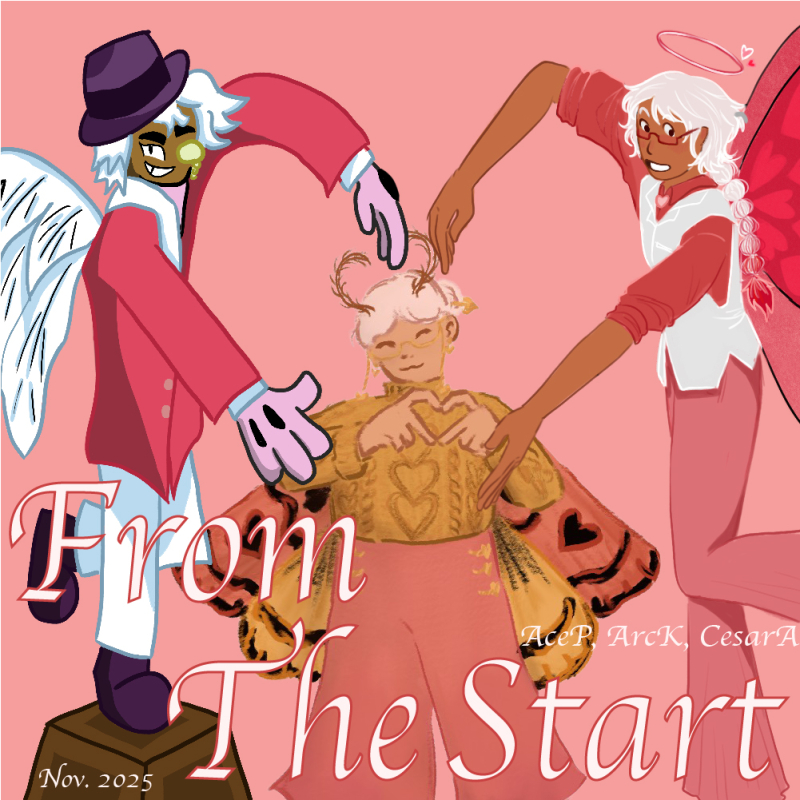
To use a song that we were already familiar with, our group recorded a cover of Laufey’s ‘From The Start’. Beginning with the ukulele instrumentation (done by Arc Kamprath) followed by the vocals done by all three of us.
“When first going into the recording studio, I felt a lot of… unsure-ness, and I didn’t want to break anything. However, once I got used to the environment and we started to record I got more comfortable and moved out the fear of breaking something” – Cesar A.
“I went into the studio early to practice on the instruments, and spent some time just getting used to playing on the unfamiliar ukulele. I was still pretty nervous while we were recording, though, and realized later that I had taken the song way over tempo. However I did have fun throughout the process, and think the end result turned out pretty good.” – Arc Kamprath
“Entering the recording studio for the first time I was so impressed by the incredible technical set up. Knowing that it was comparable to an industry recording room everything felt weirdly surreal and professional whilst in the recording booth. ” – Ace Penn
We were unfamiliar with the technology in the recording studio, and the set up appeared pretty intimidating. But with the help of Mr. Florendo, we got acquainted with our surroundings swiftly. We learned the process of recording multiple vocal and instrumentation tracks, and how to set up the technology so we could listen to our recorded backing track as we sung. Afterward, we all learned the Pro Tools software to mix together the different vocal and instrument tracks. Overall we felt that working in an industry-standard recording studio was very enjoyable.
“Hollow Moon” Group Artist Statement
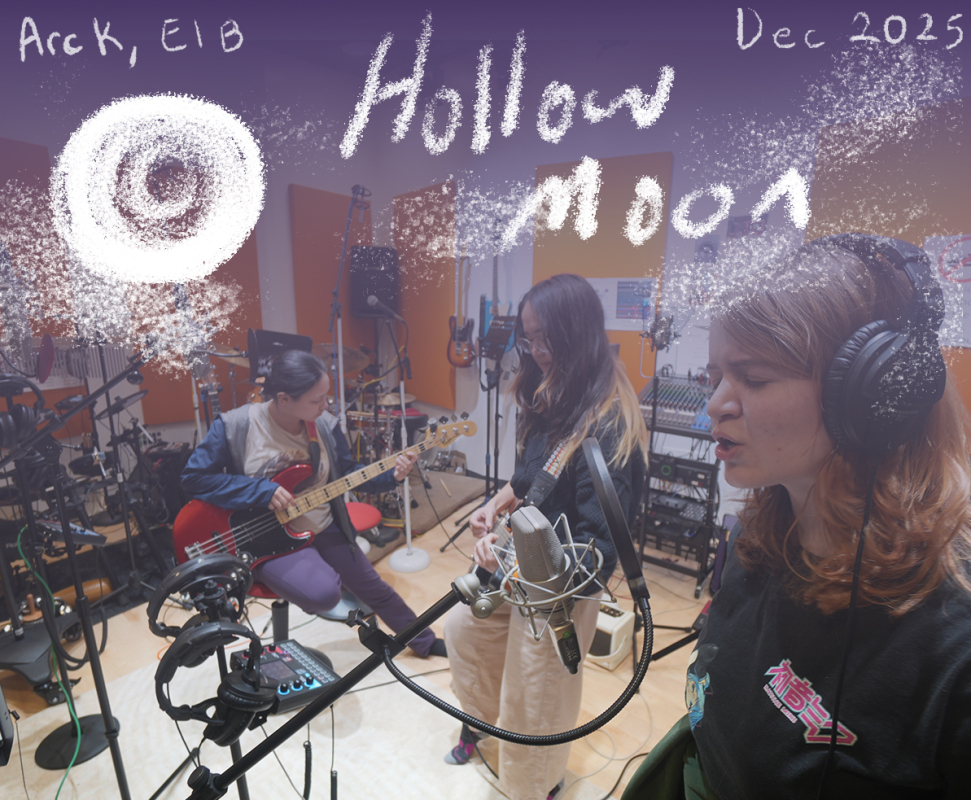
The three of us all listen to the band the Crane Wives, so we decided to learn and record their song “Hollow Moon”. We split the vocals up, making the verses solos with us all joining in on the choruses, and had Arc Kamprath on electric guitar, Kira Pelkofer on bass guitar, and El Baltz and the rest of the group on vocals. In the end, we were only able to learn the instrumental for the first 2 thirds of the song before the recording session, so we didn’t record the full song.
Our takeaways from recording in the studio are that learning the technical side of recording is quite difficult. We didn’t really know how complicated recording sessions were; we assumed that you just went into the studio and performed your song. Seeing the different parts that go into recording something with multiple instruments and singers, it was a lot more complicated than we thought.
We had two guitars and three singers, so the process had lots of layers. We recorded the instruments first, doing multiple takes with different mics and recording methods to see what sounded better, and then set up three mics to have us all sing at once. We learned how to set up the headphones in the recording studio so we could listen to the metronome and the instrumental track as we sang. After recording, we learned how to use Pro Tools in order to mix all the audio tracks of the individual instruments and vocals from the session together.
Through this project, we learned a lot about how recording technology works, and had lots of fun performing our song. We look forward to possibly learning more songs and recording in the studio again.
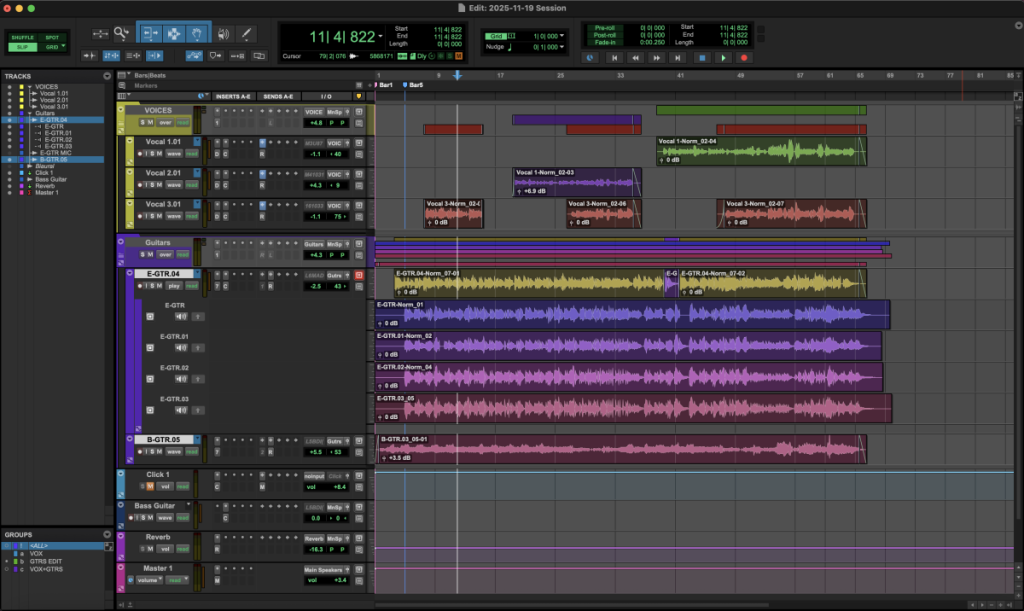
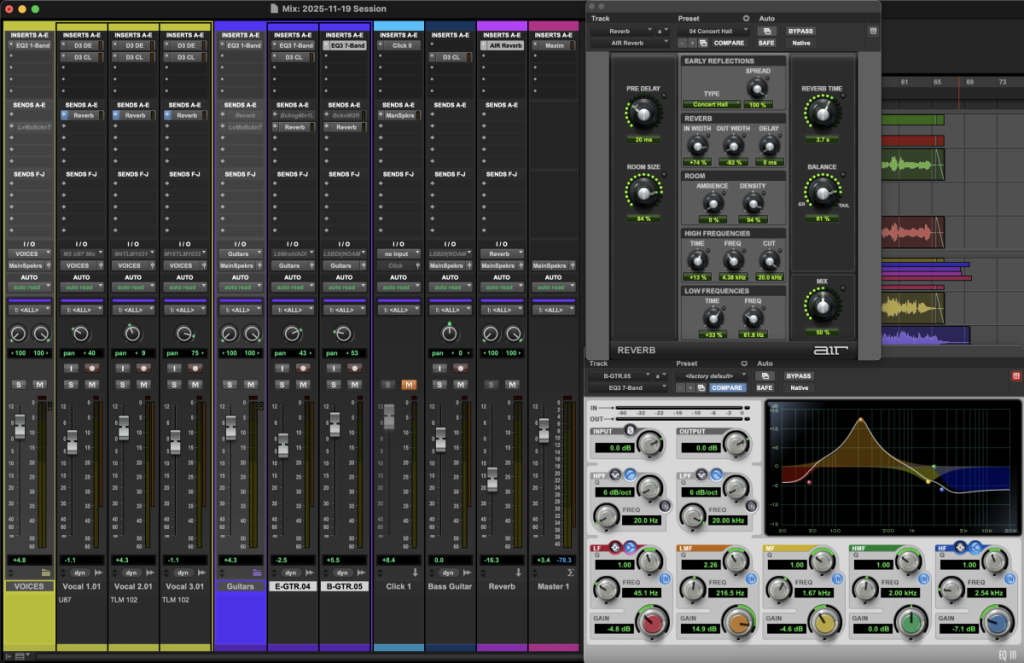
I ran into various problems with the audio mixing for these projects of which I had to find workarounds for, especially with Hollow Moon. All the singing audio for me specifically had huge static in the background, so I grabbed the audio from someone else’s mic for that section and bumped up the volume. I found the bass guitar was a lot quieter in the recording than I wanted it to be, so I played around with amplifying and quieting down certain frequencies of the audio through a plug in. Aside from the various issues that occurred, majority of the workflow was picking which recording or parts of a recording take sounded best, editing them together, adding some reverb and adjusting individual track’s volumes until I was satisfied with the result. I learned a lot of little tricks to the Pro Tools software through this process, which has been valuable for other audio projects.
Experimental Music Project
▶ Under an Ocean of Stars
⏸ Under an Ocean of Stars
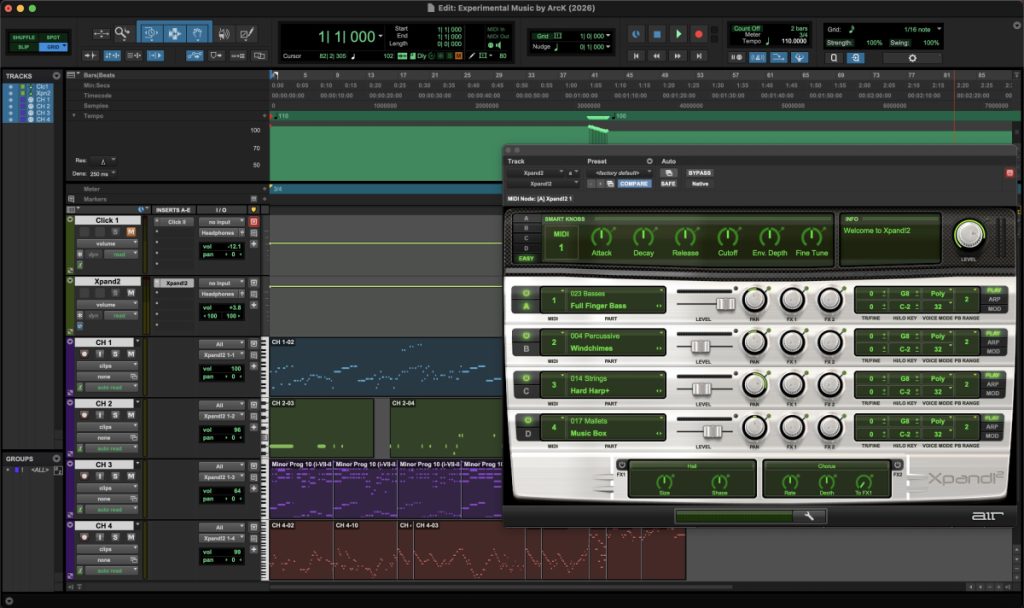
Quite possibly one of the Freestyle projects I’m most proud of so far, this assignment entailed using the various MIDI instruments within Pro Tools in order to create an original song. Despite me being in music ensembles at every opportunity since 5th grade, I never really studied music theory, but I had enough basic knowledge from understanding how to play violin and marimba that I was able to have some sort of process to make this song. I picked a random chord progression I thought sounded interesting, figured out what key it was in (it was something like B flat minor if I remember correctly), and played around in that key to create a melody on top of my chord progression that I then edited over various 8 bar phrases for the rest of the song. I had a lot of fun! The instruments I ended up using were a music box (for the melody), harp (for the chords), bass (for. bass. yay), and some wind chimes (because the Xpand!2 tool in Pro Tools can use up to 4 instruments in one group, I only had three so far, and thought some twinkly noises could be fun).
“Under an Ocean of Stars” Artist Statement
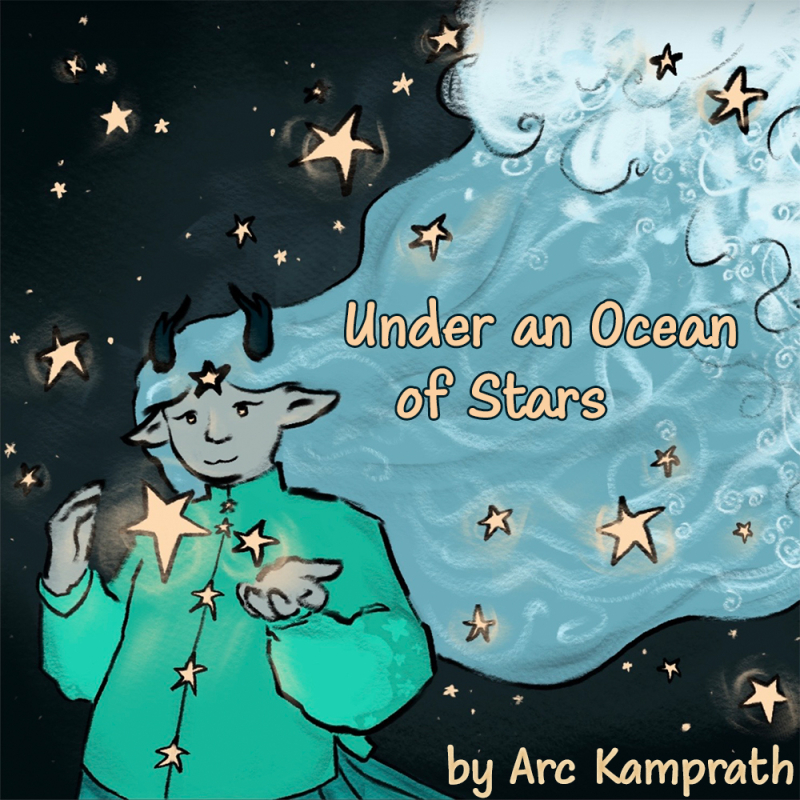
When producing this music, I was thinking of video game music and music box covers of songs… I wasn’t really thinking of any specific songs for inspiration, I just knew I really liked the sound of a music box and wanted that for the melody of this song. I thought it would be fun to create a theme song for one of my original characters, but ended up not thinking of any specific characters to relate the music to until I was already done producing the song. I decided to associate the song with my character named Nova, as the shimmering quality to the wind chimes and music box in the song reminded me of the stars associated with that character, as well as the relaxed & playful/happy vibes of the song fitting pretty well.
I’m proud of the ending section, as I learned how to program a ritardando into Pro Tools so I could have a gradual slowing down into just the music box playing the beginning melody to end out to the song. I also had fun with the bass line for this song. I like the ascending line starting at around 26s in, and the bass part leading into and during the final louder section before the drop off into the music box solo was also fun to play around with while composing. For the rest of the song, the bass is mostly there to accent the bass note for the chord progression in the harp part, as those lower notes were rather hard to notice when it was just the harp and music box in the early production stage of this song.
I really appreciate learning how to use MIDI virtual instruments, as it’s given me a method to produce my own music. I’ve wanted to get started in producing music for awhile now, but never really knew where to start, so having access to MIDI instruments with Pro Tools let me finally start experimenting with that. I had a lot of fun with this project, and will definitely be experimenting and producing more music in the future when I have time.
The main tool used within Pro Tools to create this song is called Xpand!2. It utilizes MIDI instruments, programing ‘blocks’ of different notes that then each tell the computer to play back certain noise samples for certain time periods in order to digitally synthesize your chosen instrument playing your programmed melody. Xpand!2 allows you to use 4 different MIDI instruments, adjust their individual volume levels, and pan them to the left or right within the headphones.
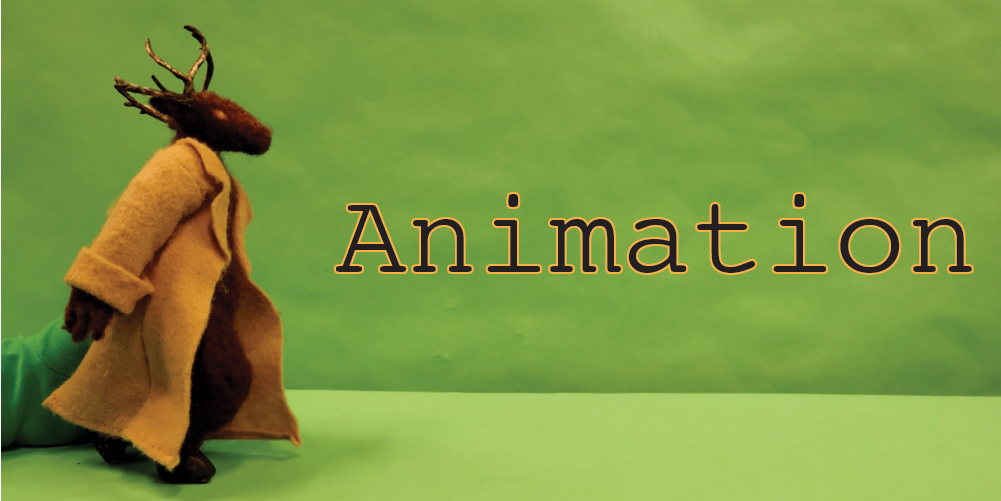
Stop Motion Puppet
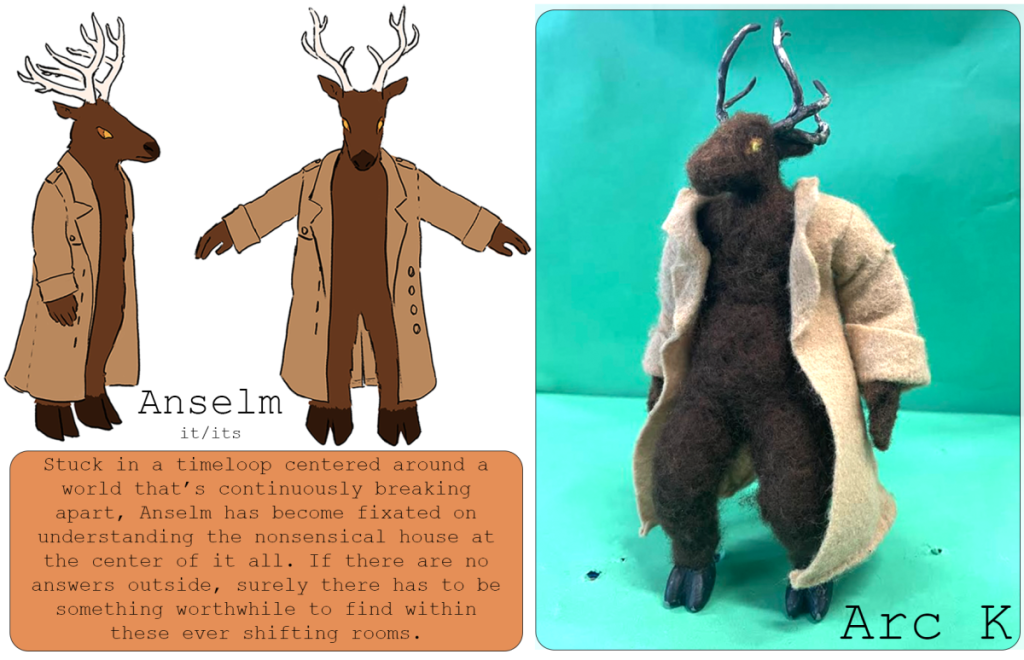
Throughout this Animation unit, we animated a walk cycles of a stop motion puppet we handcrafted, 2D animated a digital walk cycle, and then compiled them together to loop across the screen. Before doing any of that, we had to create reference sheets for our character. I choose to use the same character for both walk cycles, although we technically could’ve chosen to do two different ones. I used an original character of mine I thought would be fun to make into a puppet.
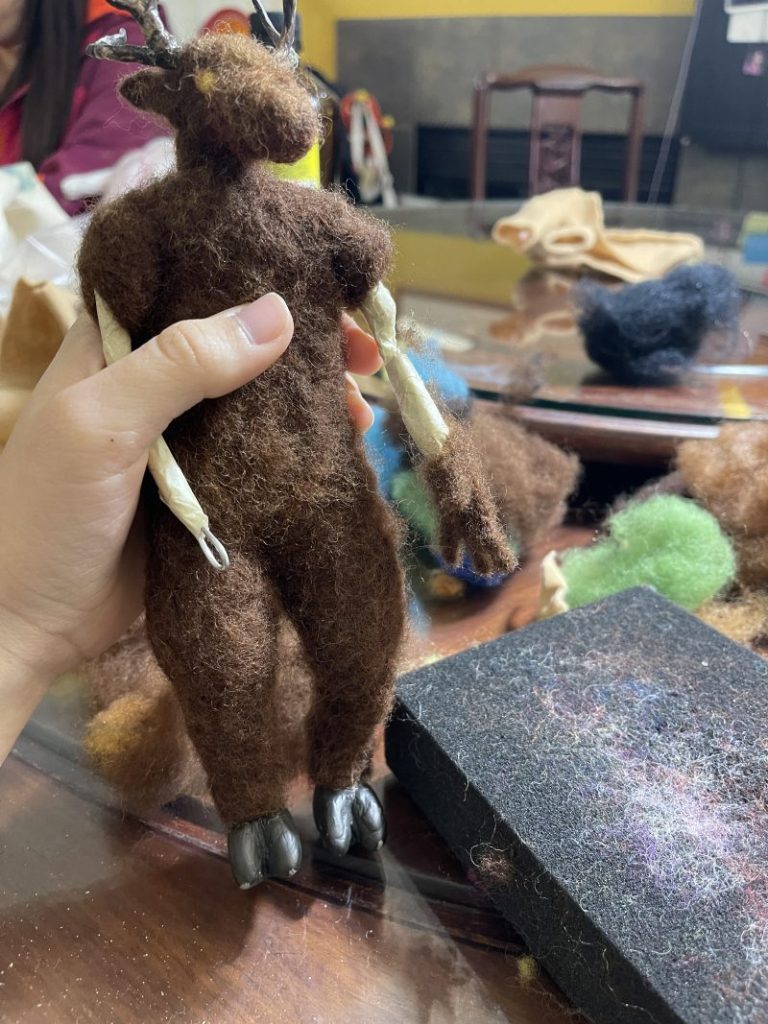
This puppet was certainly a labor of love, and was worked on for multiple weeks within my Animation class. I learned several new skills on my own in order to make this puppet how I wanted it to be, learning needle felting, creation of sewing patterns, and how to operate a dremel being the main completely new ones. I enjoy crafting things with my hands, and had lots of fun working on this project.
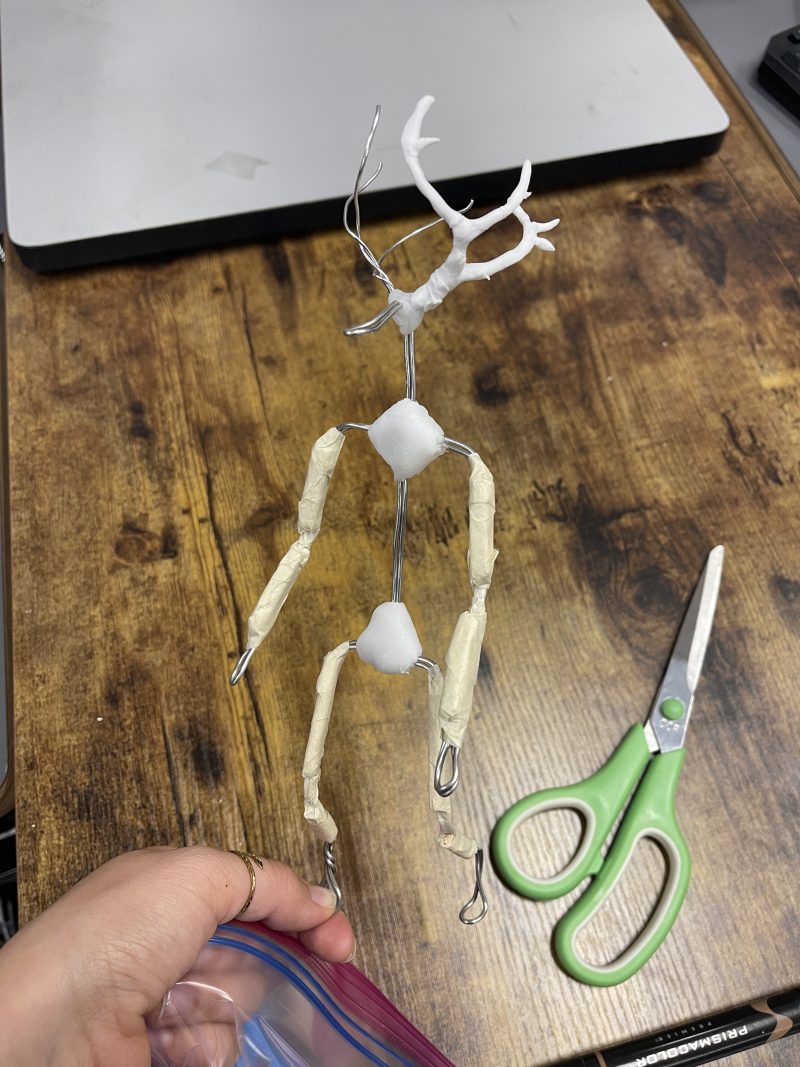
Our puppets were created with a wire frame base, key joints crafted with melting plastic and stiff sections of limbs created with disposable chopsticks and plenty of masking tape. For the antlers of my puppet, I originally tried using the clay we were given, but found its texture too soft and unable to harden as it dried as I would want, so I later switched it out for the same epoxy clay I used to create the hoof shape.
For the feet of the puppet, our animation teacher gave us pre made, 3D printed foot shapes. However, these feet were rather big and shaped like a human shoe, and my character was a deer with hooves. With the advice and supplies from one of my friends (thank you Jacques!!!), I used a dremel saw to cut off near half of the original 3D printed foot, re-crafting it and molding a hoof shape out of epoxy clay. I used this same clay to coat the antlers. After the epoxy clay dried, I painted the hooves and antlers with acrylic paints.
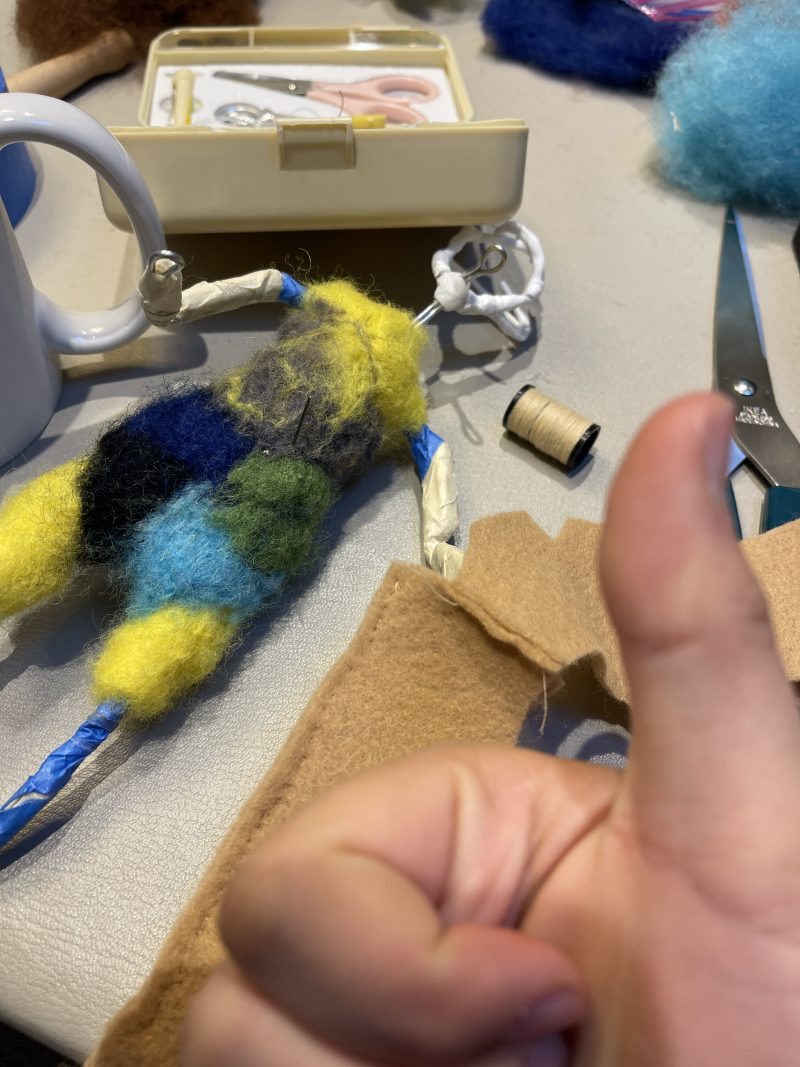
(well. I only accidentally stabbed myself a couple times)
The next new skill I learned for the creation of this puppet was needle felting, the process of repeatedly stabbing wool with specialized barbed needles in order to condense it into your desired shape. Once again, I acquired supplies and knowledge from my friend Jacques, holder of many various craft supplies. Majority of the puppet making process was spent on needle felting the fur, as the needle felting process is very time consuming.
I additionally taught myself how to make a sewing pattern through this project. I searched up sewing patterns for a doll’s trench coat, all of the good ones being locked behind paywalls, and decided to make one myself. I made a mock up design out of paper towels that I used tape to mimic sewing it to test its 3D shape, and when I had something that looked like a trench coat, I cut out felt in the same shapes and sewed it together.
I wanted to have the textural contrast of the needle felted ‘fur’, the clay bone of the antlers / hooves, and the trench coat fabric, leading to the design material and creation process choices I made. In the end, I was very happy with the finished puppet I created, and left with a newfound interest in physical arts such as needle felting.
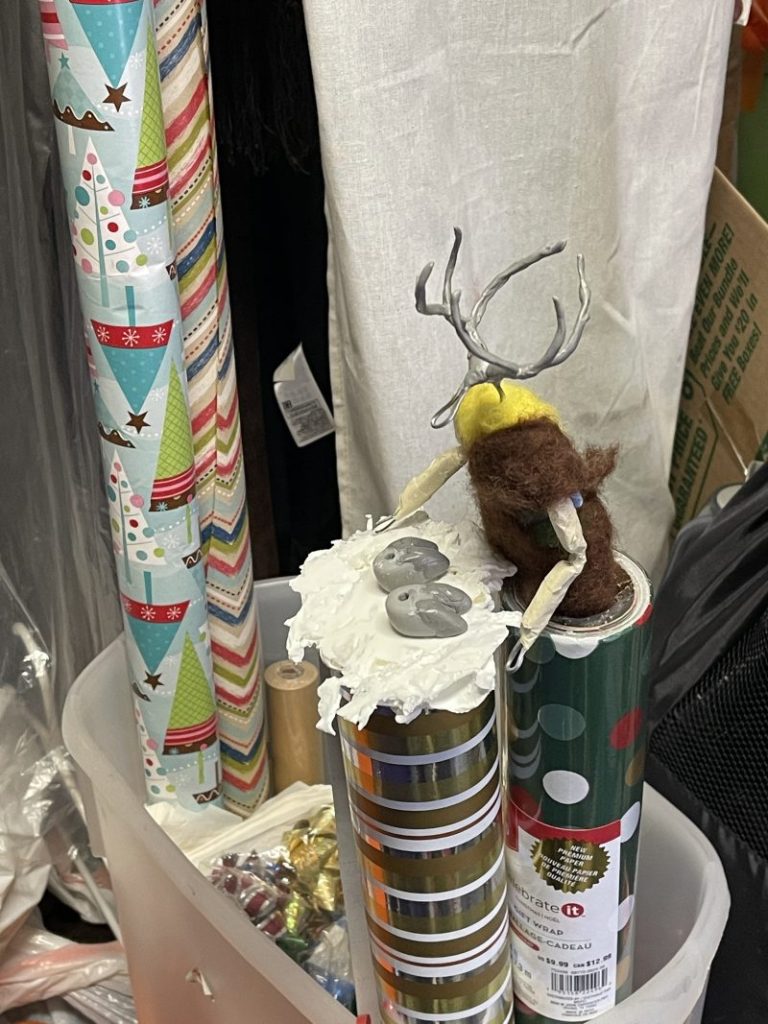
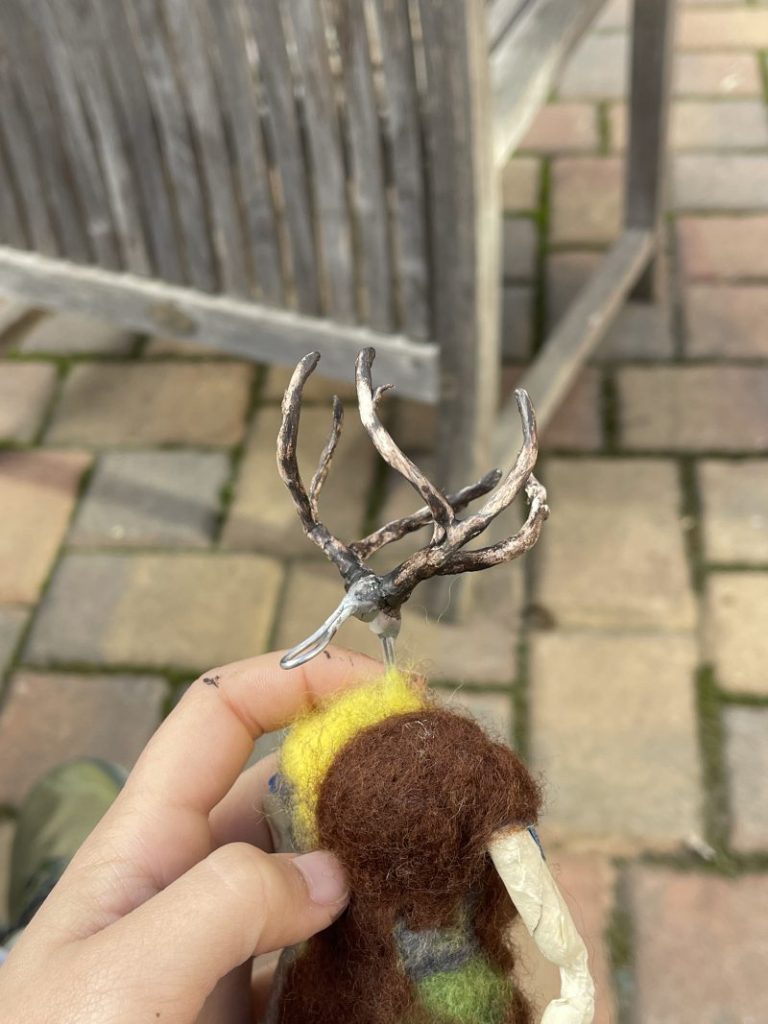
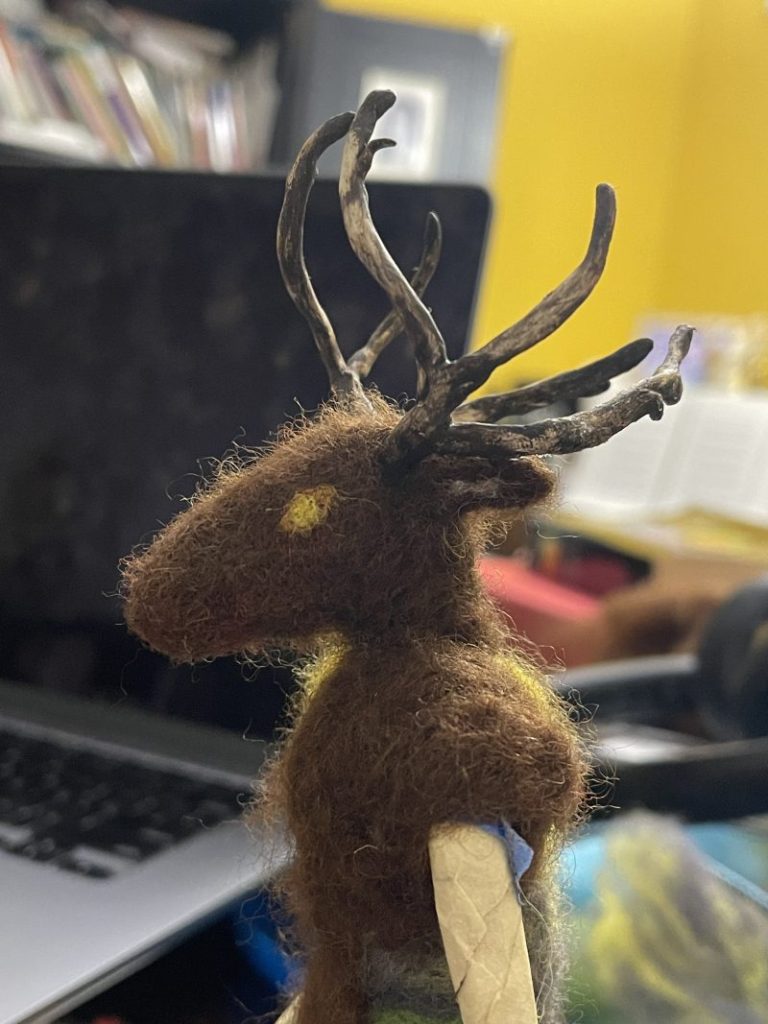
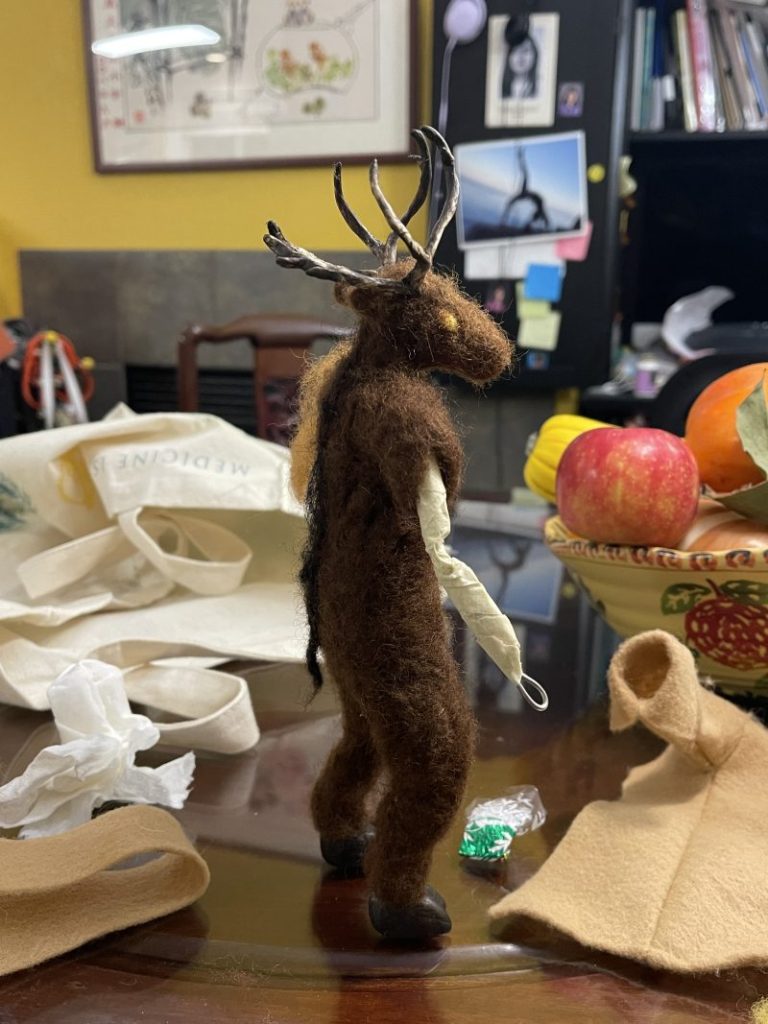
The end goal of this whole creation process was to film a stop motion walk cycle of our handmade puppet. This was done with the DragonFrame software, the same one we used to digitize our flip books from earlier assignments. We filmed on a green screen setup that could be edited out later.
After filming our stop motion walk cycle, we were to animate a 2D drawn walk cycle in Adobe Photoshop. With these two walk cycles, I composited the clips within Adobe After Effects, using a background image found on unsplash that was edited into various foreground and background pieces. The walk cycles were looped over and over, each clip starting at a different point to give the illusion of the character walking across the screen. Shadows were added by creating a duplicate of the walk cycle, changing its color, opacity, size, and position until it followed the main walk cycle like a shadow. If I were to do this project again, I would’ve re-filmed and re-animated the walk cycles while paying more attention to how the walk cycle loops, cross referencing the first and last frames with each other, in order to avoid a glitch / jump within the smoothness of the animation due those the first and last frames of the walk cycles not alining well. Despite this, I am quite proud of the final product, having put lots of work into the steps along the way.
Narrative Animation
The Narrative Animation project… possibly the largest project of Junior year animation class. We formed groups of 3-4 people, and were tasked with creating a ~1min animation with some narrative to it. My group’s animation ended up being 2min long… We collaborated with crafting the story, characters, backgrounds, etc, splitting up the work and scenes in order to finish this whole project within 5 weeks from start to finish.
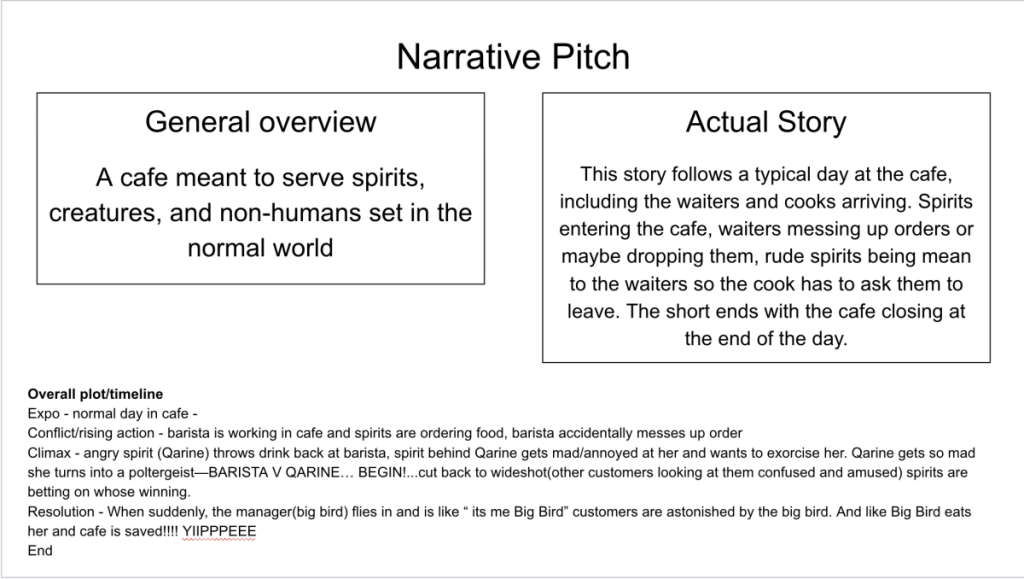
The pitch of the setting was this cafe for spirits, the story following a typical day in the cafe setting. The conflict of the story being this one really rude customer (her name started out as Karen, but the spelling and pronunciation shifted to Qarine along the way) continuously asking for her drink to be remade, and then the manager (who is a big bird) eats Qarine (a spirit based on a bug) and the story ends. yay 🎉
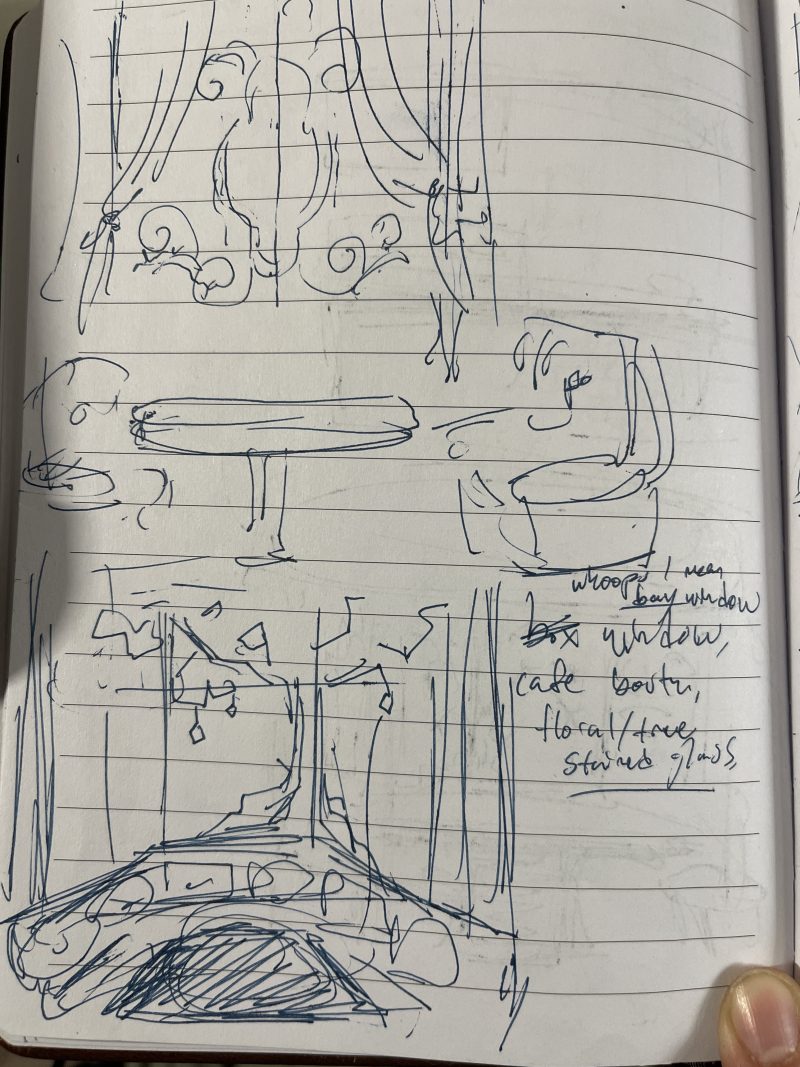
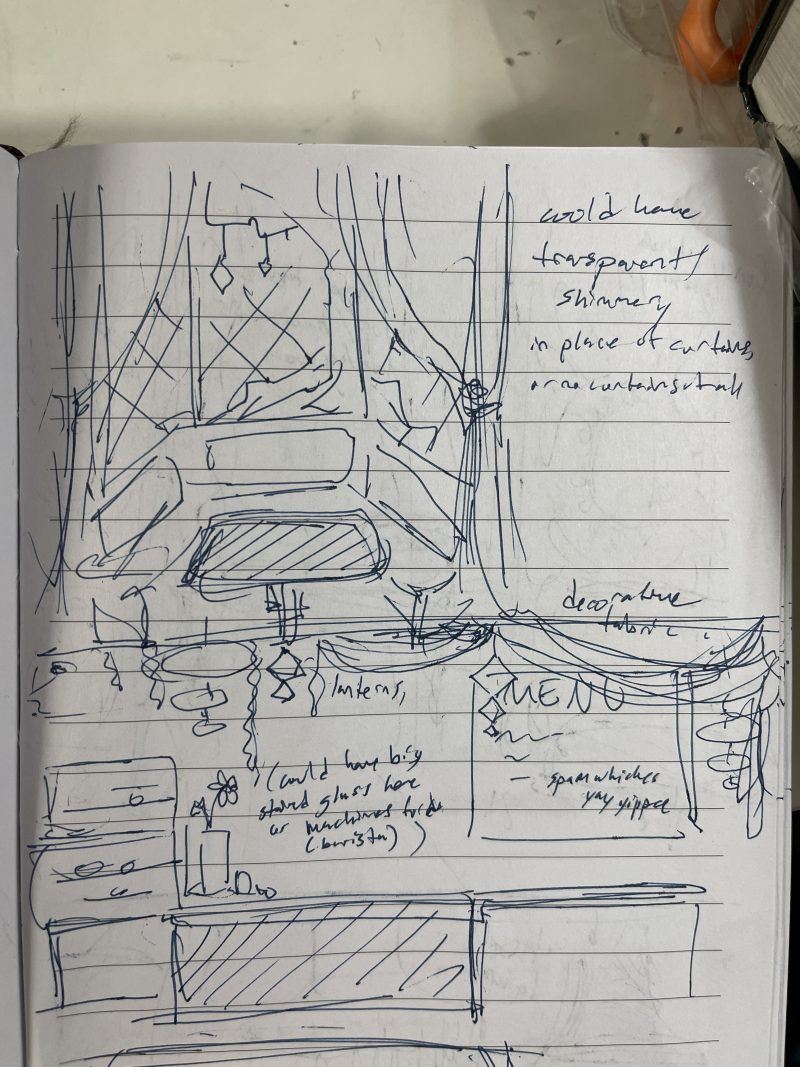
Lots of the initial work I did for this project was planning out backgrounds for our cafe. I was really attached to this concept of a bay window seating booth with fancy stained glass… Ace, who was also working on backgrounds, loved it as well, but when it came time to plan out the cafe’s floor plan, we couldn’t find a good space to put the bay window. We were struck with despair. We loved the bay window.
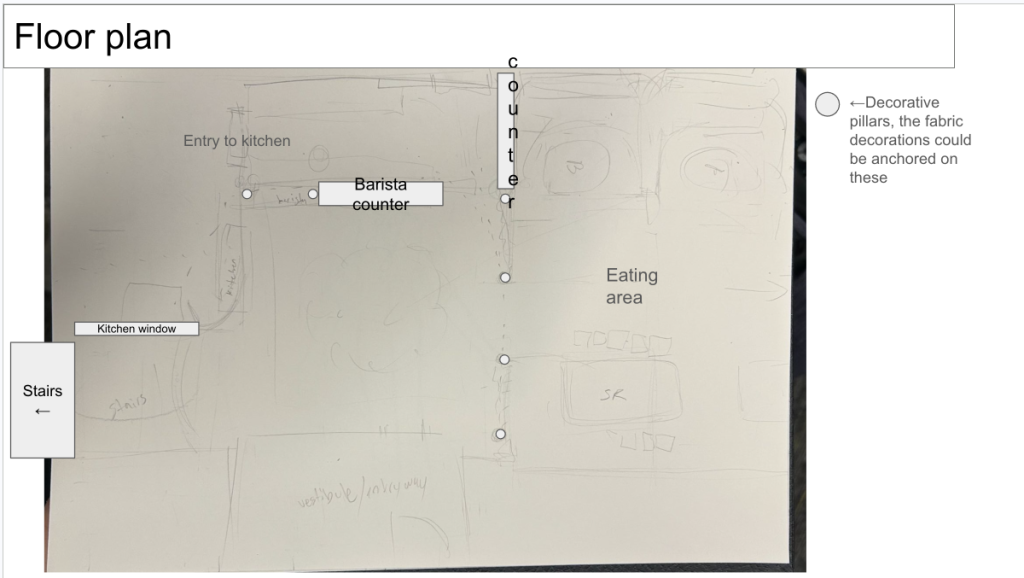
As Adri and Darius went to work on character designs, Ace and I sat together for awhile and created the. Entire floor plan for the cafe.
Our paper sketch was later edited in google slides, and this isn’t even the final version—we later decided to add back the bay window we really wanted to find a place for, putting it right between the barista counter and other eating areas. We were ecstatic upon realizing the bay window was back. We loved the bay window.
The backgrounds I drafted out were in… varying stages of completeness levels, before I sent them over to Ace to lineart and color.
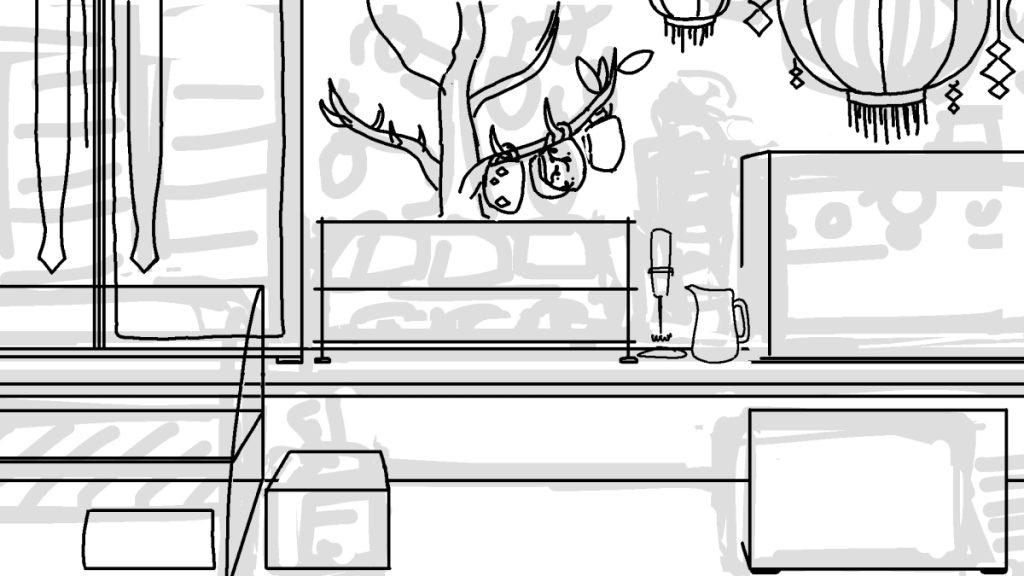
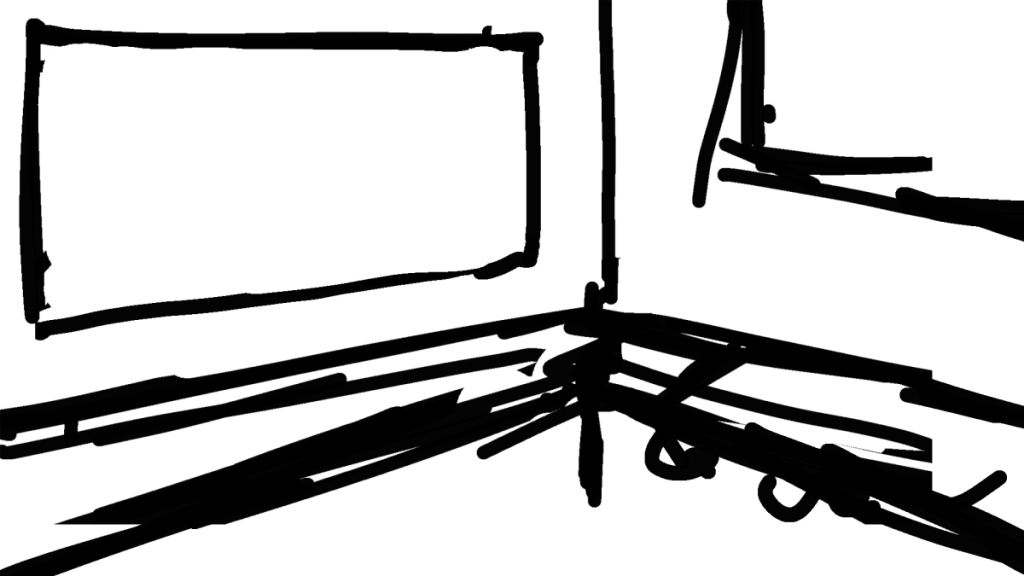
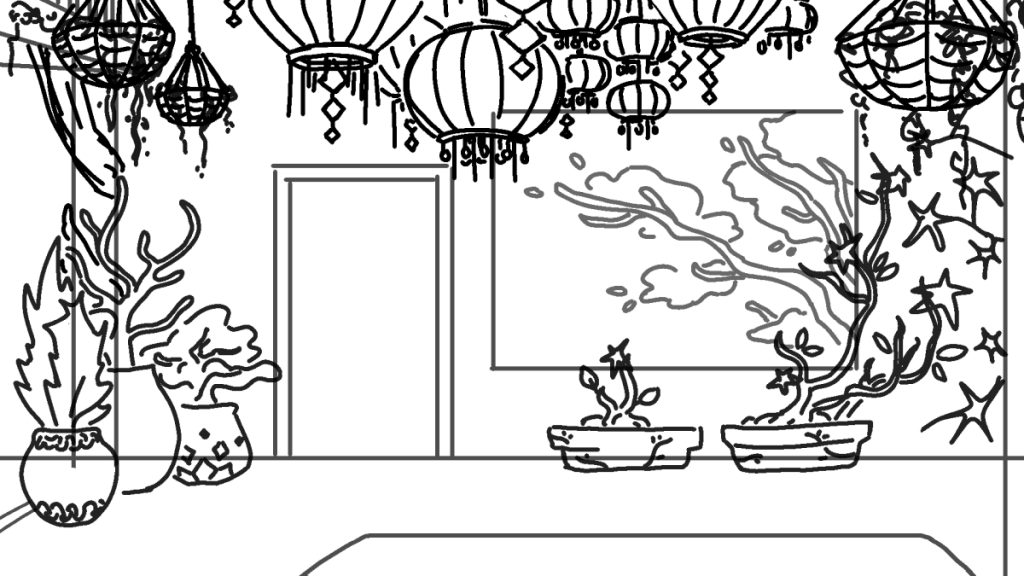
For contrast, here are the finished backgrounds after Ace was done with them. The barista counter was made in two parts—the background and then the foreground of the counter itself—in order to make animating a character behind the counter but in front of the background a bit easier (I ended up not utilizing that separation for all of my clips, though, as part of my scenes had Bari’s hands on top of the counter).
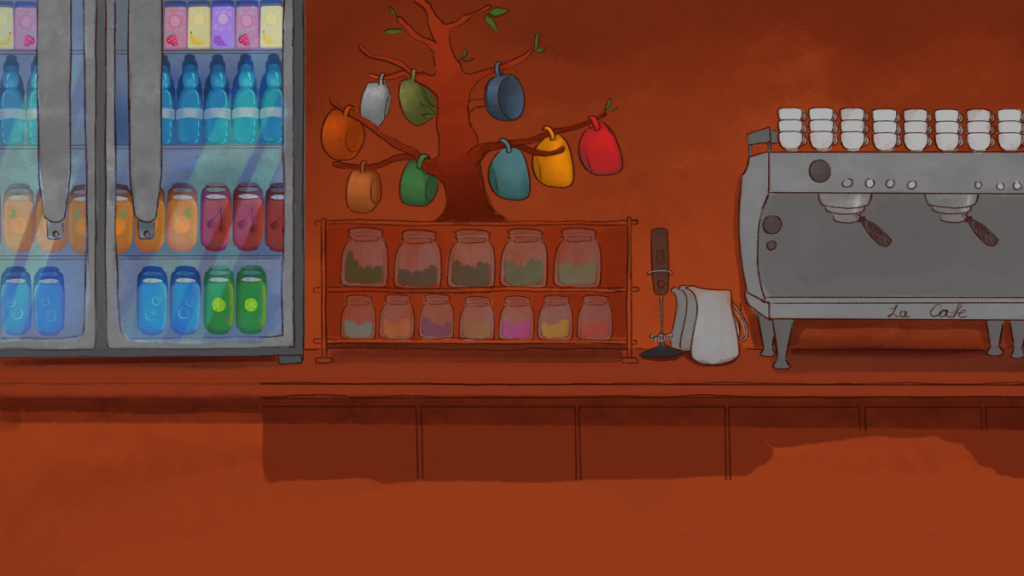
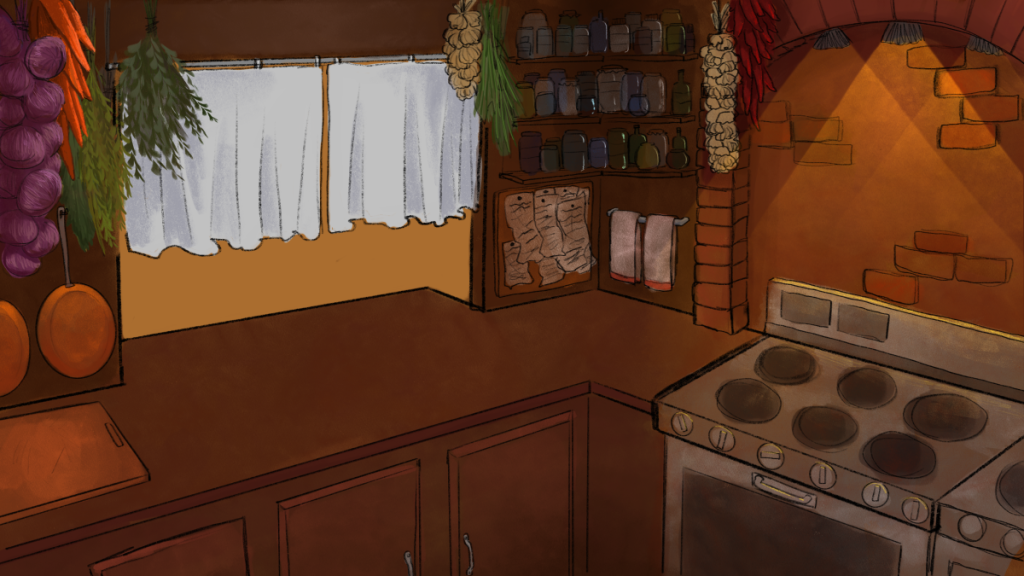
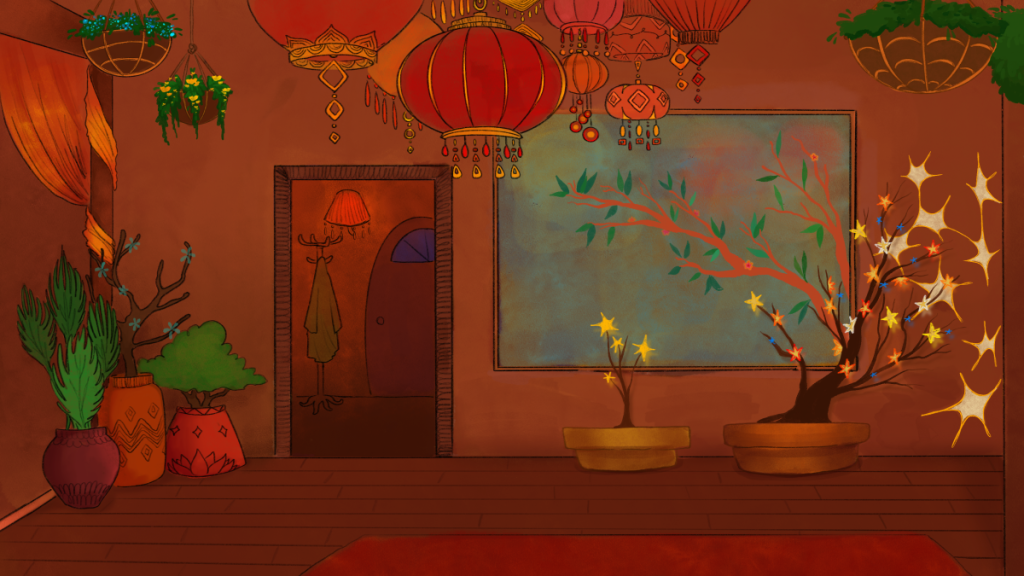
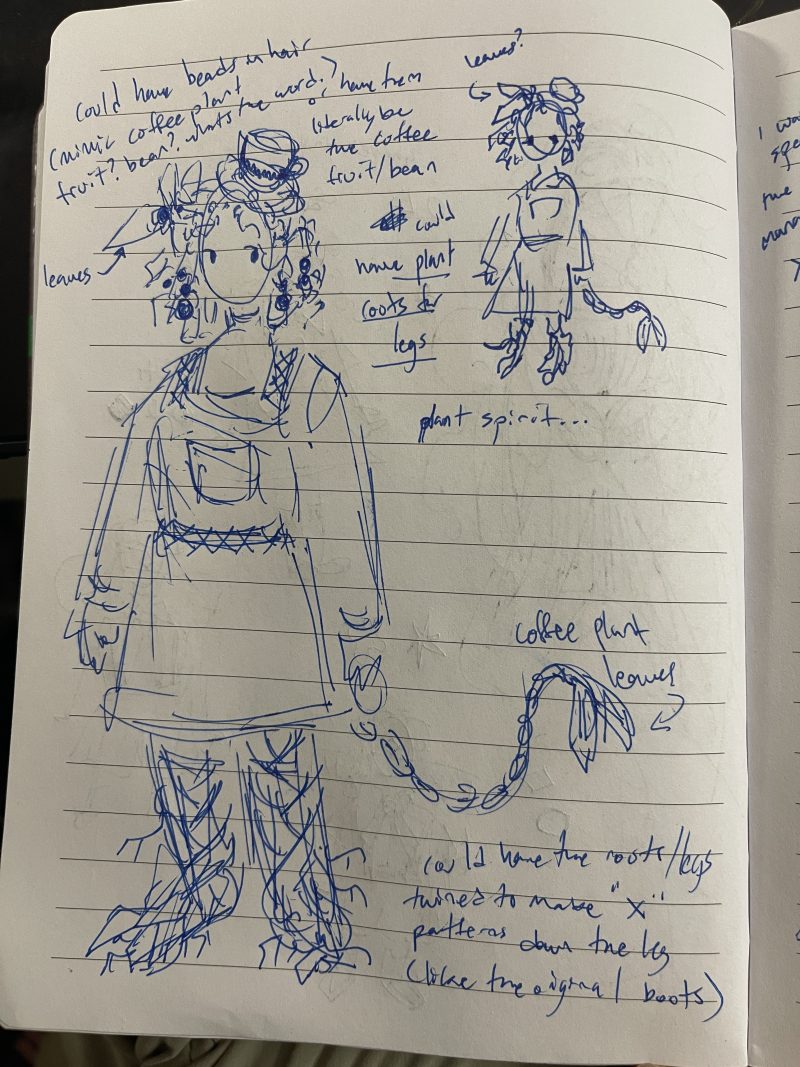
After working on backgrounds, I also did work for our main character’s design. I took a concept design Adri had done and redesigned it, leading to our final design for Bari, our barista main character. The design ended up changing a tiny bit more later on—we added a red ankle length skirt, but it’s not very visible in majority of the animation scenes. I love the tail, but it didn’t show up much in our final product. I managed to have in it one of my scenes, though—I had Bari flick her tail after slamming her hands on the table when she gets really frustrated with Qarine. That motion was so fun to animate… you’ll see it in the final product a bit down below.
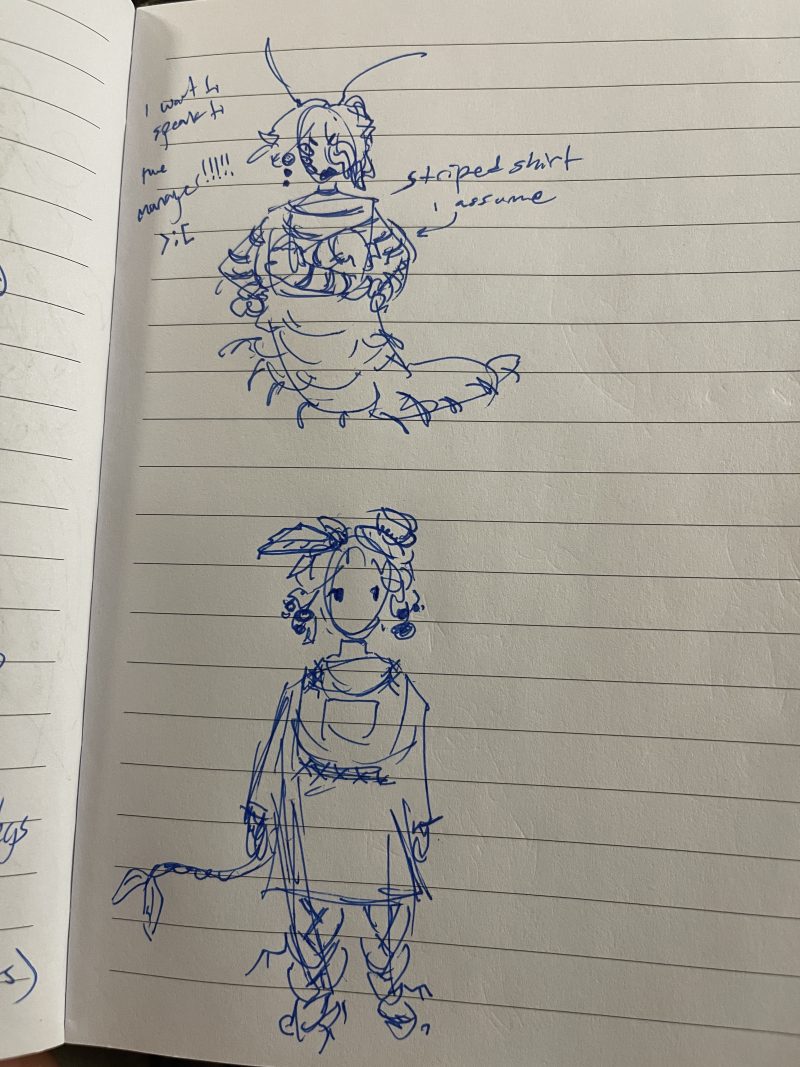
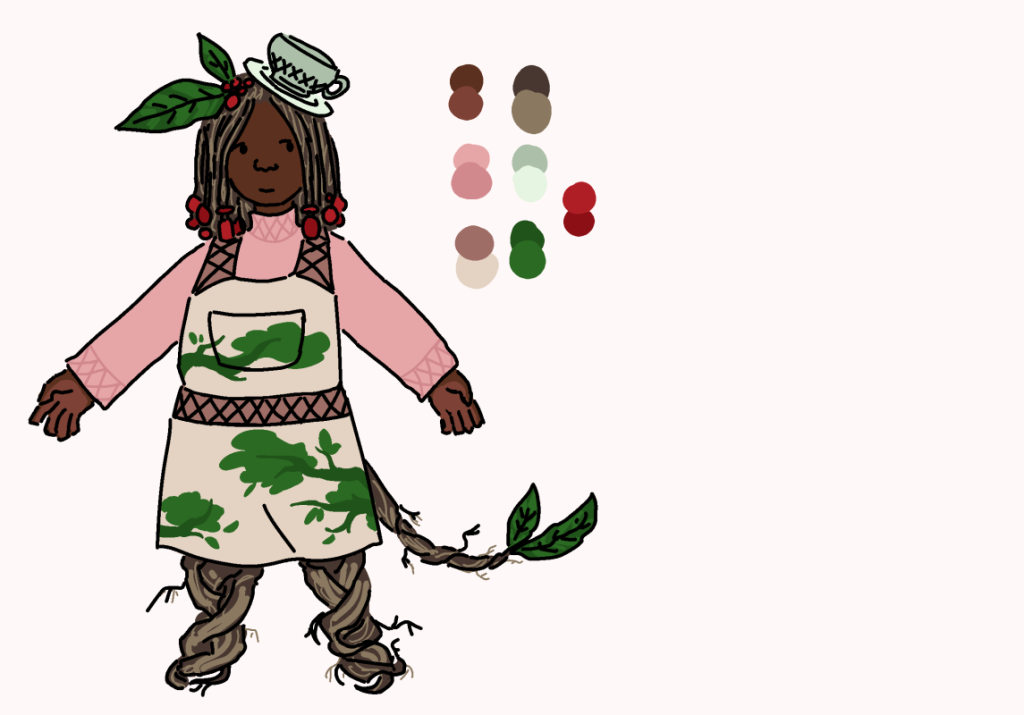
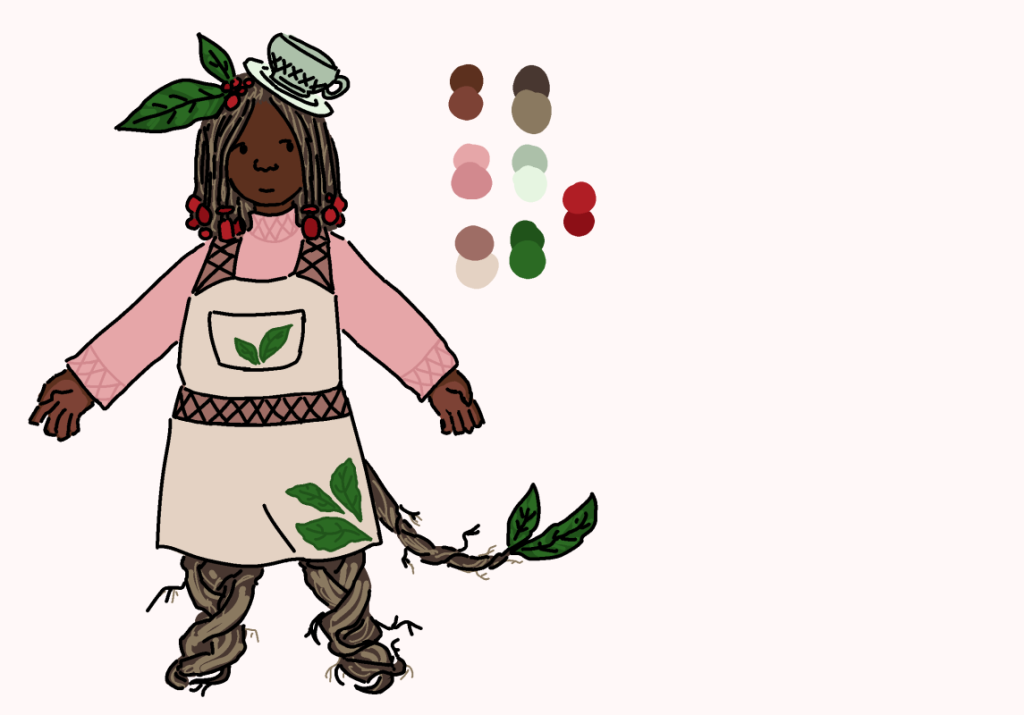
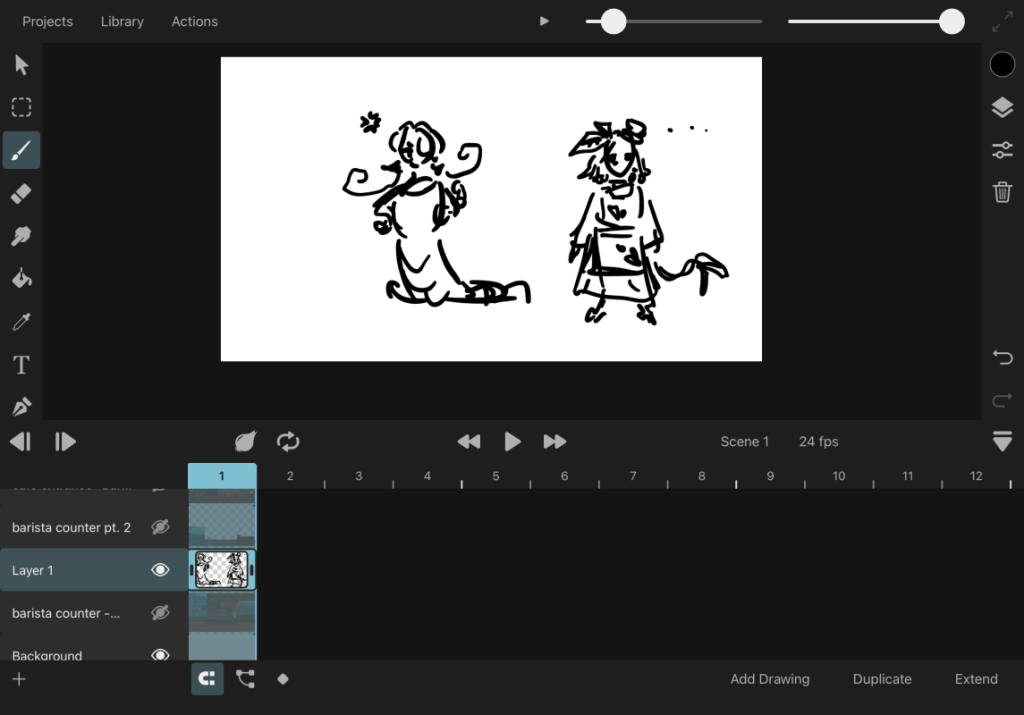
With the characters created and scenes planned out, it was time to move onto animating our scenes. With our school accounts, we had access to the Adobe suite of applications available to use. However, I chose to download an iPad application called ToonSquid, as I found its interface and capabilities a lot better suited for animation than say, Adobe Photoshop, like we had been using for earlier projects’ short animation clips.
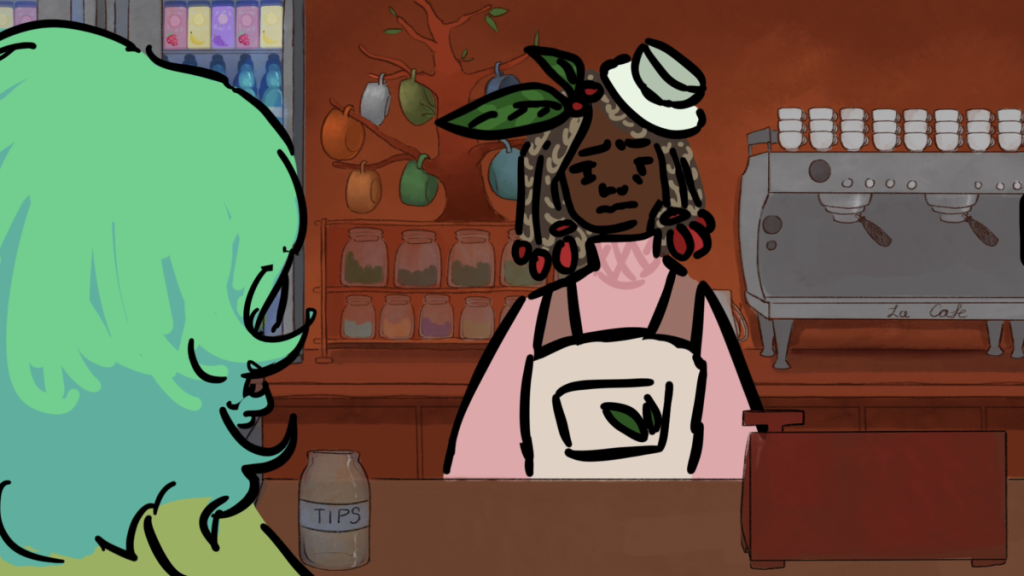
After we all finished our individual animation clips, we edited them together and added sound effects. Our final completed narrative animation is down below!
Throughout my Animation projects in this unit, I found myself challenged and trying out things I never did before. This pushed me to grow in my confidence with risk taking and following through with creative projects, and I left with many new skills and improved previous ones. I’m proud of myself and grateful for the experience of working on these projects, as a lot of effort was put into each one.