
During the Narrative Unit in my Freestyle elective (Film), we were challenged to look beyond the technical mechanics of cameras and editing software to understand the profound art of storytelling. We learned that film is ultimately a vehicle for human connection, serving as a way to translate complex emotions and abstract ideas into a visual language that resonates with an audience. The core challenge of this unit was to conceptualize and build a short film entirely from the ground up. Being tasked with creating a cohesive narrative world forced me to think critically about pacing, character arcs, and the visual metaphors that drive a story forward without relying solely on dialogue. What I valued most from this specific production process was the rigorous and often unseen nature of pre-production. The endless script revisions and meticulous planning taught me how to clearly articulate a creative vision so that others can step into that world with you, fundamentally shifting my perspective by showing me that the true foundation of any compelling project is built long before you ever hit record. Finally, I want to extend a massive thank you to my film teacher, Mr. Taylor, for his constant guidance and for consistently pushing me to approach my creative roadblocks with a fresh perspective.
Griffith’s Pattern (Scene Practice)
Griffith’s pattern is a foundational filmmaking technique used to build a scene by progressively drawing the audience closer to the action. It traditionally starts with an establishing and long shot to set the location, transitions into a medium shot to introduce the characters, and ends with close-ups to highlight their emotions. In my group’s attempt at Griffith’s Pattern, we decided to depict a scene in which a character tries to cheat his way through a cards game.
Suspense Scene
Suspense scenes are designed to keep the audience on the edge of their seats by slowly building up tension and anticipation. Directors usually pull this off by using techniques like dramatic irony, tight pacing, and close-up shots to show the viewer a threat that the characters don’t even know is there yet. The whole point is to make us feel stressed out and anxious, nervously waiting for the exact moment when the danger finally strikes. In my group’s attempt at the suspense scene, we came up with an idea where my character is trying to get poisoned by Oscar, without him noticing. But it ends with a shocking twist!
Chase scenes are basically high-energy sequences built entirely around the intense dynamic of someone trying to escape while someone else hunts them down. Filmmakers usually keep the momentum going by using fast-paced editing, shaky camera movements, and quick cuts back and forth between the pursuer and their target. This chaotic visual style puts the audience right in the middle of the action, making us feel the adrenaline and desperation as the gap between the characters keeps getting smaller. For my Chase scene, I really wanted to dig into that ominous, scary, creepy vibe that you get from certain chase scenes when watching movies. And I achieved this by filming on a creepy, dimly lit old playground set that looked very ominous. Adding to the overall intensity of the film.
Narrative Synopsis
For our narrative film project, our first major milestone was to develop a comprehensive rough draft synopsis to outline the core elements of our story. This document essentially served as an elevator pitch, allowing us to clearly present our initial creative vision to Mr. Taylor. After reviewing our submission, he collaborated closely with us to refine our ideas, troubleshoot the pacing, and strengthen the overall narrative structure before we moved further into the pre-production phase.
Storyboard
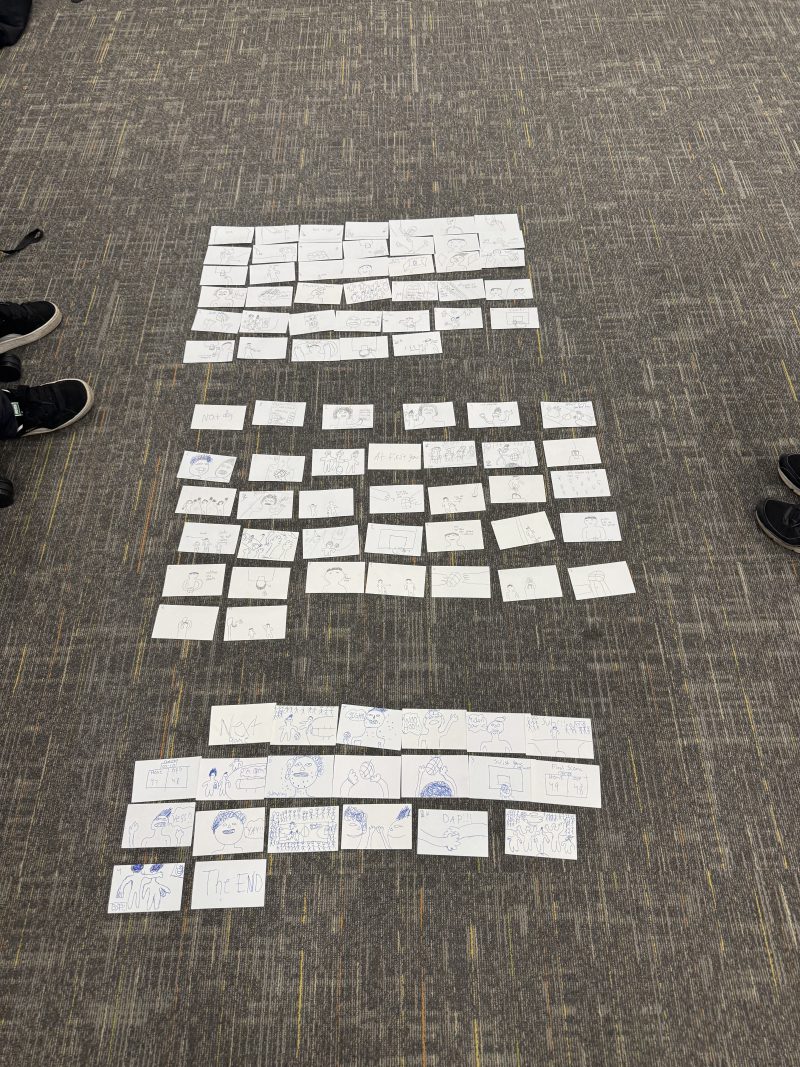
In the photo above, you can see the storyboard in which we were required to draw out every individual scene that we had planned out for our film.This process is tedious and long and often requires heavy revisions. But it helps you actually visualize your film before ever having turned on the camera.
Final Narrative Film
Reflection:
The narrative unit of our film class was a major eye-opener, revealing just how much complex thinking, meticulous planning, and intense coordination goes into making a movie. It quickly shattered the illusion that filmmaking is as effortless as sitting back and watching the final product on screen with a bucket of popcorn. In reality, the production process is incredibly unpredictable. For our narrative project, Ben and I faced constant setbacks, primarily dealing with actors canceling and forcing us into a stressful cycle of rescheduling.
Just a week before the final deadline, we had to make the difficult decision to completely pivot our story (as certain actors could no longer show up for filming). This massive shift left us with a final film that was entirely different from our original vision, yet it turned out to be just as impactful and visually beautiful. Ultimately, this project was a masterclass in adaptability. It taught Ben and me how to roll with the punches, problem-solve on the fly, and bounce back from serious logistical nightmares. Even in the face of that late-stage adversity and having to rewrite our entire plan at the last minute, we managed to pull through and deliver a final product that we were both proud of!