Introduction
There’s no better way to end junior year at Freestyle than to do a project where you get to freely explore your passions. In the explorations project, we focused on a specific 21st century skill (involving problem-solving and being creative through technology) that we are passionate about and want to learn more about. Upon getting to know about this project, there were hardly any limitations compared to other projects, as we got to work with practically any medium as long as it was school appropriate. When I was thinking about what skill I wanted to do, I was overwhelmed by the amount of freedom I had, which meant a lot of brainstorming to do.
Some ideas I initially had were to create a detailed drawing focused on a specific theme or build a 3D model of a structure. However, both ideas seemed too time-consuming, and I wanted to save them for my Zenith project next year. I eventually decided to experiment with bleaching clothing to create unique designs and patterns. I chose this project because it combined creativity with hands-on experimentation and allowed me to transform ordinary clothing into something original.
I was interested in exploring how different bleaching techniques, application methods, and fabric types would affect the final result. Through this project, I hoped to develop my design skills while learning more about the creative process of altering and customizing clothing. The unpredictability of bleach also made the project exciting, since each piece would turn out slightly differently.
Process
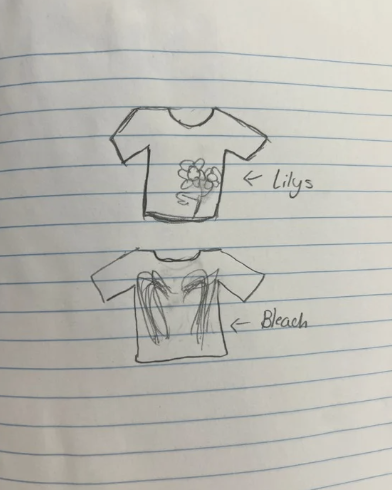
After deciding to create a bleached clothing design, I began by sketching a simple lily flower because I wanted a design that was both visually interesting and meaningful. I chose a black T-shirt because the contrast would make the bleached areas stand out clearly. Before starting on the final shirt, I researched different bleaching techniques and practiced controlling the amount of bleach on scrap fabric.
Once I was ready, I lightly sketched the lily onto the shirt with chalk and placed cardboard inside the shirt to prevent the bleach from soaking through. Using a small paintbrush, I carefully applied diluted bleach to the petals, stems, and leaves. I experimented with different amounts of bleach to create variation in the tones, allowing some areas to become lighter than others. As the bleach reacted with the fabric, the flower gradually appeared and developed a range of orange, tan, and cream colors.
After achieving the desired effect, I rinsed the shirt thoroughly to stop the bleaching process and washed it to remove any remaining chemicals. The final piece transformed a plain black T-shirt into a custom wearable artwork. Through this exploration, I learned how to work with an unpredictable medium and how patience and experimentation can help create a successful design.
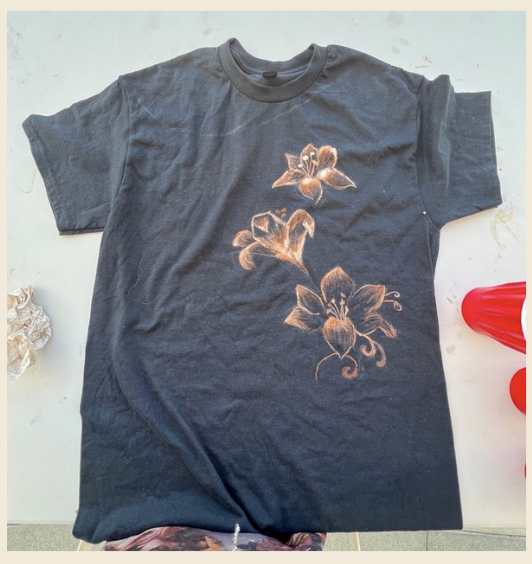
Final Product

Reflection and 21st Century skill
Overall, I am happy with how my bleaching exploration turned out. At the beginning of the project, I was not sure how much control I would have over the bleach or whether the design would come out the way I imagined. Because bleach is unpredictable, I had to be patient and work carefully throughout the process. Seeing the lily slowly appear on the black fabric was one of the most rewarding parts of the project.
One challenge I faced was controlling the amount of bleach so that the design did not become too light or spread beyond the lines. I learned that small changes in technique can have a big impact on the final result. If I were to do this project again, I would experiment with more shades and perhaps create a larger or more detailed design.
This exploration helped me develop my creativity and problem-solving skills. It showed me that art does not always have to be made with traditional materials like paint or pencils. By using bleach as a medium, I was able to transform a plain T-shirt into something unique and personal. The project encouraged me to take risks, experiment, and learn from the process rather than focus only on the final product.
This project helped me develop a 21st-century skill by strengthening my creativity and adaptability. Since bleaching clothing is an unpredictable process, I had to experiment, make adjustments, and solve problems as they came up. I learned how to take an idea and turn it into a finished product through trial and error. These skills are important in today’s world because many careers require people to think creatively, adapt to challenges, and find innovative solutions. By designing and creating my lily shirt, I practiced these skills in a hands-on way and gained confidence in my ability to learn from experimentation.
Poetry
Introduction
To be honest, I wasn’t very familiar with poetry before this unit. Poetry can feel difficult because there isn’t always a clear definition of what makes a poem “good,” and that uncertainty sometimes made it hard for me to know where to start. However, I am very grateful that Ms. Moore came to our English class and led a week of poetry workshops. She introduced us to different poetic techniques, shared examples of poems, and even wrote a poem herself for us to analyze. Her workshops helped me better understand poetry and gave me more confidence to experiment with my own writing.
During the workshops, we participated in several activities that helped us think about poetry in new ways. One activity involved creating a list of nouns paired with adjectives and then shuffling the adjectives around to form unexpected combinations. This exercise showed me how unusual word pairings can create vivid imagery and new meanings. We also wrote a cento poem, where we borrowed lines and phrases from published poems and rearranged them to create an original piece. Through this process, I learned how poets build meaning through the arrangement of language. In addition, Ms. Moore shared a poem she had written about poetry itself. Her use of parallel structure and strong imagery gave me ideas for my own writing and showed me how poetic techniques can make a poem more engaging and memorable.
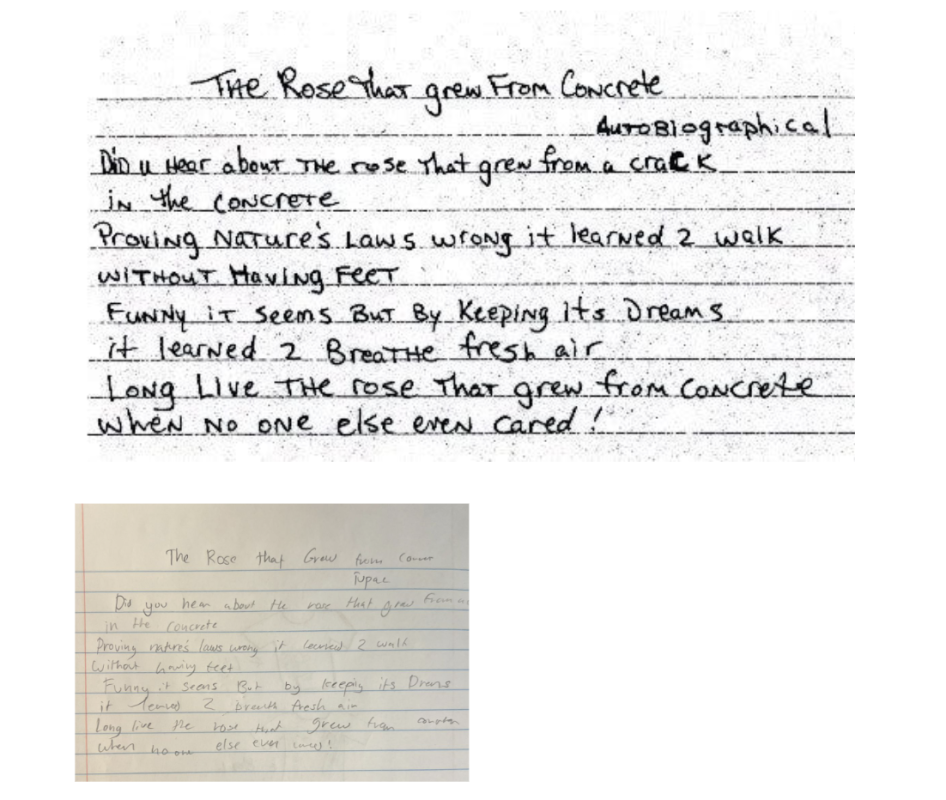
Analysis
Speaker
The speaker is an observer, who notices something unusual and reflects on it with a deeper meaning. The speaker is never directly identified, but their voice seems to be thoughtful and reflective. The speaker may represent Tupac himself because the poem has many themes represented throughout his work . Like overcoming hard circumstances, and other hardships .The speaker’s perspective shapes the poem by having readers look beyond appearances and recognize strengths.
Occasion
The immediate time of the poem is the rose growing through the concrete. But, the deeper occasion is a reflection of resilience and survival. The poem can be seen as a response to challenges faced by people ghat are growing up in difficult environments. The rose becomes a symbol for people who success despite the obstacles set in front of them. The pome feels both reflective and observational because it starts with an image and changes into an idea about human experience.
Audience
The audience is never directly identified but the author seems to be addressing anyone who has faced hardship. The poem speaks about people who have succeeded despite challenges, validating their struggles and achievements. Because the audience is broad, readers can easily connect to it.
Purpose
The purpose of the poem is to celebrate resilience , and challenge assumptions about success. Tupac encourages readers to focus on not where they came from but what they overcame. The poem also subjects that adversity does not determine someone’s success or potential.
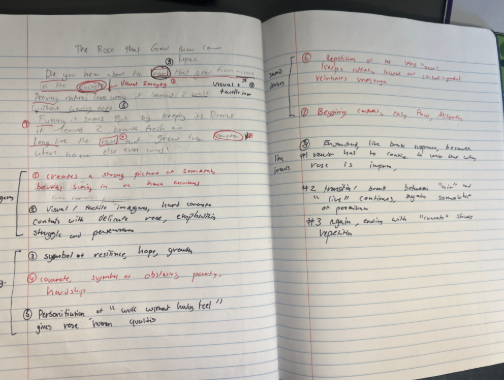
He uses the visual of the rose as a metaphor for people who overcome difficult circumstances. The concrete symbolizes harsh environments like poverty or struggle, while the rose represents resilience and growth. While the rose, while something so delicate, breaking through represents perseverance and success. Tupac also useless personification when he describes the rose to learning to walk without feet, giving it human qualities and making its struggle more relatable. The repetition of the rose throughout the poem keeps the reader focused on the central message and creates a rhythm. The short lines and line breaks slow down the reader, and plache emphasis on important ideas. These poetic techniques work together to transform the poem into feeling inspiring and a powerful message about human potential. As a reader, the poem feels inspiring because it focuses on what can be achieved despite difficult obstacles.
In my own writing I would like to use Tupac’s form of symbolism to represent deeper meaning and communicate a deep message usin simple language.
Final Poem

Poetry Production
I believe my production conveyed the meaning and spirit of my poem pretty well, my reading of it was exactly accurate to how I intended it. Also, the images were relevant to what I was talking about in the poem and accurate in setting the scene.
One creative freedom I valued during my poem production was the ability to choose how I presented the poem rather than simply writing it on a page. I decided to create a voiceover and combine it with images and video clips to help communicate the mood and meaning of the poem. This allowed me to use multiple forms of storytelling and make the poem feel more personal and engaging for the audience.
I chose the images and videos carefully so they would support the themes and emotions in the poem. The voiceover added expression and emphasis that would be difficult to communicate through text alone. These artistic and technical choices helped bring the poem to life and gave me more control over how the audience experienced it. By combining visual, audio, and written elements, I was able to create a more immersive and creative final product.