“How well can you apply advanced narrative techniques to build a compelling story?”
A large part of this part of Freestyle was building on our previous storytelling techniques with more concepts we’ve learned since then. In this unit, we had an entire world building project that spanned across both English and Digital Media. In Animation, we created an entire 3D animated short film in groups using characters we made during our first semester. We explored so many different forms of storytelling, from the typical writing, to animated works, and a variety of digital artwork. This unit is probably my favorite because of the freedom we get to create our own stories with peers across classes. I really enjoyed all of the different media we made that connected to our stories in Digital Media and English.
English
Our Pitch
Our world building project was to just create a fictional world in our groups through smaller assignments throughout the unit. After some brainstorming, my group and I settled on a fantasy world based on the mid to late 1800s, where a new church bell curses every follower of the church. Our main character was a ghost, and side characters included a detective, a witch, a priest, and an old man.
For our pitch, me and my group members all presented our idea to our class as if we were pitching a novel idea to a publishing company. We organized our written pitch document into a clean slide deck and each presented on a different aspect of our world and plot. It was very rewarding for us to finally present our idea in a somewhat formal matter and see all of the pieces come together. Watching other people’s presentations was also a lot of fun, I got so much inspiration from other groups’ worlds and characters. After the pitches, we all got the opportunity to revise our plot and world based on others’ feedback. My group and I cleared up the magic system, and made sure all of the character’s arcs were obvious. Below is our detailed Narrative Treatment with a summary of our world and plot, and an edited pitch video we put together after we revised our idea.
*insert pitch video
My Research
In English, we chose a research topic that we could tie back to our group world building project that we were currently working on. My group’s world at the time was a fantasy world based on mid to late 1800s Europe. It included two different religious groups that were tense over a new church bell that was implemented at their local church. I decided to research the development of folklore and culture to see how it’s changed over time, leading to cultural appropriation in today’s society. I thought this could help develop the relationship between the two religiously and culturally different groups in our world and strengthen the plot we were working on. Below is my annotated bibliography of my sources and the presentation slides.
Surreal Composition
Over in Digital Media, we began creating a surreal composition in Photoshop that visually reflected our world building projects. I chose to focus on the church bell and heavenly imagery. I used mostly blues to create a “pure” mood, with some yellows and warmer colors for contrast. Even though the blues may be associated with purity and lightness, the ruins in the background and darker sky suggest the hidden curse of the bell that’s really cursing the entire town. The bell itself is also covering the statue’s face, adding ambiguity and a sense of mystery to the piece.


Digital Media
Funny Images
Before we did our surreal composition, we practiced the Photoshop tools we needed by creating humorous compositions. The first one, I decided to take two photos I took myself. I made it look like my dog’s head was coming out of the clouds. I’m not super happy with the overall composition of this photo, but it was good practice for the techniques I needed for the final surreal composition. In the second composition, I combined three photos I found online to create a penguin ice cream cone. I blended the original ice cream into the penguin’s white tummy, and added shadows to make sure the cherry looked real on top.


Even though these compositions aren’t my favorite piece of work, it was interesting to work with different photoshop tools to create them. I learned a lot of the skills that I used to create the final composition, like clipping masks and color correction. Ultimately, I had some fun making such humorous designs to practice making a more serious one.
Motion Graphics
Using Adobe After Effects, we learned the basics of motion graphics. Using what I learned, I created a short, funny video based on a keychain I have. It was an acrylic keychain of a dog with a bow, and a caption that reads “i am a boy.” I didn’t enjoy the practice motion graphics that much, so I decided to make a humorous and simple video to make the process more enjoyable. I composited a bow on top of an image of a dog, and used that as the main focus. By turning the text into a shape, I used keyframes to make it write itself as a transition in. I also used keyframes to animate the confetti. Each time they disappear, they change color which I also used key framing for.
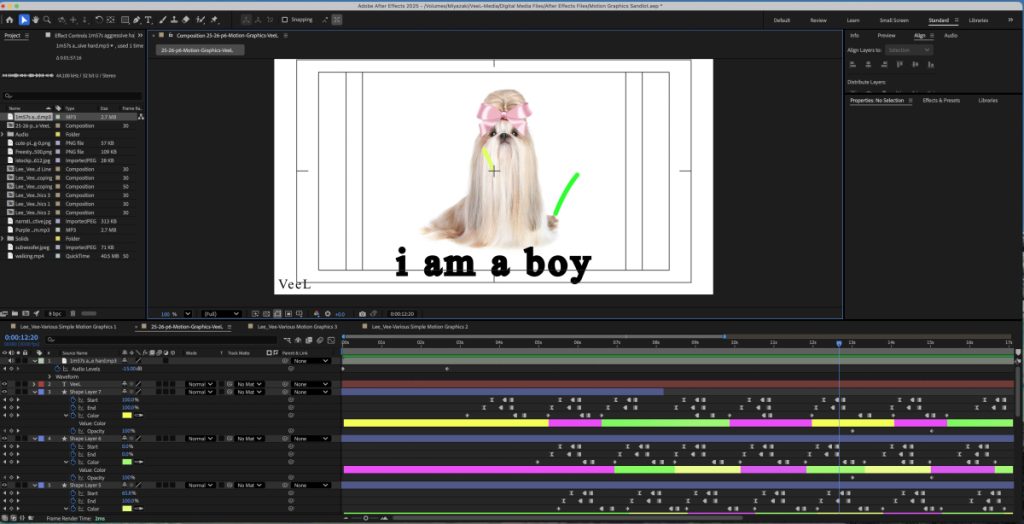
Multi-Layered Art
Our final Digital Media assignment for the Narrative 2 unit was to create some sort of multi-layered artwork that connected to our world building projects. This included a light box, stacked wood art, or stacked rings. We also had the option to work with a partner, so me and my friend, Cade, who was also in my world building group, worked together. Our design was based on a
Animation
After learning the basics of 3D modeling during first semester, we began creating animations. We started with practice, first creating a walking, running, and jumping cycle to get a feel for animating in 3D. Then we learned how to apply motion capture on our character models. We also created different expressions for our characters and lip synced them to audio. Finally, we used everything we learned and our modeled characters to create a short narrative animation in groups.
Walk, Run, and Jump
*insert walk, run, jump video
Motion Capture
Motion capture, or Mocap, is basically putting the animation from a skeleton onto another skeleton. This is done by capturing the motion from actual real life movement. When we first learned Mocap, we used free files found online so we knew how to apply the movement onto our own models. Later, during our final Narrative project, we captured our own motion. One of our classmates wore a suit full of magnetic sensors on key parts of their body, and we recorded that movement onto a skeleton. I was helping to record everyone’s movements, and it was so much fun to help and watch all the movement my classmates needed for their projects.
Keep going to watch the motion capture being used in my final Narrative Animation!
Lip Sync
For the lip syncing assignment, we made many different copies of our original, unrigged model, and modeled different expressions onto each one. Then we combined each model, and would adjust the “scale” of each original model to achieve the expression we wanted. So, we could turn up the expression for the “oh” expression and the “smile” expression to make our character smile and say an “oh” sound at the same time. Below, you can watch the lip sync I made using my Hubert snail character.
Narrative Animatic
After all of this preparation and practice, we formed groups and began creating a short animated film. After developing a story line and storyboarded our idea, we created an animatic to get our timing right. This consisted of taking our storyboards and composing them so that each board lasted for as long as we wanted that shot to show up. Basically, it was a very, very rough 2D animation that served as a basis for timing our actual 3D animation. We referenced this while animating in order to get our timing right when key framing the different poses.


Here are the original storyboard that made up our animatic!
Final Narrative Animation
Over the course of four weeks, me and my group created this final Narrative Animation. In this project, we used my Hubert character and Cam’s character, Victoria, or Vic for short. We used a combination of key framing and motion capture to animate our characters and the some of the environment. Although the final product differs from our original storyboards due to technical difficulties we had along the way, we were ultimately able to put together this final piece.
Shout out to Cam and AJ, the other group members for this project!