
In our Narrative unit, I grew as a writer and experimented with different mediums to tell a story. Centralized around the flash fiction story we wrote in English, in Design and Digital Media we created multiple projects using applications such as Adobe Illustrator, Pro Tools, and Photoshop. Whether it was through illustrations, editing our short stories into audiobooks, or music, this unit provided a platform to challenge how I traditionally view storytelling. Safe to say, a story can be made up of more than words.
I enjoyed bringing my character to life in different digital forms of art, especially in my audio short story and my narrative creature for Design. Over the course of this unit, I stepped into the role of a storyteller.

A key part of the narrative unit was writing a flash fiction story in English class. A flash fiction is a difficult literary work to master — it conveys a meaningful plot in a short delivery of words. When beginning with brainstorming the layers of my character and plot line, I was drawn to this recurring image of someone all alone in a museum, either a statue or an actual human. I wanted to capture a sense of contemplation and solitude in my story. When I finally decided to write it about a custodian working at a museum, I had to determine a central conflict to put pressure on my character. This was the most difficult part, but I eventually settled on having my character experience a moral dilemma, challenging what we view as, “right or wrong.”
After writing my story, I was excited to create my audio version of the story in Pro Tools. I was especially excited to use all of the different sound effects and music.
I really enjoyed working on this project because I was able to make my flash fiction story truly come alive and show rather than tell. To set the tone of the plot, I chose a variety of different music and sound effects to invoke certain emotions and provide context for different scenes. During dramatic and dream-like parts of my story, I opted for classical strings. On the other hand, I used the panning tool in Pro Tools to make sound effects move left to right and adjusted volume levels to add depth to footsteps and other sounds, like switches turning on and off. My goal was to immerse the listener in the setting.
I didn’t realize how powerful sound can be in terms of conveying messages and influencing thoughts. By being mindful of the world of sound around me, I hope to apply these editing and producing skills to work on future audio productions.
The Night Shift Cleaner
The Night-Shift Cleaner by Anoushka Dugar
She never understood why they always left the lights off. The great big halls in the entrance of the museum were engulfed in darkness, and when the doors clicked open she too became swallowed up in the great big shadow. Anya always wished that they would think to leave the lights on for the night-shift cleaners.
She made her way to the check-in desk, rainboots squeaking against the marbled floors, and pulled the flashlight out of her pocket to guide her to the switches. When she flicked the main switches on, the room was flooded with yellow light and she finally felt a little less alone. She unlocked the cleaning closet with one of her plethora of keys and stepped inside the claustrophobic room. The closet was filled floor to ceiling with a variety of solutions, mops, and all sorts of sprays and wipes imaginable. She pulled out her cart and slipped her gray apron over her sweater. A thread was coming loose at the neckline. With a twist, she pulled at it and tucked into the back pocket of her jeans.
As she wheeled her cart to the elevator and made her way up to the first floor, she sighed, shoulders wilting. Her eyes bags were full of pennies and her hair hadn’t seen a hairbrush in days. The elevator doors slid open and she stepped into the statue exhibition — her assigned floor for the shift. Spot lights flickered below each work, offering soft bits of glow in the room. Anya switched the room lights on and at once the marble and stone bodies were lit up from above.
It seemed inappropriate almost, to be mopping floors and scraping off gum, in the presence of ancient beings. With yellow rubber gloves on, mop in hand, she began dunking the mophead in a bucket of soapy water and lathering it all on the ground. Even after just a day, the ground was covered in grimy footprints of various shoe sizes.
Anya swabbed and mopped across the floor, maneuvering between pillars and plexiglass cases to reach hidden nooks and crannies. After a while, the motion of pushing the mop back and forth clouded her vision and the mechanical movement swept her into a rhythm.
Huffing, she walked over to one of the statues. Her eyes traced over the marble, bathed in lukewarm light. It was a lady. All wide hips and rounded edges. Her head was angled slightly forward and one could make out her shy eyes and gentle smile under her veil. The artist had carved the veil so perfectly that it looked like liquid fabric draped on her body. Anya reached out her hand and brushed the ridges of the lady’s dress.
Her finger lingered, trying to feel the artist’s movements. She wondered how something so hard could be molded into softness. What was she hiding from the world?
Anya’s own skin tingled as she imagined herself turning into marble, becoming still from the inside out.
The lady statue stared into Anya’s eyes with kindness and, for a moment, Anya believed she had shifted up the corner of her mouth. Anya blinked. The statue stared back, eyes void of emotion.
Anya tightened her grip around the mop handle and continued swabbing. She found that walking backwards was the most efficient way to clean. As she was doing so she felt a sharp object dig into the bottom of her shoe. Her eyebrows rose as she looked at the bottom of her rainboot. There was no wad of gum, no bandaid, no brown substance. She caught a glimmer in her eye.
It was a ring, and right in the center of the golden band sat a big, bold, and beautiful, diamond. Its shine teased her. It looked perfectly cut — and very expensive.
She knelt, fingers on the accessory as she brought it up to her eyes and felt the metal press into her hand. The eye of the diamond was clear water in a stream. A buzzing radiated in the center of her forehead — dizzying her. And in a lick of time, she saw herself wearing a velvet pantsuit holding a glass of some fizzy drink. Red heels clicking against a tiled floor as she smiled and greeted a lady in a silk dress and a man in a tux. She saw herself pointing to paintings, impressionist, abstract, renaissance and speaking loudly as she conversed about French cubism and African bronze statues. The whole ordeal felt alive and warm as she saw herself once again in front of the veiled lady statue. Placing her hand on the marble, she felt for a crack, a hairline, and imagined it deepening and deepening until it combusted from the inside out. Crumbling stone.
It had a heaviness now in her palm, the ring, it weighed against her cracked skin. The weight still sagged in her pocket, where she placed it, and dug into the denim of her jeans. She stepped into the elevator, rainboots squeaking, as she went back down to the first floor. She left the lights on.


Overall, I am most proud of the accuracy of the sounds I picked to match the different moments in my story. Also, I am proud of the ending of my story because I used panning and layered sounds to create a dramatic and compelling effect for the listener. After producing an audio-only story and learning to use music and SFXs together, I value the importance of learning the skill of nuance. For this production, I had to make sentences in my story come to life by choosing sounds which evoke certain feelings and be patient while trying to find the sound which fit the moment exactly.

Part of the Narrative unit was learning to create a variety of illustrations using Adobe Illustrator. In Illustrator, I applied new skills to projects like the Exquisite Corpse, Short Story album cover, and our Illustration Project Choice, allowing me to take creative liberties with my art. I really valued learning new technical skills in Adobe Illustrator to create unique illustrations with a variety of effects.
The Exquisite Corpse illustration project was a collaborative project which was one of the first assignments we had after learning new skills with Adobe Illustrator. For my section, I chose to use a technique we learned in Digital Media to create a ribbon-like form in Illustrator and created shapes of dancers on the ribbon. The style of the people is from the tribal art form, Warli, from India. It was really interesting to see all of my classmates’ illustrations put together and I love how we each did a unique form of art!

I also used Adobe Illustrator to create my short story’s album cover. I found the gradient tool and very pen tool very useful to create the mask and marble shards.

For my Illustration Project Choice, I chose to create a mousepad.
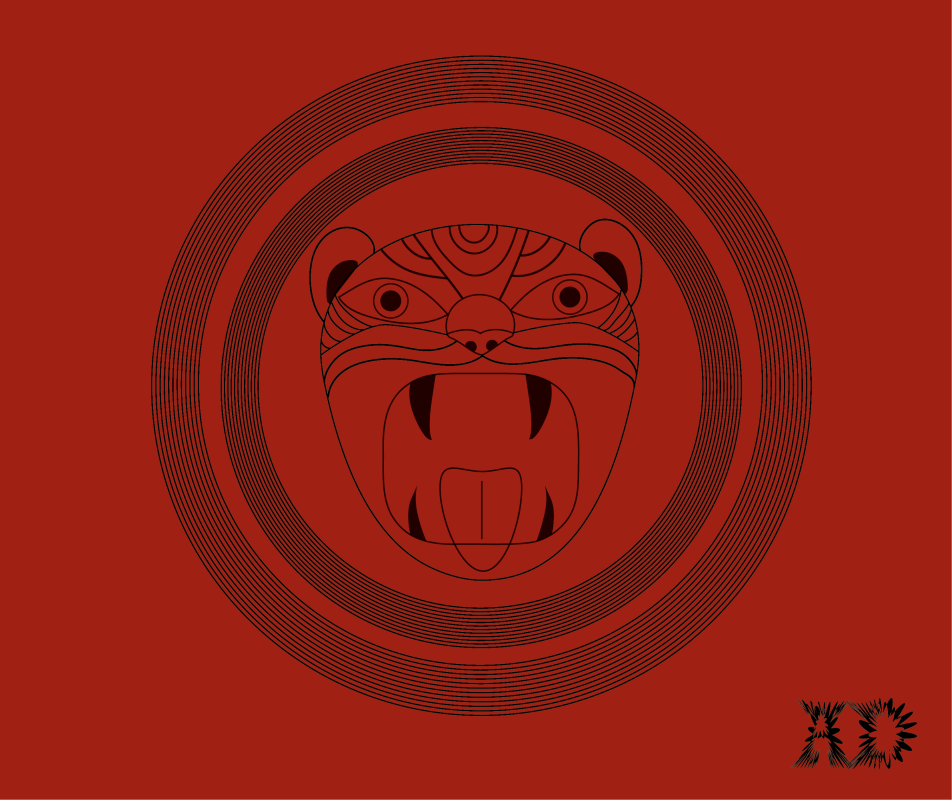
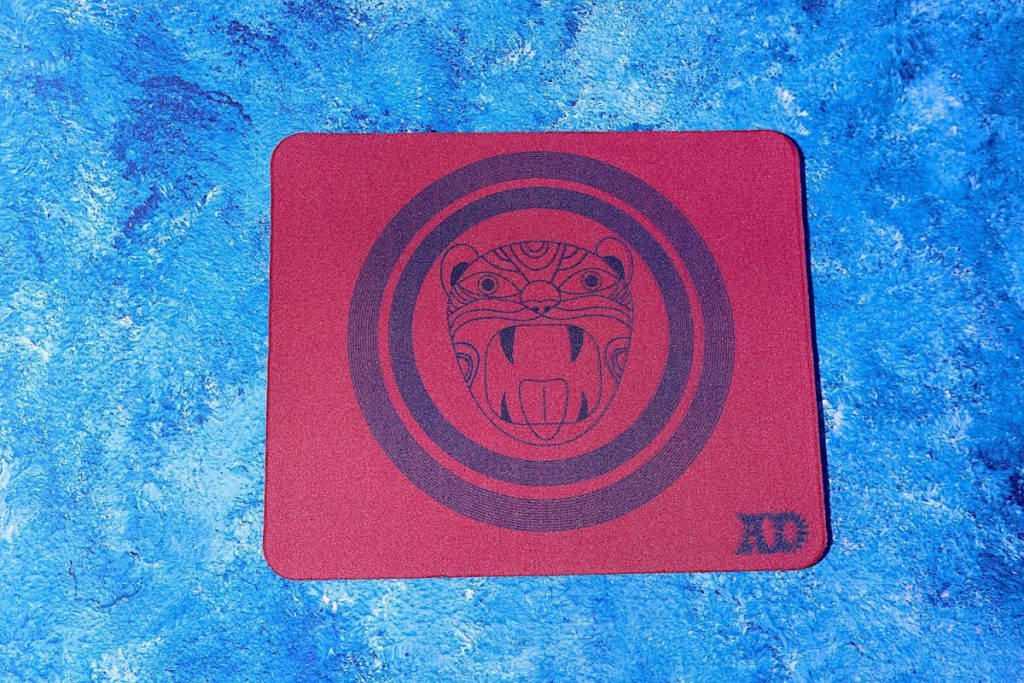
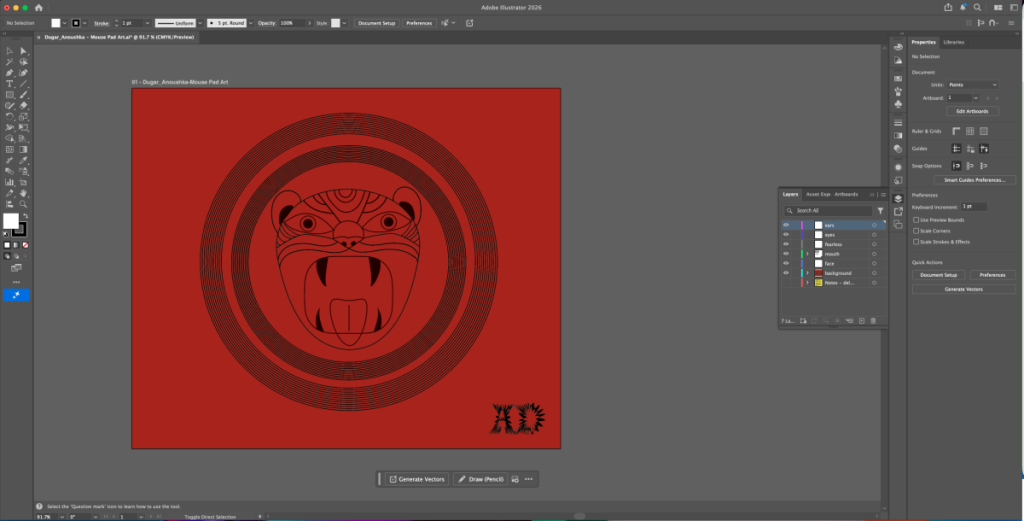
I chose to create a mouse-pad because I felt it would be a practical choice, especially because I use my mouse and monitor frequently for the projects I’m working on at Freestyle. My inspiration for designing this mousepad was from a unique illustration of a leopard I saw on Pinterest which was striking and fierce. I liked the way the artist had done the eyes and shape of the face of the leopard, which I wanted to replicate. However, I wanted to change the shape of the teeth and not add spots on the face and instead add concentric circles on the face. I primarily used the pen tool and ellipse tool to create the face by adjusting different anchor points to create the shape I liked. By changing different stroke widths and fills I was able to create the basic outline of the face. Grouping objects was essential here to ensure I wasn’t affecting the entire illustration as I worked. Also, the blend tool was very useful because it helped me repeat strokes of shapes so I could create concentric circles on the leopard and around it. In the end, I decided to add my initials at the bottom and I used the distort tool to roughen the font so it looked spiky. To enhance the illustration, I applied a multiply effect to it and set it against a deep red background. This production is important to me because it was fulfilling to see a physical manifestation of the work I’ve created digitally. Although simple, I am proud of the fierce and strong image I was able to portray with the leopard and the added details of the circles and my initials. Now every time I work on my computer, I’ll remember to have no fear.
What I value about using Illustrator as opposed to Photoshop for image creation is that Illustrator has a wider variety of tools to create unique parts of illustrations and add more creative effects to them. Compared to Photoshop, which I’ve only used to create simple fonts and poster designs, I used Illustrator to streamline processes that would have taken longer had I done them from analog drawing. Yet I found that I was still able to apply analog effects to my work in Illustrator by applying different filters and effects, preserving the style I wanted but in a convenient digital format.

For one of our music related projects, I got to use the recording our recording studio! My group decided to sing Dancing Queen, by ABBA, a classic 70s song. After we recorded it in the recording studio, we each edited it differently in Pro Tools.
▶ Dancing Queen
⏸ Dancing Queen
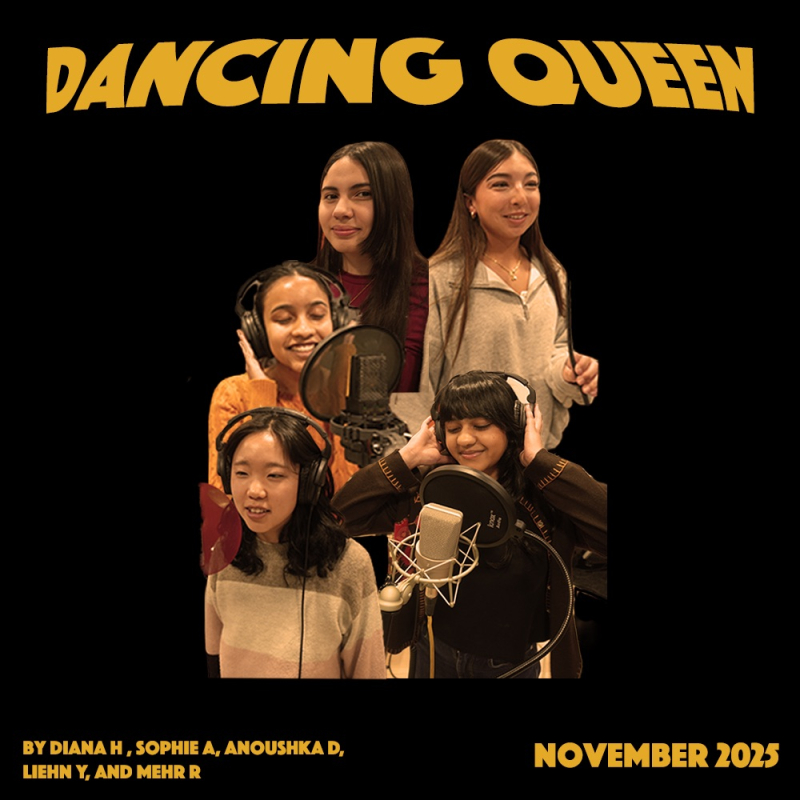
Our main takeaways were the technology setup of the recording studio. We had a lot of fun singing, and learned quickly that it was a lot easier to sing if we were more relaxed. One thing that particularly stood out to us was the headphones and the system that allowed us to hear individual voices and adjust the volumes accordingly. Another interesting thing was that while originally recording, we had separated verses, but we learned that we could all just sing the whole song, and later edit/mix it to cut out mistakes. A third takeaway was working with mics, and how we had to have ourselves and our head positions at a certain distance away from the mic filters to ensure the best audio quality, and avoid any drastic volume changes. Overall, it was very fun and interesting to see the mic and studio setup of the recording studio.

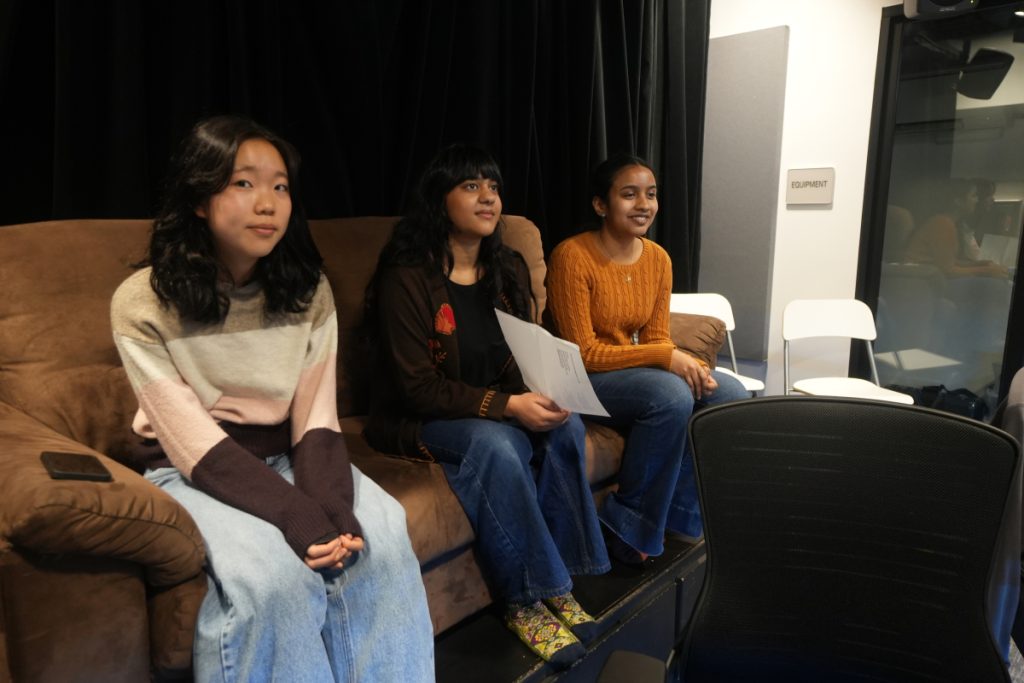

Our main takeaways were the technology setup of the recording studio. We had a lot of fun singing, and learned quickly that it was a lot easier to sing if we were more relaxed. One thing that particularly stood out to us was the headphones and the system that allowed us to hear individual voices and adjust the volumes accordingly. Another interesting thing was that while originally recording, we had separated verses, but we learned that we could all just sing the whole song, and later edit/mix it to cut out mistakes. A third takeaway was working with mics, and how we had to have ourselves and our head positions at a certain distance away from the mic filters to ensure the best audio quality, and avoid any drastic volume changes. Overall, it was very fun and interesting to see the mic and studio setup of the recording studio.
For the Experimental Music project, we were allowed to create any piece of music we wanted using Pro Tools and MIDI keys. I wanted to use nature sounds in my music, so I centralized my piece to have a heartbeat as percussion and bubbling water and crashing wave sounds. I love the sound of waves because it brings me peace and reminds me of memories of the ocean with my family and friends and the serenity of being underwater.
▶ Ocean Heart
⏸ Ocean Heart
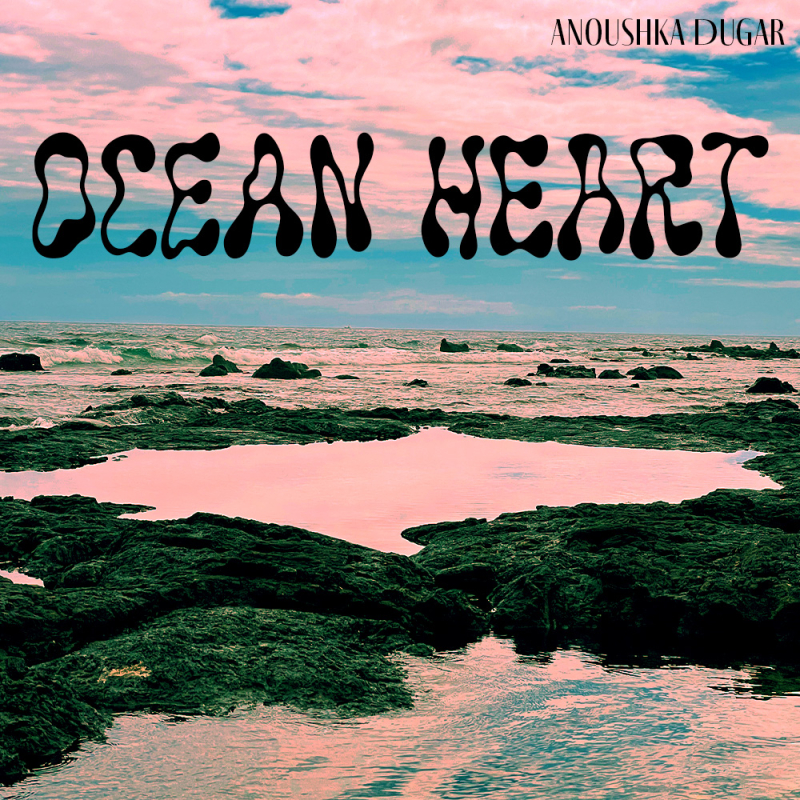
My inspiration for this piece was combining music and nature sounds. I wanted to create a vibe similar to meditation music — which I find relaxing and peaceful — but contrast it with rhythmic drum beats. I kept having this idea of incorporating a heart-beat into my music, so I used the MIDI drums to create a pattern for the intro and outro to give this effect. My artistic vision for this piece was to make the listener feel like they are floating underwater, where the music of the waves, water, and their heart, is all they can hear.
For this piece, I am most proud of the unique drum pattern I created and my unified use of natural sounds, like ocean waves, along with musical instruments, like synths. Throughout this process I valued being able to record multiple different instruments at once, modify sounds individually, and be able to play instruments I’ve never learned how to play before through the streamlined process of using MIDI keys.


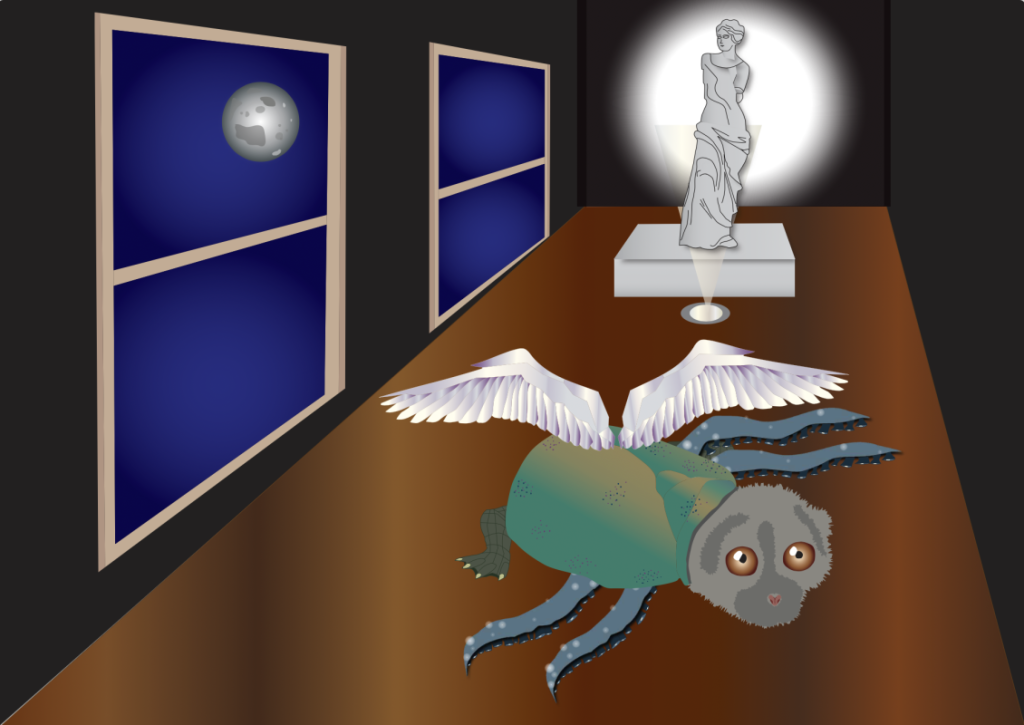
In Design, we dove into to focus on improving our skills using Adobe Illustrator to create complex illustrations using linear perspective, color theory, and gradients. Our most extensive project for this unit was the Narrative Creature, which was an animal representation of the character from our flash fiction story from English class.
Slow Scaralligretopus
My flash fiction story follows my protagonist, Anya, who is a shy and unassuming night-custodian at a museum who is faced with a conflicting moral decision when she stumbles upon a very valuable object during her shift. This scene depicts the statue exhibition at night and the marble statue, which is a central symbol of the story. The windows reflect the moon and inky sky to emphasize the quiet nature of the typical environment she works in.
True to her introverted nature, I selected animals which are observant and typically follow solitary behavior, but also exhibit deep sensitivity. I thought of Anya as being hardworking, observant, wistful, unassuming, and introverted. To represent each trait, I settled on an octopus (hardworking), alligator (observant), egret (wistful), slow loris (unassuming), and a scarab (introverted.) Next, I picked colors which matched the emotions. With the help of some research about different meanings of colors, I picked blue (hardworking), green (observant), lilac (wistful), gray (unassuming), and brown (introverted.) Using Adobe Illustrator, I placed images of the different body parts I wanted to use from each creature and traced and colored them. This was the most difficult process as I had to keep readjusting body parts to make them “meld” together. Once my creature was finished, I then drew the museum background featuring the marble statue from my story. I chose to use a one-point linear perspective to create an eye-level view of the darkened museum room.
Overall, I am pleased that my creature has an expressive face and cohesive color scheme. Next time, I would like to spend more time to make the background more detailed and engaging by adding more details and elements of linear perspective. This project challenged my skills with Adobe Illustrator but was a unique way to make my character come to life!
During this project, I discovered some of my favorite tools in Adobe Illustrator (thank you live paint, the warp tool, and drop shadow!) All of the skills I learned to use for this piece of work are ones I continue to use in many of my other art productions.